
Does UV-C Light in Air Purifiers Actually Work?
Last Updated: October 25, 2026
Quick Summary
UV-C air purifiers work only when the UV dose is high enough, which depends on wavelength, lamp intensity and contact time. UV-C inactivates viruses, bacteria and mold spores at sufficient dose, but it does not trap particles like pet dander or smoke, so pair it with HEPA filtration.
- UV-C is commonly used at a wavelength of 254 nm to damage microorganism genetic material.
- Double the airflow through the same chamber and you halve contact time, cutting the dose.
- A Public Health Agency of Canada review found nine studies agreeing UVGI can reduce SARS-CoV-2 in occupied rooms.
- Run the unit continuously on low or in scheduled cycles, since dose accumulates over time.
- Replace lamps on the manufacturer’s interval even if the bulb still glows, because intensity declines.
Table of Contents
- How UV-C Light in Air Purifiers Works
- Does UV-C Kill Viruses, Bacteria, and Mold?
- UV-C vs. HEPA Air Purifier: Which Does What
- UV-C Air Purifier Safety: Ozone, Eyes, and Skin
- How Long to Run a UV-C Air Purifier
- UV-C Air Purifier Maintenance and Real Costs
- Choosing a UV-C Air Purifier for Your Home
- Frequently Asked Questions
How UV-C Light in Air Purifiers Works
The effectiveness of UV-C air purifiers comes down to three variables that most product pages never mention: wavelength, dose, and contact time. UV-C is ultraviolet radiation commonly used at a wavelength of 254 nm, according to peer-reviewed research on filtration and UV air cleaning. At that wavelength, the light damages the genetic material inside microorganisms, which stops them from reproducing.
Here is the uncomfortable truth: a lamp glowing blue inside a plastic housing proves nothing. Germicidal effectiveness depends on how much UV energy reaches the contaminant and for how long. The Air-Conditioning, Heating, and Refrigeration Institute notes that effectiveness is limited when UV lights sit in a return-air duct, and that results vary by biological contaminant.
Wavelength, Dose, and Contact Time
UV dose is the product of lamp intensity (irradiance) and exposure time. Double the airflow through the same chamber and you halve the contact time, which cuts the dose. That is why two purifiers with identical lamps can perform completely differently. When you compare UV-C air purifiers, ask for dose data at real operating airflow, not a kill-rate headline measured in a sealed lab box.
Does UV-C Kill Viruses, Bacteria, and Mold?
Yes, UV-C inactivates viruses, bacteria, and mold spores when the dose is sufficient, but “sufficient” is doing enormous work in that sentence. A Public Health Agency of Canada evidence review found that nine studies agreed UVGI technologies can reduce SARS-CoV-2 in the air of occupied rooms. That is evidence for UVGI generally, not a guarantee for every consumer device on a shelf.
What the Studies Show
Researchers publishing in Aerosol and Air Quality Research found a portable UV air cleaner effective at clearing virus-laden droplets when placed in appropriate locations.
Mold deserves its own caveat. UV-C can inactivate spores that pass the lamp, but it does not remove settled mold from a basement wall or fix the moisture feeding it. For a deeper look at virus-specific performance, see our guide to medical grade air purifier for viruses.
UV-C vs. HEPA Air Purifier: Which Does What
UV-C and HEPA solve different problems, and the smartest setups use both.
That distinction matters for allergy sufferers. If your trigger is cat dander, a UV lamp alone will not remove it from the air. Particle filtration will.
| Feature | UV-C | HEPA |
|---|---|---|
| Primary job | Inactivate microorganisms | Trap particles |
| Removes pet dander | No | Yes |
| Removes smoke particles | No | Yes |
| Needs airflow contact | Yes | Yes |
| Consumable cost | Lamp replacement | Filter replacement |
If you are still mapping out filtration options, our breakdown of how to choose air purifier filter types covers the trade-offs in detail.
UV-C Air Purifier Safety: Ozone, Eyes, and Skin
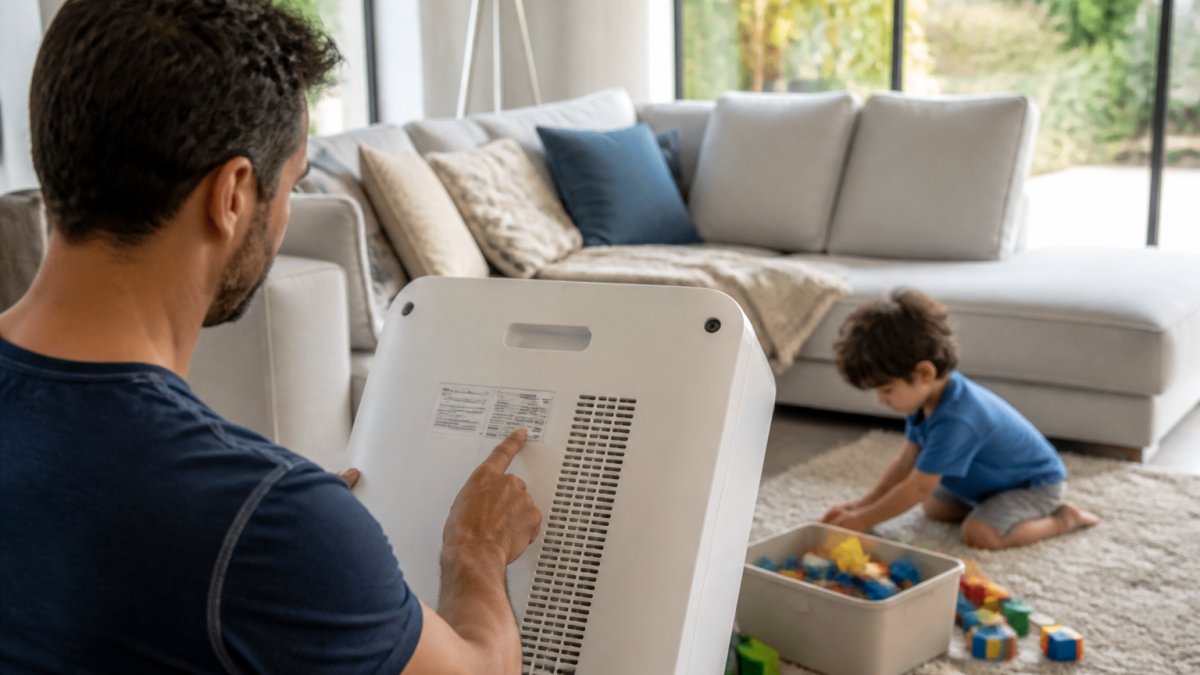
UV-C air purifier safety is where marketing claims and physics collide. UV-C at 254 nm is a real hazard to eyes and skin with direct exposure, which is why enclosed-chamber designs matter.
Ozone and Other Byproducts: It Depends on the Lamp
Ozone risk is not uniform across UV devices. The wavelength and lamp type determine what byproducts a unit can produce:
- Low-pressure mercury lamps (254 nm): The dominant germicidal wavelength. Well-designed units emit little ozone, but a damaged or poorly shielded lamp can produce more. Look for an explicit “ozone-free” or “no ozone” claim tied to the lamp, not just the housing.
- Pulsed xenon and excimer lamps: Output depends on the gas mix and optics; some excimer wavelengths are chosen specifically to avoid ozone formation.
- Far-UVC (around 222 nm): Marketed as lower-risk to skin and eyes, but byproduct emissions still depend on the lamp and filter design, and the evidence base in occupied rooms is still developing.
The National Institute of Standards and Technology reported in 2024 that UV disinfection lights can cause indoor air pollution (UV Disinfection Lights Can Cause Indoor Air Pollution | NIST). That is a byproduct warning, not a reason to abandon the technology, but it means buyers should ask what the device emits, not just what it inactivates.
What to Check Before You Buy
A credible safety review covers four things:
- Enclosure: Is the lamp fully shielded so no direct UV escapes during normal operation? Open-lamp designs belong in unoccupied spaces only.
- Ozone claim: Is there a written ozone-free statement, and does it name the lamp type? Vague “low ozone” language is not enough.
- Independent testing: Look for test reports from a recognized laboratory, not just a manufacturer’s kill-rate chart. The test conditions (airflow, distance, humidity) should be stated.
- Certification and listings: Check for electrical safety listings and any indoor-air-quality certifications the manufacturer claims, and verify them on the certifier’s site rather than trusting the box.
No kill-rate claim justifies an ozone-generating device in a home with children or asthma. If a product advertises “activated oxygen” or “ozone purification,” treat that as a red flag, not a feature.
Eyes, Skin, and Occupied Spaces
Direct exposure to 254 nm light can cause eye irritation and skin redness, which is why enclosed-chamber designs dominate the consumer market. If a unit is rated for occupied use, the manufacturer should state the exposure basis and any upper-room or shielded configuration requirements. When in doubt, run UV treatment when the room is empty and ventilate before reoccupancy.
How Long to Run a UV-C Air Purifier
Run a UV-C air purifier continuously on low, or in scheduled cycles that match your occupancy, rather than blasting it for an hour and switching off. Dose accumulates over time, so consistent operation beats short bursts. Most units are designed for 24/7 running; check the manual for the duty cycle your model supports.
Practical scheduling looks like this:
- All day, low speed: baseline biological load and particle control
- Before occupancy: a higher-speed cycle in bedrooms or basements
- After cooking or smoke events: boost mode, then return to low
- During wildfire smoke: run continuously with windows closed
Keeping the unit running well over months is its own skill, and our home air purifier maintenance guide walks through the routine.
UV-C Air Purifier Maintenance and Real Costs
UV-C air purifier maintenance comes down to two consumables: the lamp and the filter. Lamps lose intensity gradually, so replace on the manufacturer’s interval even if the bulb still glows. Filters load up and choke airflow, which indirectly reduces UV dose because less air passes the lamp.
Most buying guides stop at the purchase price. A total-cost-of-ownership view is more useful, and you can build it yourself with four inputs.
The Four Cost Inputs
- Lamp replacement interval and price. Intervals vary by lamp type and rated hours; pull the number from the manual, not from a retailer listing. Mercury lamps typically carry a rated life in hours, and intensity declines before the lamp fails outright.
- Filter replacement interval and price. Filter cost depends on filter size and how hard you run the unit. A unit run continuously in a smoky or pet-heavy home will load filters faster than the manual’s baseline.
- Electricity. Wattage × hours run ÷ 1,000 × your local rate per kWh. A unit run 24/7 uses far more electricity than one run on a schedule, so decide your duty cycle before you estimate.
- Expected years of ownership. Multiply annual consumable and energy costs by the years you plan to keep the unit, then add the purchase price.
A Calculation Framework You Can Fill In
Use this checklist with your own numbers:
- Purchase price from the retailer
- Lamp replacement interval (hours or months) and price per lamp
- Filter replacement interval and price per filter
- Wattage and your planned hours per day
Ask the manufacturer for the lamp’s rated hours and the recommended replacement interval in writing. A lamp that still glows may be delivering far less UV than it did when new, and the replacement interval is the only reliable guide.
Maintenance Beyond Consumables
Lamp and filter swaps are not the whole job. Dust on the lamp sleeve or reflector reduces the UV that reaches the air, so follow the manual’s cleaning schedule.
For a full accounting method, read our UV-C air purifier long term cost breakdown. It is the question we get most from skeptics, and it deserves real numbers rather than a slogan.
Choosing a UV-C Air Purifier for Your Home
Choose a UV-C air purifier by matching dose data, filtration, and room size to your actual problem, not by the biggest kill-rate number on the box. For budget-conscious buyers, see our affordable air purifier picks with low running costs. Start with the pollutant: dander and pollen need particle filtration, smoke needs carbon and HEPA, mold spores need filtration plus a moisture fix.
A decision framework that works:
- Pets or allergies: filtration first, UV-C as a secondary layer
- Wildfire smoke zone: high CADR particle filtration plus continuous running
- Basement mold concern: pair purification with moisture control, not instead of it
- Open-concept space: size to square footage and expect one unit per zone
Our SR100 was built for households juggling several of these at once, with visual confirmation that it is actively working.
Frequently Asked Questions
Are UV-C air purifiers safe to run around children and pets?
Enclosed UV-C lamps in a sealed purifier are safe to run around children and pets because the ultraviolet radiation stays inside the unit. Risk comes from exposed lamps, so never operate a purifier with the housing open or a damaged lamp door. The National Institute of Standards and Technology reported in 2024 that UV disinfection lights can cause indoor air pollution, so choose a unit that limits ozone and chemical byproducts. Keep the purifier out of reach and follow the manufacturer’s safety instructions.
Is a HEPA filter more effective than UV-C for removing dust, pollen, and pet dander?
Yes. A HEPA filter traps particles like dust, pollen, and pet dander, while UV-C targets microorganisms and does not remove particles from the air. A 2022 study in a PubMed Central-indexed journal added UV-C to a particulate-matter filtration prototype and described a double-barrier effect, but filtration did the particle removal. For allergy relief, pair a HEPA filter with UV-C rather than choosing one over the other. The SR100 from Aero Essence is built to address nine pollutant types, including dander and pollen.
Can UV-C air purifiers produce ozone?
Some UV-C devices can produce ozone as a byproduct, and the National Institute of Standards and Technology reported in 2024 that UV disinfection lights can cause indoor air pollution. Ozone output varies by lamp type and device design, so check the manufacturer’s specifications and look for units that state low or zero ozone emissions. Avoid devices marketed as ozone generators. If you notice a sharp metallic smell, stop using the unit and contact the manufacturer.
How often do I need to replace the UV-C lamp and filters?
UV-C lamp output fades over time, so most manufacturers specify a replacement interval in the manual, often around 8,000 to 12,000 hours depending on the lamp. HEPA and pre-filters typically need replacement every 6 to 12 months, sooner in homes with pets or heavy smoke. Track both schedules so germicidal performance and particle filtration stay at their rated levels. Aero Essence can confirm the SR100’s specific replacement intervals and current part pricing on its website.
The real challenge is not finding a device with a UV lamp. It is finding one whose dose, filtration, and safety design you can actually trust in a home full of pets, kids, and seasonal smoke. At Aero Essence LLC, we built the SR100 to handle nine pollutant categories with visual confirmation of performance, so you are never guessing whether it is working. Get started with Aero Essence LLC and breathe easier about the air your family shares.
