
How to Maintain Your Home Air Purifier: 2026 Guide
Table of Contents
- Why Air Purifier Maintenance Protects Your Indoor Air Quality
- How Often to Change Air Purifier Filters (and Which Ones)
- How to Clean Air Purifier Pre-Filters Without Damaging Them
- Best Practices for Air Purifier Placement and Airflow
- Cleaning Sensors, Vents, and the Filter Housing
- Resetting the Filter Change Light and Recycling Old Filters
- Seasonal Air Purifier Maintenance Schedule
- Frequently Asked Questions
Last Updated: September 15, 2026
Why Air Purifier Maintenance Protects Your Indoor Air Quality
Learning how to maintain your home air purifier is the difference between a machine that cleans your air and one that quietly recirculates dust. A common pattern is that a purifier runs for months, the filter clogs, airflow drops, and the homeowner assumes the unit stopped working. It didn’t. It just stopped being maintained.
Air purifier maintenance is the routine practice of cleaning, replacing, and resetting the components of a purifier so it keeps removing airborne contaminants at its rated efficiency. Skip it, and filter saturation forces the fan to work harder while moving less clean air.
That distinction matters most in homes with pets, seasonal pollen, or wildfire smoke, where the unit runs constantly. The steps below take about 30 minutes a month.
How Often to Change Air Purifier Filters (and Which Ones)
Most HEPA filters need replacement every 6 to 12 months, while carbon and odor filters typically last 3 to 6 months (the EPA). The real signal is not the calendar, though. It is airflow, visible dust accumulation, and how often the unit runs.
Reading MERV and HEPA Filter Ratings
MERV ratings describe a filter’s ability to capture particles on a 1-to-16 scale, while true HEPA filters capture 99.97% of particles at 0.3 microns (the EPA). That 0.3-micron figure is the hardest particle size to catch, which is why it is the benchmark. A MERV 13 filter handles most household particulate matter; HEPA handles fine allergens and smoke particles.
When to Swap Carbon and Odor Filters
Activated carbon filters absorb volatile organic compounds, cooking odors, and smoke, and they lose capacity silently (the EPA). Unlike a clogged HEPA filter, a spent carbon filter gives no airflow warning. Replace it on schedule, especially during wildfire season.
| Filter Type | Typical Lifespan | Replace When |
|---|---|---|
| Washable pre-filter | 2-4 weeks between cleanings | Mesh looks gray or matted |
| HEPA filter | 6-12 months | Airflow drops or filter darkens |
| Activated carbon | 3-6 months | Odors return quickly after use |
| UV-C light | 12 months | Dimmed or flickering |
Running a purifier with a saturated HEPA filter strains the fan motor and can shorten the unit’s life. If airflow feels weak but the fan sounds loud, the filter is the first thing to check.
How to Clean Air Purifier Pre-Filters Without Damaging Them
A washable mesh pre-filter is the easiest component to maintain and the one most often neglected. Cleaning it takes five minutes and protects the HEPA filter behind it.
- Unplug the unit before touching any component.
- Remove the pre-filter from the filter housing.
- Rinse under lukewarm running water, from the clean side toward the dirty side.
- Use a soft brush on stubborn dust accumulation. Never use a stiff brush or abrasive pad.
- Let the pre-filter air-dry completely before reinstalling it.
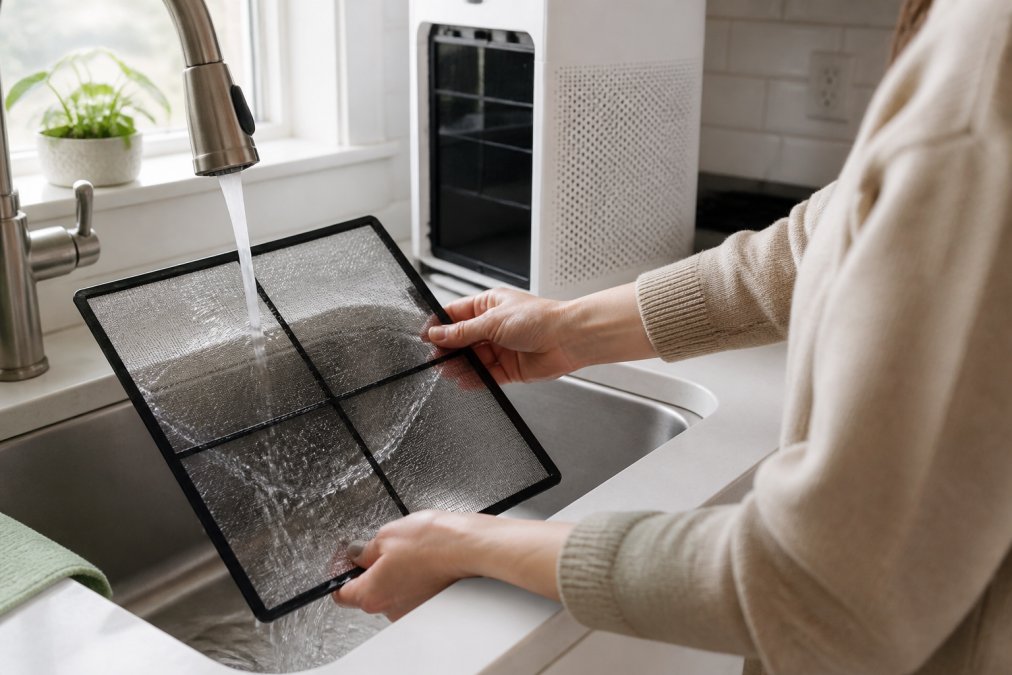
A common mistake is reinstalling a damp pre-filter. Moisture encourages mold growth inside the filter housing, which defeats the purpose of the unit. Dry time is usually a few hours.
Best Practices for Air Purifier Placement and Airflow
Unit placement decides how well your purifier performs before any maintenance question even comes up. A purifier pushed against a wall or tucked behind furniture cannot draw air properly, and its clean air delivery rate drops accordingly.
- Keep at least 6 inches of clearance on all sides for air intake.
- Place the unit where air circulation naturally moves through the room.
- Avoid corners, closets, and spots directly behind sofas or curtains.
- Keep the unit off the floor if pets or young children are in the home.
For open-concept spaces, one unit may not cover the full area. Check the manufacturer’s rated room size against your actual square footage, and consider whether a single high-capacity purifier or two smaller units serve the layout better.
Cleaning Sensors, Vents, and the Filter Housing
Sensor cleaning is the maintenance step almost every guide skips, and it is the one that keeps automatic mode honest. Dust on the particulate sensor makes the unit misread air quality, so it either runs unnecessarily or stays idle when it should be working.
Wipe the sensor lens with a dry, soft cloth every month. Use a vacuum brush attachment on the air intake and exhaust vents to clear dust accumulation. Wipe the exterior surfaces with a damp cloth, and never spray liquid directly into the housing.
If your unit’s auto mode seems to react slowly or not at all, clean the sensor before assuming the unit is faulty. A dust film on the sensor is the most common cause of sluggish automatic response.
::: Maintaining a clear sensor ensures your purifier functions at its peak, which remains a foundational step as you work to improve indoor air quality throughout your living space.
Resetting the Filter Change Light and Recycling Old Filters
Most purifiers track filter lifespan by run hours, not by actual filter condition, so the indicator light may come on early or late. After installing a new filter, you need to clear that counter manually, or the unit will keep nagging you.
How to Reset the Filter Change Indicator
The reset method varies by control type. Match your unit to one of these patterns:
- Physical reset button: Press and hold the button labeled “Filter Reset,” “Reset,” or a small recessed pinhole for 3 to 5 seconds, until the indicator blinks or turns off.
- Touch panel: Press and hold the filter icon for 3 to 5 seconds. Some panels require a two-finger press or a press-and-hold on the icon while the unit is powered on.
- App-connected units: Open the manufacturer’s app, go to the filter or maintenance menu, and tap “Reset Filter Life.” The physical button may not work until the app counter is cleared.
- No visible reset control: Unplug the unit for 30 seconds, plug it back in, and check whether the light clears. If it does not, the reset is likely buried in a menu or requires a specific button combination listed in your manual.
If the light returns immediately after a reset, the unit is reading a sensor, not a counter. That points to a dirty particulate sensor rather than a filter problem, see the sensor cleaning section above.
Write the installation date on the new filter’s frame with a permanent marker before you slide it in. When the light comes on again, you will know whether the counter is tracking reality or just run hours.
Disposing of and Recycling Used Filters
Spent filters are not all the same waste stream, and tossing them incorrectly can release the very particles they captured.
- HEPA filters: The pleated media is typically not recyclable through curbside programs because it is a mix of synthetic fibers and captured particulate.
If your purifier ran during a wildfire smoke event or a renovation, the captured load in the HEPA filter is heavier than normal. Bag the filter before removal and wear a mask during the swap to avoid re-suspending fine particulate.
Seasonal Air Purifier Maintenance Schedule
A Month-by-Month Maintenance Calendar
| Period | Primary Trigger | Maintenance Action |
|---|---|---|
| March-May | Tree and grass pollen | Clean the pre-filter every 2 weeks; inspect HEPA for early gray saturation |
| June-August | Ozone alerts, wildfire smoke | Check carbon filters monthly; replace if odors return within days of use |
| September-November | Ragweed pollen, heating startup | Deep-clean the filter housing and vents before the furnace runs |
| December-February | Closed-window stagnation, holiday cooking | Wipe the sensor monthly; vacuum vents every 6-8 weeks |
Why the Triggers Matter More Than the Calendar
Adjusting Frequency for Your Home
Three household factors shorten every interval in the table:
The single highest-value habit is a monthly five-minute check: pre-filter, sensor, and vents. Layer the seasonal calendar on top of that baseline, and the unit stays at rated efficiency through pollen season, wildfire season, and the closed-window months in between.
Frequently Asked Questions
How often should I run my air purifier in my home?
Run it continuously for the best indoor air quality, especially if you have pets, allergies, or live in a wildfire-prone area. Most units are designed for 24/7 operation and use minimal electricity on low or auto mode. If noise is a concern, run it on high while you are away and switch to a lower fan speed overnight. Consistent operation keeps air circulation steady and prevents particulate matter from building up between cycles.
How do I know when to change my air purifier filter?
Check the filter every 3 to 4 weeks. Visible gray or brown discoloration, a musty smell, reduced airflow, or a filter change indicator light are all signs it is time. HEPA filters typically last 6 to 12 months depending on use and pollution levels. If you have pets or run the unit constantly, expect the shorter end of that range. Replacing on schedule protects airflow efficiency and the fan motor.
Can I clean a HEPA filter or should I replace it?
Most HEPA filters are not washable and should be replaced, not cleaned. Rinsing them can damage the fine fiber structure and reduce allergen removal. Washable mesh pre-filters are different: those can be rinsed and reused. Check your unit’s manual to confirm which filters are washable. If a HEPA filter looks clogged, replace it. Trying to vacuum or rinse it usually causes more harm than good.
What is the 2/3 rule for air purifiers?
The 2/3 rule is a placement guideline: keep the unit at least 2 to 3 feet away from walls, furniture, and other objects so air can flow freely into the air intake and out of the vents. Blocking airflow forces the fan motor to work harder and lowers clean air delivery rate. Following this rule is one of the simplest best practices for air purifier placement and can noticeably improve performance.
Maintaining a purifier is simple, but the details decide whether it actually protects your air. If you want a unit built for consistent performance across dust mites, pet dander, pollen, mold spores, and smoke, the Aero Essence LLC SR100 handles nine kinds of pollutants and gives you visual confirmation that it is working. Get started with Aero Essence LLC and breathe easier with a purifier designed to show its results.