
Affordable Air Purifier With Low Running Costs: 7 Picks
Table of Contents
- Quick Comparison: Affordable Air Purifiers With Low Running Costs
- How We Evaluated These Low-Cost Air Purifiers
- 1. Aero Essence LLC SR100: Best for Visual Confirmation and Multi-Pollutant Removal
- 2. Coway Airmega Mighty AP-1512HH: Best for Proven CADR and Quiet Operation
- 3. Coway Airmega 100: Best for Low Filter Replacement Costs
- HEPA Filter Replacement Cost: Yearly Expenses for Each Model
- 4. SwitchBot Air Purifier: Best Budget Pick for Small Rooms
- 5. AirFanta 3Pro: Best CADR per Dollar
- 6. Dreo 539S: Best Smart Features Under $200
- 7. Corsi-Rosenthal Box (DIY): Best for Maximum Airflow per Dollar
- Frequently Asked Questions
Last Updated: October 1, 2026
Quick Comparison: Affordable Air Purifiers With Low Running Costs
An affordable air purifier with low running costs is a unit whose purchase price, filter replacements, and electricity use stay cheap over years of ownership, not just on day one. This guide breaks down options by what they actually cost to own, not just what they cost to buy.
Most shoppers fixate on the sticker price. That’s the wrong number. A unit that sells cheap but eats filters every few months can cost more by year two than a pricier model with inexpensive replacements. Below, we break down each pick by filter replacement cost, electricity usage, and real-world performance.
| Model | Starting Price | Best For | Standout Trait |
|---|---|---|---|
| Aero Essence SR100 |
$190 |
Multi-pollutant removal | Visual confirmation |
| Coway Airmega Mighty AP-1512HH | $190 | Proven CADR, quiet operation | Four-stage filtration |
| Coway Airmega 100 | $130 | Low filter replacement costs | Compact footprint |
| SwitchBot Air Purifier | $99 | Small rooms on a budget | Ultra-quiet mode |
| AirFanta 3Pro | $152 | CADR per dollar | Portable design |
| Dreo 539S | $160 | Smart features on a budget | Auto-adjusting sensor |
| Corsi-Rosenthal Box (DIY) | $90 | Maximum airflow per dollar | Standard MERV-13 filters |
How We Evaluated These Low-Cost Air Purifiers
Running cost, not sticker price, decides whether a purifier is actually affordable. We scored every unit on the four variables that drive long-term expense, then converted them into a single number: estimated three-year cost of ownership.
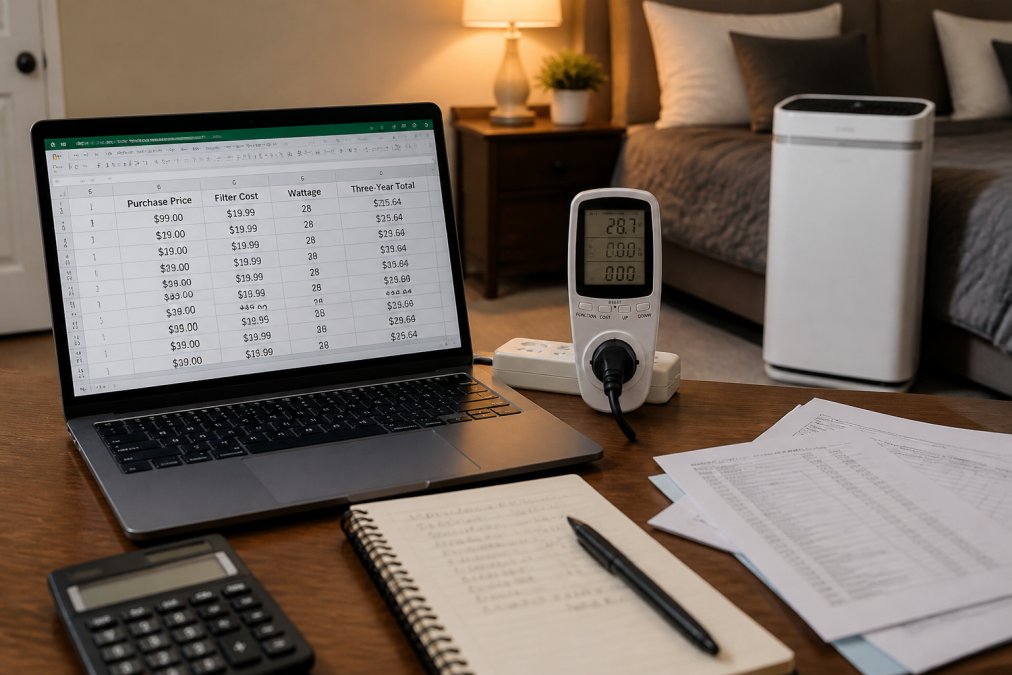
**1.
When you compare two purifiers, divide purchase price plus three years of filters plus three years of electricity by three. That annualized figure is the only honest way to compare a $99 unit against a $190 unit.
We also weighted maintenance. A washable pre-filter that traps pet dander and dust before it reaches the HEPA media stretches filter longevity, which lowers total cost of ownership without any drop in performance. Units that require proprietary filters with no generic alternative scored lower, because you’re locked into one price for the life of the machine.
ENERGY STAR certified room air cleaners
1. Aero Essence LLC SR100: Best for Visual Confirmation and Multi-Pollutant Removal
The SR100 targets nine kinds of pollutants, including dust mites, pet dander, pollen, mold spores, and smoke, and it gives you visual confirmation that purification is happening. That last feature matters more than it sounds.
2. Coway Airmega Mighty AP-1512HH: Best for Proven CADR and Quiet Operation
The AP-1512HH has earned its reputation over years on the market. It starts around $190 and pairs strong air cleaning performance with genuinely quiet operation at low speeds.
3. Coway Airmega 100: Best for Low Filter Replacement Costs
If filter replacement cost is your deciding factor, the Airmega 100 is the pick. It starts around $130 and was built around efficiency and low long-term ownership costs.
HEPA Filter Replacement Cost: Yearly Expenses for Each Model
Filter replacement is the single biggest driver of running costs, and it varies more than the purchase price does. A HEPA filter captures fine particulate matter, but how often you replace it depends on the replacement cycle your unit specifies and how dirty your air runs. Below is the ownership math most spec sheets never show you.
How to calculate your real yearly cost
Use this formula for any purifier you’re considering:
Yearly cost = (filter price / replacement interval in years) + (wattage x hours per day x 365 / 1,000 x your electricity rate)
| Wattage at medium speed | kWh per year | Approx. yearly electricity cost |
|---|---|---|
| 15 W | 131 | ~$22 |
| 30 W | 263 | ~$44 |
| 45 W | 394 | ~$66 |
| 60 W | 525 | ~$88 |
What filter swaps actually cost by model type
- Compact units (Coway Airmega 100, SwitchBot): Replacement filters typically run in the $20-$40 range with a stated 6-12 month interval, putting yearly filter cost near $25-$50 depending on air quality.
- Mid-size units (Coway AP-1512HH, Dreo 539S): Genuine replacement filter sets commonly land in the $40-$70 range annually. The AP-1512HH’s washable pre-filter can extend the HEPA cartridge’s life, which is why it holds up well on three-year cost despite a higher sticker price.
- High-CADR units (AirFanta 3Pro): Filters are usually inexpensive and widely available, but the unit moves more air, so it can load filters faster in dirty environments.
- DIY Corsi-Rosenthal Box: Standard MERV-13 furnace filters are the cheapest consumable on this list, often $10-$25 each, and are stocked at any hardware store. A box using four filters needs all four swapped at once, so budget for the set, not the single filter.
The three-year ownership picture
Purchase price alone is misleading. A $99 purifier with a $35 filter every 6 months and a 45-watt draw costs roughly $99 + $210 in filters + $200 in electricity over three years, about $509. A $190 purifier with a $45 annual filter and a 20-watt draw costs roughly $190 + $135 + $90, about $415. The cheaper unit loses.
Generic vs. OEM filters
Aftermarket HEPA filters for popular models often sell for 30-50% less than the manufacturer’s branded version. The trade-off is real: fit can be looser, media quality varies, and using a third-party filter may void a warranty. For budget-focused buyers, a common pattern is to use OEM filters during the warranty period, then switch to a well-reviewed generic once coverage ends.
Habits that cut yearly filter cost
- Vacuum or rinse the pre-filter monthly to protect the HEPA media
- Run the unit on auto so it works harder only when air quality drops
- Track replacement dates so you buy on schedule, not in a panic
- Compare filter prices before you buy the purifier, not after
- In smoke season or during remodeling, expect to replace filters early, budget for it
Skipping pre-filter cleaning is the most common mistake. A clogged pre-filter forces the motor to work harder, which raises wattage and shortens filter longevity at the same time. You pay twice.
Filter cost, not purchase price, separates a genuinely cheap purifier from an expensive one. A unit with a $25 filter every 12 months beats a $99 unit with a $35 filter every 6 months over any three-year window.
4. SwitchBot Air Purifier: Best Budget Pick for Small Rooms
At around $99, the SwitchBot Air Purifier is the cheapest entry point on this list. It’s built for small apartments and dorm rooms, not open-concept living spaces.
5. AirFanta 3Pro: Best CADR per Dollar
The AirFanta 3Pro starts around $152 and focuses on one thing: high CADR relative to its price. CADR, or Clean Air Delivery Rate, measures how quickly a unit delivers filtered air, so a high number for the money means faster particle removal.
6. Dreo 539S: Best Smart Features Under $200
The Dreo 539S costs around $160 and packs smart features usually reserved for pricier units. A smart particle sensor reads air quality and auto-adjusts fan speed, and you get app and voice control plus a 360-degree air intake.
7. Corsi-Rosenthal Box (DIY): Best for Maximum Airflow per Dollar
The Corsi-Rosenthal Box isn’t a manufactured purifier, but it belongs on any low-running-cost list. Built from a standard box fan and MERV-13 filters, it starts around $90 and delivers extremely high CADR for the money.
Frequently Asked Questions
What is the cheapest and most effective air purifier?
The Corsi-Rosenthal Box, a DIY build using a box fan and MERV-13 filters, starts around $90 and delivers high CADR for the price. Among ready-made units, the SwitchBot Air Purifier at $99 and Coway Airmega 100 at $130 are strong budget options. Effectiveness depends on matching CADR to room size and keeping up with filter changes. A low purchase price means little if HEPA filter replacement cost runs high every year.
Do air purifiers cost a lot of money to run?
Most affordable air purifiers draw between 20 and 60 watts on low to medium fan speeds. At a typical U.S. electricity rate, running one 24/7 costs roughly $25 to $70 per year. Units with sleep mode and auto-fan adjustments cut that further. The bigger ongoing expense is usually filter replacement, not air purifier electricity usage, so check both before buying.
How much does it cost to run an air purifier 24/7?
Running a 40-watt purifier continuously uses about 350 kWh per year. At an average U.S. rate of 16 cents per kWh, that’s roughly $56 annually. A 20-watt model on sleep mode drops to about $28 per year. Energy Star certified models and those with air quality sensors that lower fan speed automatically will keep annual operating expenses at the low end.
Are HEPA filters necessary for budget air purifiers?
Yes. True HEPA filters capture 99.97% of particles at 0.3 microns, including pet dander, pollen, dust, and smoke particles. Budget purifiers that use HEPA filtration still remove these pollutants effectively; the savings come from smaller room coverage or fewer smart features, not weaker filtration. Always confirm the unit uses a true HEPA filter, not a HEPA-type or HEPA-like filter.
What should I look for in a low-maintenance air purifier?
Prioritize three things: a washable pre-filter that extends the main HEPA filter’s life, filter replacement intervals of 6 to 12 months, and widely available replacement filters. Also check for an air quality sensor that adjusts fan speed automatically, which reduces both energy consumption and filter wear. Units with simple filter access save time and avoid damage during changes.
The real challenge with low running costs isn’t finding a cheap unit. It’s finding one that stays cheap after the first filter change and still proves it’s working. Aero Essence LLC built the SR100 to close that gap, with coverage for nine pollutant types, visual confirmation of purification performance, and a design that targets invisible particles like pet dander, pollen, mold spores, and smoke. Get started with Aero Essence LLC and know your air is actually getting cleaner.