How to Choose Air Purifier Filter Types: 2026 Guide
Table of Contents
- Types of Air Pollutants in Homes and What Filters Capture Them
- HEPA Filter vs Activated Carbon: Which One Do You Actually Need?
- Filter Certification Standards and Efficiency Ratings Explained
- How to Choose Air Purifier Filter Types for Allergies, Smoke, and Mold
- How Often to Change Air Purifier Filters and What It Costs Long-Term
- Environmental Impact of Filter Disposal and Recycling Options
- Frequently Asked Questions
Last Updated: September 21, 2026
Types of Air Pollutants in Homes and What Filters Capture Them
Choosing the right air purifier filter starts with knowing what’s actually floating in your home. Indoor air typically carries two broad categories of pollutants: solid particles and gases. Particles include dust, pollen, pet dander, mold spores, and smoke. Gases include volatile organic compounds, cooking fumes, and odors. Each requires a different capture mechanism.
Particles vs. Gases: Why You Need Different Filter Media
Particles are trapped physically. Gases are trapped chemically. A mechanical filter catches solid matter in its fibers, while gas-phase filtration relies on adsorption, where molecules stick to a treated surface. This is why a filter that excels at dust capture may do almost nothing for cooking odors, and vice versa.
HEPA Filter vs Activated Carbon: Which One Do You Actually Need?
The honest answer: most households need both, but in different proportions. HEPA captures particles. Activated carbon handles gases and odors.
| Filter Type | Captures | Best For | Limitation |
|---|---|---|---|
| HEPA | Particles down to 0.3 microns | Allergies, dander, pollen, smoke particles | No gas or odor removal |
| Activated carbon | Gases, VOCs, odors | Smoke odor, cooking fumes, chemicals | Saturates faster than HEPA |
| Pre-filter | Large debris, hair, lint | Extending main filter life | Doesn’t clean air on its own |
Match filter media to your dominant pollutant. Particle problems need HEPA. Odor and gas problems need substantial activated carbon. Most homes need both.
Pre-Filters and the Filtration Stages That Protect Your Main Filter
A pre-filter is the first line of defense, catching hair, lint, and large dust before it reaches the HEPA media. This matters more than most buyers realize. A clogged HEPA filter loses efficiency and forces the fan to work harder.
Filter Certification Standards and Efficiency Ratings Explained
Certification is what separates a filter that performs as claimed from one that just uses impressive-sounding language. Three ratings matter most: MERV, HEPA, and CADR. Understanding what each one actually measures prevents you from paying a premium for a label that doesn’t deliver.
MERV: The Particle-Size Ladder
MERV (Minimum Efficiency Reporting Value) is set by ASHRAE Standard 52.2 and rates a filter on a 1-to-16 scale based on how efficiently it captures particles across three size ranges: 0.3-1.0 micron, 1.0-3.0 microns, and 3.0-10.0 microns. The higher the MERV, the smaller the particles it traps.
- MERV 1-4: Captures pollen, dust mites, and large debris. Common in basic furnace filters.
- MERV 5-8: Adds mold spores and finer dust. A reasonable middle ground for general filtration.
- MERV 9-12: Captures finer particles including some bacteria and smoke. Noticeably more restrictive to airflow.
- MERV 13-16: Captures the smallest particles in the test range, including fine smoke and virus carriers. High airflow resistance.
HEPA: A Specific Standard, Not a Vibe
HEPA is not a point on the MERV scale. It is a defined performance standard: a filter must capture at least 99.97% of particles at 0.3 microns to earn the label. That 0.3-micron figure is deliberate. It is roughly the most penetrating particle size (MPPS), the size at which particles slip through filter media most easily because they are too large for diffusion capture and too small for direct interception.
CADR: Efficiency Meets Airflow
CADR (Clean Air Delivery Rate) is verified through the AHAM air cleaner certification program and reported in cubic feet per minute (CFM). It combines filter efficiency with fan power, so it tells you how much clean air the unit actually delivers, not just how good the media is. CADR is reported separately for smoke, dust, and pollen because filter performance varies by particle type.
ULPA: The Step Above HEPA
ULPA (Ultra-Low Penetration Air) filters capture 99.999% of particles at 0.12 microns, a tighter standard than HEPA. ULPA is common in cleanrooms and semiconductor manufacturing. For a home purifier, the extra efficiency rarely justifies the added airflow resistance and cost, since HEPA already covers the particles that matter for allergies and smoke.
A “HEPA-type” or “HEPA-like” label is not the same as true HEPA. Those filters often miss the 0.3-micron threshold. If allergen removal is your goal, confirm the filter meets the actual HEPA standard, and check the CADR number rather than trusting the word on the box.
What to Actually Look For
When comparing units, check three things in order: the filter’s true rating (MERV number or confirmed HEPA), the CADR for smoke, dust, and pollen, and the airflow the fan can sustain through that media. A high rating paired with low airflow is a common trap. Third-party verification from AHAM or a comparable testing body is the clearest signal that the numbers are real.
How to Choose Air Purifier Filter Types for Allergies, Smoke, and Mold
Most guides tell you to “match the filter to the problem” and stop there. The useful version of that advice is more specific: each condition has a different dominant pollutant, a different particle or gas profile, and therefore a different filter specification that actually solves it. Here is how the major conditions map to filter types.
Pet Dander and General Allergies
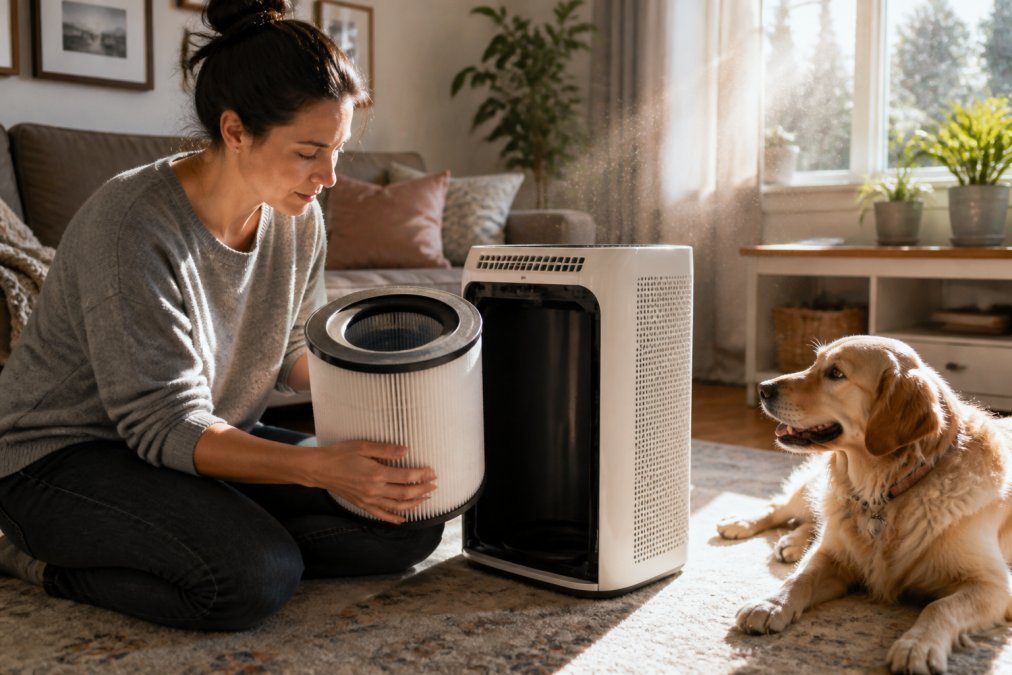
Pet dander is a protein carried on particles that range from about 1 to 10 microns, with the smallest fragments staying airborne for hours. The dominant pollutant is particulate, so the priority is true HEPA media with a sealed filter housing. Sealing matters because unsealed filters let air bypass the media entirely, which is why some units underperform despite good specs.
- Filter spec: True HEPA (99.97% at 0.3 microns) plus a washable pre-filter to catch hair and lint.
- What to skip: Thin carbon pads add little for dander. Spend the budget on HEPA quality and airflow instead.
- Why it works: HEPA captures the dander-carrying particles; the pre-filter keeps the HEPA media from loading up with hair.
Wildfire Smoke
Smoke is a dual problem. It carries fine particulates (much of it under 2.5 microns) and gas-phase compounds that produce odor and irritation. A HEPA-only filter removes the particles but leaves the smell and many of the volatile compounds behind.
- Filter spec: True HEPA for particulates plus substantial activated carbon for gas-phase removal. Carbon weight is the number that matters, not the presence of carbon.
- What to skip: Units with a thin carbon pad. They saturate within days under heavy smoke and stop adsorbing.
- Why it works: The two media handle two different pollutant classes. One filter cannot do both jobs well.
Mold Spores
Mold spores are particulate and typically fall in the 1 to 20 micron range, so HEPA captures them. But a purifier only removes spores already in the air. It does not fix the moisture source feeding the mold, and it will not remove mold growing on surfaces.
- Filter spec: True HEPA for airborne spores.
- What to skip: Relying on a purifier as a remediation tool. It is a supplement, not a solution.
- Why it works: HEPA reduces airborne spore counts, but moisture control is what stops new spores from being released.
Cooking Odors and VOCs
Cooking produces both grease particles and gas-phase compounds, including volatile organic compounds. The dominant pollutant here is gas, so carbon is the workhorse.
- Filter spec: Substantial activated carbon media, sized to the cooking frequency. Replace on schedule, since saturated carbon stops adsorbing silently.
- What to skip: HEPA-only units for odor control. They will not touch the smell.
- Why it works: Carbon adsorbs the gas-phase molecules that cause odor and irritation.
Chemical Sensitivities and Multiple Conditions
Households managing chemical sensitivities or several conditions at once need a staged approach: pre-filter for debris, HEPA for particles, and a meaningful carbon stage for gases. The challenge is that carbon and HEPA have different replacement intervals, and a unit that forces you to replace both on the same schedule wastes money on the filter that still has life left.
Match the filter specification to the dominant pollutant, not the condition name. Dander, spores, and smoke particles need HEPA. Smoke odor, cooking fumes, and VOCs need carbon weight. Chemical sensitivities and multi-condition homes need both, staged so each filter is replaced on its own schedule.
How Often to Change Air Purifier Filters and What It Costs Long-Term
Filter replacement timing depends on the filter type and your air quality, but the cost of ownership is where most buyers get surprised.
As a general rule:
- Pre-filters: clean monthly, replace every few months
- HEPA filters: replace every 6 to 12 months
- Carbon filters: replace every 3 to 6 months, sooner with heavy smoke or odor
Set a recurring calendar reminder for filter replacement based on your worst-case season, not your average. Smoke season and peak pollen both shorten filter life, and a saturated filter quietly stops working before it looks dirty.
Environmental Impact of Filter Disposal and Recycling Options
Most purifier filters end up in landfill, and that’s a real problem given how often they’re replaced. HEPA media is typically a mix of fiberglass and synthetic fibers, which most municipal recycling programs won’t accept.
What you can do:
- Choose units with washable pre-filters to cut replacement volume
- Look for manufacturers with take-back or recycling programs
- Avoid disposable filters where a reusable option performs comparably
Frequently Asked Questions
How do I know what air purifier filter I need?
Start by identifying your main concern. For pet dander, dust mites, and pollen, a true HEPA filter captures 99.97% of particles at 0.3 microns. For smoke, VOCs, or odors, you need activated carbon. Many homes benefit from both. Check the clean air delivery rate (CADR) for your room size, and verify the filter meets HEPA standards. If you have asthma or mold issues, look for sealed HEPA systems that prevent filter bypass.
What is the 2/3 rule for air purifiers?
The 2/3 rule is a guideline for filter replacement: change your filter when it has been in use for about two-thirds of its rated lifespan, or when you notice reduced airflow or increased noise. For example, a filter rated for 12 months should be checked at 8 months. This prevents filter saturation from degrading air purifier performance. Actual timing depends on usage hours, pollutant levels, and whether you run the unit continuously.
Which is better, HEPA or ionic?
HEPA filters use mechanical filtration to trap particles, while ionic purifiers use electrostatic precipitation to charge and collect particles. HEPA is generally more effective for allergen removal and does not produce ozone, which ionic models may generate. For wildfire smoke, pet dander, and mold spores, HEPA combined with activated carbon is the most reliable choice. Ionic purifiers can be a supplement but rarely match HEPA’s filter efficiency.
Do all air purifiers use the same type of filters?
No. Filter types vary widely by brand and model. Some use a single HEPA filter, while others combine pre-filters, HEPA, and activated carbon in a multi-stage system. Filter dimensions and mounting mechanisms are rarely universal, so you must buy replacements specific to your unit. Before purchasing any air purifier, confirm that replacement filters are available and check the filter replacement cycle to estimate long-term costs.
Clean indoor air comes down to matching the right filter media to the pollutants you actually face, then keeping that filter fresh. Aero Essence LLC built the SR100 around that principle, with staged filtration that targets dust mites, pet dander, pollen, mold spores, and smoke, plus visual confirmation that purification is working in real time. If you’re tired of guessing whether your purifier is doing its job, shop the SR100 and see the difference for yourself.