
7 Facts on Whether Activated Carbon Filters Remove VOCs
Last Updated: October 29, 2026
Quick Summary
Activated carbon filters can trap many common volatile organic compounds, but they are not effective against all of them in every home. Results depend on how much carbon the filter holds and how long air stays in contact with it. Consumer units often carry too little carbon to remove VOCs well.
- Carbon removes gases through adsorption, where molecules stick to its porous surface.
- Filters saturate over time, and a saturated carbon bed can release VOCs back into the air.
- Reactive VOCs can behave differently from non-reactive ones, so one filter may not handle all types.
- HEPA filters trap particles, but most VOCs are gases, so carbon is needed for VOC control.
- Choose a purifier with a substantial carbon bed, not a thin coating, and match it to room size.
Table of Contents
Activated carbon filters are effective against many volatile organic compounds, but not all of them and not in every home. This guide explains how these filters work, where they fall short, and how to choose the right setup. The short answer is that carbon can trap a lot of VOCs, but results depend on the filter’s design and how much carbon it holds.
Volatile organic compounds, or VOCs, are chemicals that evaporate easily at room temperature. They come from paints, cleaning products, furniture, building materials, and cooking. Because they are gases rather than solid particles, they pass straight through the fine mesh of a standard HEPA filter. That is why filter choice matters so much for this problem.
Why VOCs are hard to remove:
- They are gases, so they slip past particle filters
- Many types exist, and each behaves differently
- Concentrations rise when rooms are sealed or new products are used
- Some VOCs bond weakly to carbon and escape again Because these volatile compounds remain airborne and resistant to simple filtration, homeowners often consider whether HVAC UV lamps provide a more effective solution for maintaining indoor air quality.
How Activated Carbon Filters Work
Activated carbon removes gases through adsorption. Adsorption means molecules stick to the surface of a material, and activated carbon has a huge amount of surface area thanks to its porous structure. Compare HEPA and carbon filters for large spaces to see how each type suits a bigger room. When air moves through the carbon, VOC molecules attach to these pores and stay there.
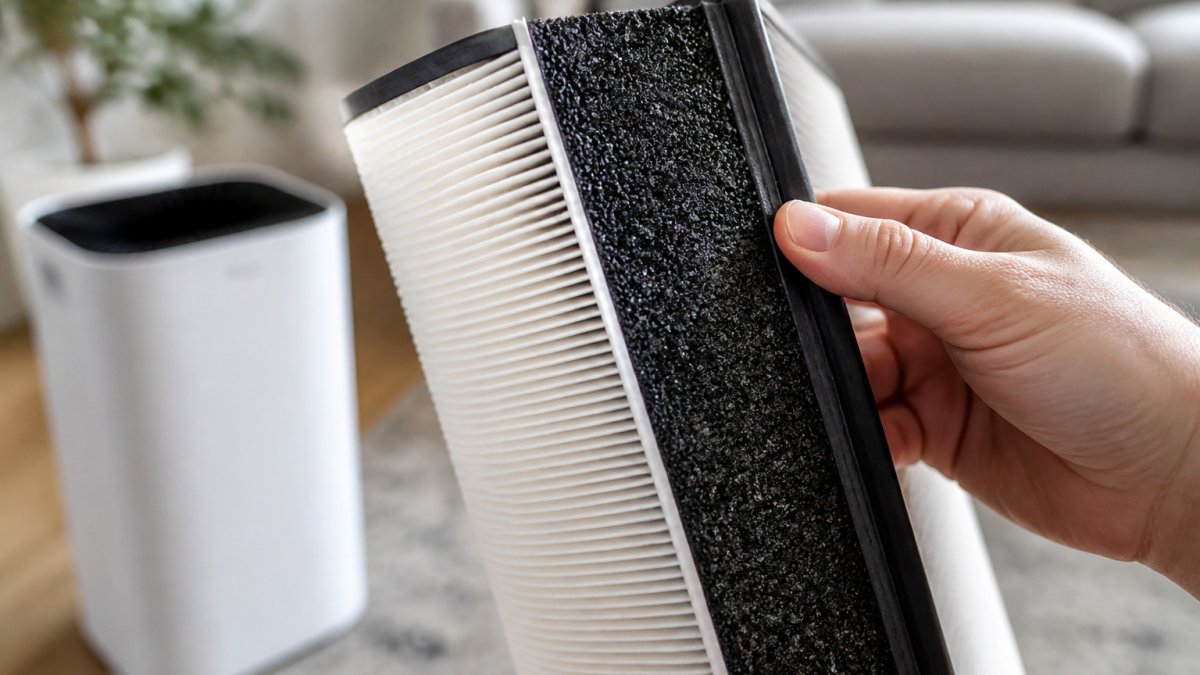
Carbon filters work well for odors and many common gases. A California Air Resources Board research on advanced air purifiers and filtration describes activated carbon and chemisorbent filters as a viable way to adsorb gaseous contaminants indoors.
Why Carbon Quantity and Dwell Time Matter
More carbon usually means more capacity. A thin layer of carbon fills up fast, while a deeper bed holds more molecules before it saturates. Dwell time matters too. Air has to stay in contact with the carbon long enough for molecules to attach. A fast fan on a small filter may move air through without much capture.
Are Activated Carbon Filters Effective Against VOCs?
Yes, for many VOCs, but the answer depends on the filter. Industrial tests show that carbon-based systems can achieve average to excellent removal of odorous compounds and VOCs, as shown in a PubMed study on carbon scrubber efficiency. Home units are a different story, since they often carry much less carbon.
The MIT research is a useful reality check. MIT News reporting on consumer air cleaners and VOC removal found that consumer-grade cleaners often fall short because many filters are not built for the chemistry of indoor pollutants. Professor Jesse Kroll put it bluntly: air cleaning with activated carbon, “a tried-and-true technology, is not as effective as many consumers believe for removing VOCs in homes and offices.”
“Air cleaning using activated carbon filters, a tried-and-true technology, is not as effective as many consumers believe for removing VOCs in homes and offices.” — Jesse Kroll, Professor of Chemical Engineering and Civil and Environmental Engineering at MIT (MIT News, 2021)
Pros of activated carbon filters:
- Can trap many common VOCs and odors
- Improves odor comfort in everyday rooms
- Works without electricity in the filter media itself
Cons of activated carbon filters:
- Capacity is limited, so filters saturate over time
- Performance varies widely between products
- Weakly bonded VOCs can escape back into the air
Reactive Versus Non-Reactive VOCs
VOCs differ in how they interact with carbon. Non-reactive VOCs, such as many hydrocarbons, bind to carbon reasonably well. Reactive VOCs and gases can behave differently, and some pass through or react in ways standard carbon does not handle. This is why a filter that works on one VOC may do little for another.
HEPA vs. Carbon Filter for VOCs
HEPA and carbon do different jobs. A HEPA filter traps particles such as dust, pollen, pet dander, and smoke particles. A carbon filter traps gases and odors. See how each filter handles smoke removal for a side-by-side look at airborne pollutants. Most VOCs are gases, so a HEPA filter alone will not remove them. For VOC control, you need carbon, and for particles, you need HEPA. Many purifiers combine both in one unit.
Choosing an Air Purifier for VOCs
Look for a purifier with a real carbon bed, not a thin coating. Check how much carbon the unit holds and whether the manufacturer explains its design. Read the guide to air purifier filter types to see which combinations suit your needs. A useful VOC air purifier pairs a substantial carbon layer with a HEPA stage for particles.
Next, think about room size. A purifier rated for a small bedroom will struggle in an open-plan living area. Match the unit to the room, and run it on a setting that moves enough air. Find out whether UV-C add-ons are worth paying for alongside carbon filtration.
Saturation Signs and VOC Air Purifier Filter Replacement
Carbon does not last forever. Once the pores fill up, the filter stops capturing VOCs and can even release some back. Signs of saturation include returning odors, a stronger smell from the unit, and a filter that feels heavy or has lost its grayish tint. Replacing the carbon on schedule matters more than most buyers expect. Compare HEPA filter replacement costs before deciding when to swap yours.
Replacement cost varies by model and filter type. Filter prices depend on the brand, the carbon weight, and how often you use the unit, so check the manufacturer’s current listing for exact figures.
Frequently Asked Questions
Do air filters work on VOCs?
Some do, but it depends on the filter type. Standard HEPA filters capture particles such as dust, pollen and smoke particles, but they do not trap most gases. Activated carbon adsorbs many VOCs because the carbon’s porous structure holds gas molecules on its surface. Effectiveness still depends on how much carbon the filter contains, how long air stays in contact with it, and which VOCs are present. Check whether a purifier lists a carbon weight and a tested VOC removal rate before assuming it will work.
Can a HEPA filter remove VOCs?
A HEPA filter cannot remove most VOCs. HEPA media is designed to capture airborne particles, typically those 0.3 microns and larger, but VOCs exist as gas molecules that pass straight through it. For VOCs you need a filter that adsorbs gases, usually one containing activated carbon. Many purifiers combine HEPA for particles with a carbon layer for gases, which covers both types of pollutants.
How long do activated carbon filters last when removing VOCs?
Lifespan depends on the amount of carbon, the VOC load in your air, and how many hours the unit runs. Once the carbon’s surface sites fill up, the filter becomes saturated and stops capturing VOCs effectively, and it may release previously trapped compounds. Manufacturers usually give a replacement interval, often every few months to about a year. Heavy use in a home with high pollutant levels will shorten that interval, so track runtime and any odor return.
Does activated carbon remove odors as well as VOCs?
Activated carbon is effective against many odor-causing compounds, which is why it is used in both residential and industrial settings. Odor reduction and VOC removal overlap, but they are not identical. Some odors come from VOCs, and some come from compounds that carbon adsorbs poorly. If a filter reduces smells but a VOC concern remains, the carbon may be too thin or the contaminant may be one carbon handles weakly.
Next Step: Matching Your Filter to Your Home’s Air Needs
Activated carbon works against many VOCs, but its results depend on how much carbon the filter holds, how air moves through it, and how often you replace it. If you have pets, allergies, or wildfire smoke, you may also need HEPA for particles. The right move is to match the filter to the pollutants in your home.
For a closer look at what Aero Essence LLC’s SR100 handles, check the product page for current details and pricing.
