
HEPA vs Carbon Filters for Smoke Removal: What Works
Table of Contents
- HEPA vs Carbon Filters for Smoke Removal: The Core Difference
- How HEPA Filters Trap Smoke Particles
- How Activated Carbon Filters Work for Smoke and Odor
- Key Differences: Particulate Matter vs. Gaseous Pollutants
- Which Filter Is Better for Wildfire Smoke and Cigarette Smoke?
- Why You Need Both Filters for Complete Smoke Removal
- What to Look For in the Best Air Purifier for Wildfire Smoke
- Air Purifier Maintenance Schedule: When to Replace Filters
- Frequently Asked Questions
Last Updated: September 8, 2026
HEPA vs Carbon Filters for Smoke Removal: The Core Difference
Smoke is not a single pollutant. It is a complex mixture of solid particles and gaseous chemicals, which is why the hepa filter vs carbon filter for smoke removal debate misses the point if you only pick one. A HEPA filter mechanically captures the visible particulate matter, the ash and soot you can see. An activated carbon filter adsorbs the invisible gaseous pollutants and odors that travel with the smoke.
The core distinction is simple: HEPA filtration targets particles measured in microns, while activated carbon targets molecules measured in angstroms. Understanding this difference determines whether your air purifier actually clears the smoke smell or just hides the visible haze.
How HEPA Filters Trap Smoke Particles
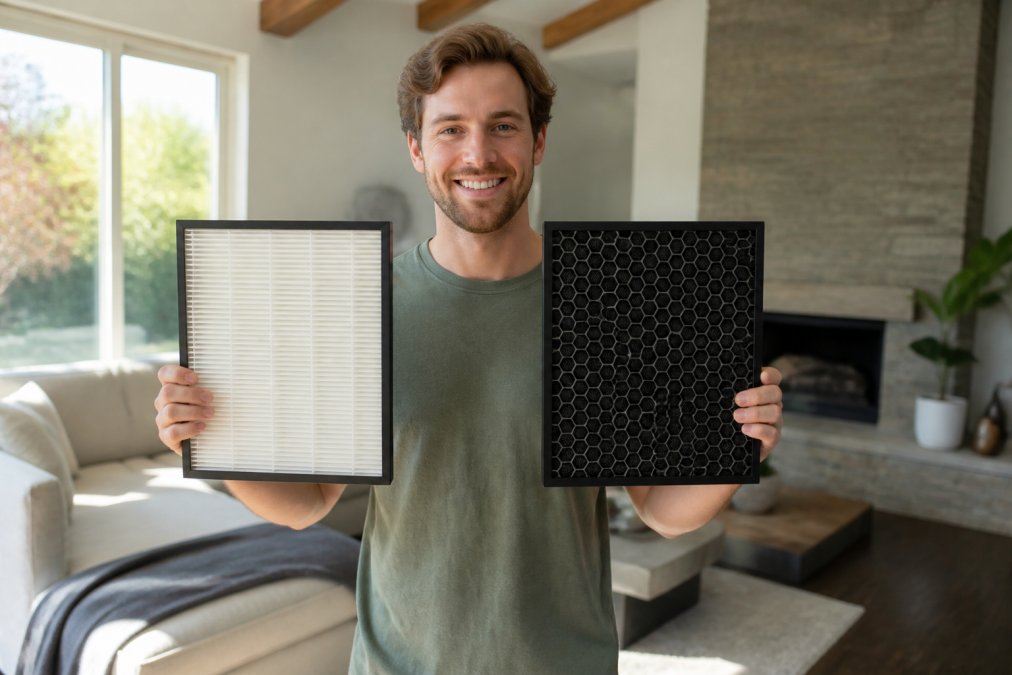
A HEPA filter is a mechanical barrier made of densely packed fibers, typically fiberglass, that captures airborne particles through interception, impaction, and diffusion. To meet the HEPA standard, a filter must capture at least 99.97% of particles at a 0.3 micron test size, which is the most penetrating particle size (energy.gov).
For smoke, this means the filter catches the solid combustion byproducts: the visible ash, soot, and fine particulate matter that makes the air look hazy. Smoke particles range from 0.1 to 1.0 microns, and HEPA filtration excels at pulling these sub-micron particles out of the air stream. However, the filter does nothing for the smell because odor travels as gas, not as particles.
The practical result is cleaner, clearer air that still carries the smoke odor. Many homeowners notice the haze disappears but the campfire or cigarette smell lingers, which is the first sign that a HEPA-only approach is incomplete.
How Activated Carbon Filters Work for Smoke and Odor
Activated carbon filters use a process called adsorption, where gaseous pollutants stick to the surface of highly porous carbon granules. The carbon is treated to create an enormous internal surface area, and a single gram can contain hundreds of square meters of adsorption surface. This is where volatile organic compounds, chemical fumes, and smoke odors get trapped.
Unlike HEPA filtration, which physically blocks particles, activated carbon chemically binds with gas-phase pollutants. The carbon bed pulls smoke smell, cooking odors, and VOCs out of the air and holds them in the filter media. This is the technology that actually removes the odor, not just the visible smoke.
The critical limitation is that carbon filters do not capture particulate matter. Smoke particles pass right through the carbon bed, which means the visible haze and fine ash remain in the air. A carbon-only filter leaves you with air that smells fresh but still contains the harmful particles you can see.
Key Differences: Particulate Matter vs. Gaseous Pollutants
| Filter Type | Removes | Mechanism | Best For | Limitation |
|---|---|---|---|---|
| HEPA Filter | Particulate matter, smoke particles, mold spores, pet dander | Mechanical filtration | Visible smoke haze, airborne allergens | Does not remove odors or gases |
| Activated Carbon | Gaseous pollutants, VOCs, smoke smell | Adsorption | Odor removal, chemical fumes | Does not capture particles |
The fundamental distinction comes down to what you are trying to remove. Particulate matter includes the solid fragments of combustion: ash, soot, and the fine particles that penetrate deep into lungs. Gaseous pollutants include the invisible chemicals released during burning, such as formaldehyde, benzene, and the compounds responsible for smoke smell.
HEPA filtration excels at removing airborne allergens like pollen, dust mites, and mold spores alongside smoke particles. Activated carbon excels at removing the gas-phase pollutants that trigger respiratory irritation. Neither technology replaces the other, and choosing based on only one pollutant type leaves a gap in your air purification.
Which Filter Is Better for Wildfire Smoke and Cigarette Smoke?
The answer shifts depending on the smoke source, and the distinction comes down to the ratio of particulate matter to gaseous pollutants. Wildfire smoke is predominantly a particulate problem. During the 2023 Canadian wildfire events that blanketed the Northeast and Midwest, PM2.5 concentrations exceeded 400 µg/m³ in some areas, far above the EPA’s 24-hour standard of 35 µg/m³ (the EPA). For this scenario, a HEPA filter is non-negotiable because it mechanically captures those fine particles. However, the smoky odor that permeates homes during these events is caused by VOCs and other gases, which is why a carbon stage becomes essential for comfort, even if the health priority is particulate removal.
Cigarette smoke presents a different challenge. It is a dynamic mixture of over 7,000 chemicals, with roughly 70 known carcinogens. The particulate phase includes tar and nicotine droplets, while the gas phase contains formaldehyde, acrolein, and benzene. A HEPA filter will capture the particulate fraction, but the gas-phase compounds that create the lingering ‘thirdhand smoke’ odor on fabrics and walls require substantial activated carbon. The key metric to evaluate is the carbon bed’s weight and volume. A filter with 1 pound of carbon will saturate quickly under daily cigarette smoke exposure, often within 4 to 6 weeks, while a 5-pound carbon bed can last several months.
A unique angle that most comparisons miss is the CADR impact of running these filters in tandem. CADR, or Clean Air Delivery Rate, is measured separately for smoke particles, dust, and pollen. A HEPA-only purifier might achieve a smoke CADR of 200 CFM, but when you add a thick carbon stage, the airflow resistance increases, potentially lowering the smoke CADR to 150 CFM. This is a critical trade-off: the carbon stage reduces odor but can slightly reduce the particle removal rate. The most effective units are designed with larger fans and optimized airflow paths to compensate for this resistance, maintaining a high smoke CADR while still providing meaningful gas-phase adsorption.
For a practical decision framework, consider the source and your primary exposure concern. If you live in a wildfire-prone region like California or the Pacific Northwest, prioritize a unit with a smoke CADR of at least 300 CFM for a 300-square-foot room, and ensure it has a carbon stage heavy enough to handle the odor during multi-day smoke events. If you are addressing secondhand cigarette smoke, the carbon filter weight becomes the primary specification to compare, as that determines how long the odor removal will last before the media is exhausted.
Why You Need Both Filters for Complete Smoke Removal
The most effective smoke removal strategy combines both technologies in a single unit, which is why the hepa filter vs carbon filter for smoke removal question often leads to a hybrid solution. Synergistic filtration efficiency means the HEPA layer captures the particles while the carbon layer adsorbs the gases, and together they address the full spectrum of smoke pollution.
A common mistake is buying a purifier labeled HEPA and assuming it handles smoke completely. The visible haze disappears, but the smoke smell persists because the carbon stage is missing. The reverse problem occurs with carbon-only units that freshen the air while leaving harmful particles circulating.
EPA guidance on indoor air filtration during wildfire events confirms that portable air cleaners with both particle and gas-phase filtration provide the most comprehensive protection. When you shop for an air purifier, look for a unit that includes a true HEPA filter for particles and a substantial activated carbon bed for odors and VOCs.
Many budget purifiers include a thin carbon-coated pre-filter that is useless for smoke odor. The carbon must be present in a thick granular bed to provide meaningful adsorption capacity for gaseous pollutants.
What to Look For in the Best Air Purifier for Wildfire Smoke
The best air purifier for wildfire smoke needs a high CADR rating for smoke particles, a true HEPA filter, and a substantial carbon stage. CADR, or clean air delivery rate, tells you how quickly the unit filters a given room size, and you want a rating that matches your square footage.
Filter saturation indicators matter more than most shoppers realize. A carbon filter that has reached its adsorption limit stops removing odors and can even release trapped gases back into the room. Look for a unit that tracks filter life and gives you visual confirmation that the purification system is actively working.
The Aero Essence LLC SR100 handles nine distinct types of pollutants, including smoke particles and smoke odor, and provides visual confirmation of purification performance so you always know the system is functioning.
Check the carbon filter weight when comparing units. A filter with 1 to 2 pounds of activated carbon will exhaust its adsorption capacity far faster than one with 5 pounds. Heavier carbon beds mean longer effective life for odor removal.
Air Purifier Maintenance Schedule: When to Replace Filters
Filter replacement is where the true cost of ownership becomes clear, and most comparisons gloss over the financial reality. Filter replacement is where the true cost of ownership becomes clear, and most comparisons gloss over the financial reality. To calculate your true monthly cost, divide the filter price by its expected lifespan in months.
Knowing when to replace each filter is the practical challenge. HEPA filters offer a visible cue: they darken as they load with particles. A common pattern is that a HEPA filter in a smoky home will show a gray to dark brown discoloration within 3 to 6 months, even if it still functions for up to 18 months. The more important issue is carbon filter saturation, which is invisible. Once the carbon bed reaches its adsorption limit, it stops removing odors and can begin to release previously trapped VOCs back into the air, a phenomenon known as desorption. A practical test is to place your nose near the air outlet after the unit has been running for a few minutes. If you detect a musty or chemical smell, or if the original smoke odor returns despite the unit running, the carbon is exhausted.
Some higher-end purifiers include a filter life indicator that tracks cumulative runtime and estimates remaining life. However, these indicators are often based on hours of use, not on actual pollutant load. A carbon filter in a home with daily cigarette smoke will exhaust far faster than one in a clean environment, regardless of what the timer says. The most reliable approach is to replace the carbon filter after any major smoke event, such as a multi-day wildfire episode, because the adsorption capacity can be consumed in a matter of days under extreme particulate and gas loads.
Environmental disposal is an overlooked aspect of filter maintenance. A saturated carbon filter contains the concentrated VOCs, nicotine, and combustion byproducts it removed from your air. Check with your local waste management authority for specific guidance. The EPA’s household hazardous waste program provides general direction, but local rules vary, so always verify with your city or county’s waste department before discarding a heavily loaded carbon filter.
Frequently Asked Questions
Is a carbon filter better than a HEPA filter for smoke?
For smoke removal, neither filter is better on its own. A HEPA filter captures solid smoke particles like ash and particulate matter, while activated carbon filters adsorb gaseous pollutants, VOCs, and the smoke smell itself. Cigarette and wildfire smoke contain both particles and gases. A HEPA filter alone will clear the air of visible particles but leave the odor behind. Carbon alone removes the smell but lets fine particles pass. Effective smoke removal requires both technologies working together.
Will a HEPA filter remove cigarette smoke?
A HEPA filter will remove the solid particulate matter from cigarette smoke, including tar and ash particles down to 0.3 microns. It will not remove the gaseous components, which are responsible for the lingering smoke smell. Those gases require adsorption by an activated carbon filter. If you are trying to eliminate cigarette smoke from your home, a purifier with a true HEPA filter and a substantial carbon bed is necessary to address both the visible smoke and the odor.
Can you use HEPA and carbon filters together for smoke removal?
Yes, combining HEPA and activated carbon filters is the recommended approach for comprehensive smoke removal. Most high-performance air purifiers, like the Aero Essence SR100, use a multi-stage system. The pre-filter captures large particles, the HEPA filter traps sub-micron smoke particles and allergens, and the activated carbon layer adsorbs odors, VOCs, and chemical fumes. This synergistic approach ensures you are cleaning both the particulate matter and the gaseous pollutants that make smoke hazardous.
What is the best filter type for wildfire smoke?
Wildfire smoke contains a complex mix of fine particulate matter (PM2.5) and gases like carbon monoxide and VOCs. The best air purifier for wildfire smoke uses a true HEPA filter to capture the dangerous fine particles and a thick activated carbon filter to adsorb the gaseous irritants and smoke smell. Look for a high CADR rating for smoke and a filter that is explicitly designed to handle both particle and gas-phase pollutants to keep indoor air safe during wildfire events.
Choosing the right filtration approach for smoke removal comes down to matching the technology to the pollutant. The Aero Essence LLC SR100 combines HEPA filtration for particulate matter with activated carbon adsorption for gaseous pollutants, and its visual confirmation feature shows you the system is actively purifying your air. Get started with Aero Essence LLC and breathe cleaner air through every wildfire season.