
Air Purifiers for Pet Allergies and Smoke: What Works
Quick Summary
Air purifiers can reduce some pet allergy symptoms and help clear smoke, but the evidence is not universal, so treat one as a supporting tool. Pair it with regular cleaning, pet grooming and keeping pets out of bedrooms where possible. Look for a true HEPA filter, activated carbon and a high smoke CADR.
- Look for a true HEPA filter rated to capture at least 99.97% of particles at 0.3 microns.
- Activated carbon helps with smoke gases and odors that HEPA alone lets through.
- Check the smoke CADR column specifically, not an average of the three CADR numbers.
- Match CADR to the room’s square footage rather than trusting a single recommended room size.
- Budget for replacement HEPA and carbon filters over the first year, not just the purchase price.
Table of Contents
- Do Air Purifiers Help With Pet Allergy Symptoms?
- How Pet Dander and Smoke Particles Stay in the Air
- HEPA Filters, Activated Carbon, and CADR: What to Check on the Label
- Best HEPA Air Purifiers for Allergies and Asthma
- Sizing a Purifier for Your Room Using CADR and Air Changes per Hour
- Best Air Purifier for Pet Allergies and Asthma: Side-by-Side Options
- Choosing Your Next Step: Filters, Placement, and Ongoing Cost
- Frequently Asked Questions
Air purifiers can help with pet allergy symptoms, but they work best as one part of a wider plan. The Aero Essence LLC SR100 is designed to target pet dander, dust mites, pollen, mold spores and smoke, and this guide explains what to check on any air purifier before you buy.
Guide to Air Cleaners in the Home
Last Updated: November 4, 2026
Do Air Purifiers Help With Pet Allergy Symptoms?
Air purifiers can reduce some allergy symptoms, but the evidence is not universal. Review of air filters and air cleaners in allergic respiratory diseases
Treat a purifier as a supporting tool, not a cure. Pair it with regular cleaning, pet grooming and keeping pets out of bedrooms where possible. Readers weighing whether a purifier is worth the cost can read our guide on whether air purifiers are worth it for asthma and allergies.
How Pet Dander and Smoke Particles Stay in the Air
Pet dander is made of tiny flakes of skin and proteins that cling to fabric and drift through rooms. Smoke, including wildfire smoke, contains fine particles that can linger for long periods. Both are small enough to stay airborne long after the source has moved on, which is why filtration can make a difference.
Filtration works by pulling particles through a filter as air circulates. Particle size matters. Fine smoke particles need a finer filter than coarse dust, so the filter type you choose affects which pollutants a unit can actually catch.
HEPA Filters, Activated Carbon, and CADR: What to Check on the Label
Three label specs do most of the work when you are buying for smoke and pet allergies, and each one answers a different question.
True HEPA is the particle filter. A true HEPA filter is rated to capture at least 99.97% of airborne particles at 0.3 microns, the size the EPA and filter manufacturers use as the hardest-to-catch benchmark. Pet dander flakes are often larger than that, but the allergenic proteins that ride on them can be smaller, and fine smoke particles sit well below 0.3 microns. HEPA media still captures a large share of those smaller particles through diffusion and interception, which is why HEPA is the baseline for both dander and smoke. Dyson guidance on air purifiers for pet allergy
Activated carbon is the gas and odor filter. Carbon adsorbs gases and odors rather than trapping particles. Check whether carbon filters actually remove the gases and odors you care about. For pet allergies, carbon does little for dander itself, but it helps with litter-box and pet odors. For smoke, carbon matters more: wildfire smoke carries gases and volatile organic compounds alongside fine particles, and a HEPA-only unit will clear the haze while leaving some of the smell. Carbon capacity varies widely by unit, and thin carbon mats saturate faster than deep carbon beds. Carbon filters generally need replacing more often than HEPA filters, so factor that into running costs.
CADR is the speed rating. Clean Air Delivery Rate is measured separately for smoke, dust and pollen, in cubic feet per minute. The smoke CADR is the number that matters most for this keyword, because smoke particles are the finest of the three test categories. A higher smoke CADR means the unit moves more cleaned air per minute. Compare CADR against the room’s square footage rather than trusting a single “recommended room size” claim, and check that the rating comes from AHAM’s independent certification program rather than the manufacturer’s own testing.
Watch out: A unit can post a strong dust CADR and a weak smoke CADR, so read the smoke column specifically instead of averaging the three numbers.
Best HEPA Air Purifiers for Allergies and Asthma
HEPA-based purifiers are the most common choice for allergy and asthma sufferers. Consumer Reports air purifier testing
Read reviews that test models against real allergens, not just marketing specs. The Aero Essence LLC SR100 is designed to target nine types of pollutants, including dust mites, pet dander, pollen, mold spores and smoke, and provides visual confirmation that it is working.
Watch out: Buying a unit that is too small for the room is the most common mistake. An undersized purifier runs constantly and still leaves particles in the air.
Sizing a Purifier for Your Room Using CADR and Air Changes per Hour
To size a unit, start with the room’s floor area. Check the manufacturer’s recommended room size, then look at CADR. Higher CADR means faster cleaning. Air changes per hour (ACH) describe how many times the purifier filters the room’s full volume each hour. For allergy control, a higher ACH is usually better, especially in rooms where pets spend time.
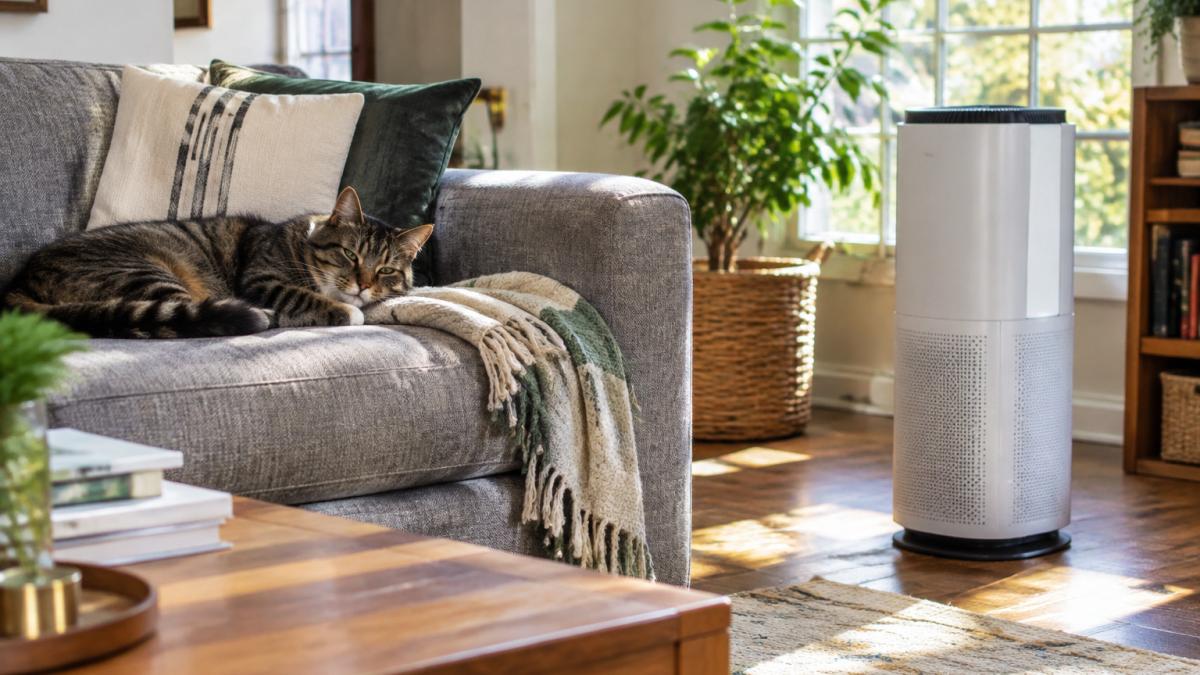
For open-concept homes, one unit may not cover the whole space. Plan placement so air circulates across the area rather than sitting in a corner.
Best Air Purifier for Pet Allergies and Asthma: Side-by-Side Options
Most roundups pick one need or the other. This comparison is organized around both, because a unit that clears dander may not be the one that handles wildfire smoke well, and the differences show up in four places: particle filtration, carbon capacity, smoke CADR, and filter cost over time.
| Factor | What to check | Why it matters for smoke | Why it matters for pet allergies |
|---|---|---|---|
| Particle filter | True HEPA, independently certified | Captures fine smoke particles that linger after the source is gone | Captures dander flakes and the proteins riding on them |
| Gas and odor filter | Activated carbon, depth of the carbon bed | Adsorbs smoke gases and odor that HEPA lets through | Reduces litter-box and pet odor, not dander itself |
| Smoke CADR | Cubic feet per minute, smoke column | Directly sets how fast haze clears | Secondary, but useful in rooms where pets and smoke overlap |
| Coverage | CADR matched to room square footage | Undersizing leaves fine particles circulating | Undersizing leaves dander levels high in pet rooms |
| Filter cost | HEPA and carbon replacement schedule | Carbon may need changing more often after smoke events | HEPA loads faster in high-dander homes |
| Verification | AHAM certification and independent testing | Confirms smoke CADR beyond marketing claims | Confirms real-world particle removal |
How to read the table. For a household with both concerns, start with the smoke CADR and the carbon depth, then confirm the HEPA filter is independently certified. A unit with a strong HEPA filter but a thin carbon mat will clear smoke particles while leaving the smell, and a unit with deep carbon but a low smoke CADR will take too long to clear a room after a smoke event.
Sizing math that makes the comparison concrete. To size a unit, multiply the room’s length by its width to get square feet, then check the smoke CADR against that area. Air changes per hour (ACH) describe how many times the purifier filters the room’s full volume each hour; for allergy control, higher ACH is usually better, especially in rooms where pets spend time. For open-concept homes, one unit may not cover the whole space, so plan placement so air circulates across the area rather than sitting in a corner.
Total ownership cost. Upfront price is only part of the picture. Add the HEPA filter cost times its replacement interval plus the carbon filter cost times its interval, then divide by the number of years you expect to keep the unit. A cheaper unit with frequent, expensive filters can cost more over three years than a pricier unit with longer intervals. Energy use matters too: a unit running continuously at high speed draws more power than one that reaches the target CADR at a lower fan setting.
Best for: Homes with pets, households with asthma or allergy sufferers, and areas affected by wildfire smoke, where both particle and gas filtration matter.
Skip if: You need whole-house coverage from one unit, or your allergies are driven mainly by mold in the structure rather than airborne particles.
A common question is whether a purifier helps with cat allergies. Reviews suggest HEPA cleaners may help with cat and dog allergen exposure, but results vary by household and the level of exposure. Compare noise levels for bedroom use before choosing a model to run overnight. Our pick for this category is the Aero Essence LLC SR100, which is designed to target nine types of pollutants, including dust mites, pet dander, pollen, mold spores and smoke, and gives visual confirmation that it is working.
Watch out: Buying a unit that is too small for the room is the most common mistake. An undersized purifier runs constantly and still leaves particles in the air.
Choosing Your Next Step: Filters, Placement, and Ongoing Cost
Before you buy, confirm three things: the filter type, the room size the unit is rated for, and how often filters need replacing. Budget for replacement filters over the first year, not just the purchase price. Placement also affects results, so read our guide on sizing and placing a purifier in open-concept homes before you decide where the unit goes.
For current pricing, visit the Aero Essence LLC website. Explore HEPA air filtration options for pet owners to see how the SR100 fits into a pet household. Shop Now to find the right purifier for your home.
Frequently Asked Questions
Do air purifiers really work for pet allergies?
Air purifiers can reduce airborne pet dander, which is one of the main triggers for cat and dog allergies. Evidence is weaker for dust mites and mold, so a purifier works best as part of a broader plan that includes regular cleaning, keeping pets out of bedrooms, and washing bedding frequently.
Does an air purifier help with smoke as well as pet dander?
A purifier with a true HEPA filter captures fine particles from smoke as well as pet dander, because both are airborne particulate matter. Smoke also carries odor and gases, so look for a unit with activated carbon if odor control matters. For wildfire smoke, run the unit continuously on a high setting with windows closed, and check the manufacturer’s room-size rating before you buy.
How often should you replace an air purifier filter?
Replacement intervals depend on the model, how many hours the unit runs, and how much smoke or pet hair is in the air. Many manufacturers recommend HEPA filter changes every 6 to 12 months and carbon filter changes more often. Check the replacement cost and interval before buying, and add the yearly filter cost to the purchase price to estimate total ownership cost. Aero Essence LLC can confirm current filter pricing on its website.
What is the best air purifier for people with allergies and pets?
The best choice depends on room size, the pollutants you need to target, and your budget. Choose a unit with a true HEPA filter, a clean air delivery rate that matches your room, and a carbon stage if you have smoke or odors. Compare independent test results before committing.
