
Are Air Purifiers for Asthma and Allergies Worth It?
Last Updated: October 26, 2026
Quick Summary
An air purifier for asthma and allergies is worth it mainly for reducing airborne particles, not for curing symptoms. Home HEPA air cleaners used for 12 weeks lowered many indoor air pollutants, but a 2025 study found they did not improve asthma symptom days. Treat filtration as one part of your trigger-control plan, not a stand-alone fix.
- Air filtration was the fourth most common environmental-control strategy among surveyed allergic respiratory patients, at 27.4%.
- A 2025 study found air cleaners reduced pollutant levels versus placebo but did not improve asthma symptom days.
- Aim for four to five air changes per hour in the room where you spend the most time.
- Most HEPA main filters are rated for 6 to 12 months and carbon stages for 3 to 6 months.
- The SR100 from Aero Essence LLC handles nine kinds of pollutants, including dander, pollen, mold spores, and smoke.
Table of Contents
- What the Evidence Says About Air Purifiers for Asthma and Allergies
- How We Evaluated These Air Purifier Reviews
- The Best Air Purifier for Allergies: Trigger-by-Trigger Picks
- Choosing the Best Air Purifier for Asthma: What to Prioritize
- Air Purifier CADR and Room Size: Sizing a Unit Correctly
- How Often to Change an Air Purifier Filter and What It Costs
- Smoke, Odors, and VOCs: Matching Filtration to the Trigger
- Shop the SR100 and Match It to Your Room
- Frequently Asked Questions
What the Evidence Says About Air Purifiers for Asthma and Allergies
Air filtration was the fourth most commonly used environmental-control strategy among surveyed patients with allergic respiratory disease, at 27.4%, according to a review of air filter and air cleaner effectiveness.
An air purifier for asthma and allergies is a room-level filtration device that pulls airborne particles through a filter to lower indoor concentrations of triggers like pollen, dander, and smoke.
Where Air Cleaners Help and Where They Fall Short
The strongest case is for particle reduction. A 2025 summary from the American Academy of Allergy, Asthma & Immunology reports that home HEPA air cleaners used for 12 weeks lowered levels of many indoor air pollutants.
Symptom relief is murkier. A 2025 study in the Journal of Allergy and Clinical Immunology: In Practice found air cleaners reduced pollutant levels versus placebo but did not improve asthma symptom days in either subgroup.
Purifiers should not be treated as a stand-alone fix. For a deeper walkthrough of the mechanism, see how an air purifier helps with asthma.
How We Evaluated These Air Purifier Reviews
Consumer Reports notes its ratings cover nearly 170 air purifiers, per its 2026 air purifier testing roundup. That scale is useful context. Independent testing matters because a filter’s real-world particle removal often differs from its label.
| Criterion | What We Check | Why It Matters |
|---|---|---|
| Filtration | True HEPA plus carbon stage | Particle and odor removal |
| Sizing | CADR vs. room volume | Prevents undersized units |
| Trigger fit | Pollen, dander, smoke, mold | Matches unit to your problem |
| Cost of ownership | Filters over 3 years | Reveals the real price |
The Best Air Purifier for Allergies: Trigger-by-Trigger Picks
The best air purifier for allergies depends on your dominant trigger, not on a single universal winner. Pollen calls for high particle CADR and a pre-filter you can rinse. Pet dander needs strong air circulation and true HEPA. Dust mites respond to consistent runtime. Mold spores need particle capture plus humidity control, since a purifier cannot dry a damp basement.
For brand-level comparisons, our best air purifier brands for allergies breakdown goes deeper.
Pollen, Pet Dander, Dust Mites, and Mold Spores
Match the feature to the particle. Pollen grains are relatively large and settle fast, so air changes per hour matter more than exotic filtration. Dander is light and stays airborne, which makes continuous low-speed operation effective.
Mold is the one to handle carefully. Filtration removes spores from the air, but it does not fix the moisture source. Watch out: running a purifier in a wet basement without addressing the leak wastes money and gives false confidence.
Choosing the Best Air Purifier for Asthma: What to Prioritize
Start with true HEPA filtration and a sealed system. A HEPA filter captures fine particulate matter, and a well-sealed housing stops air from bypassing the filter.
The best air purifier for asthma is the one you will leave running. A loud unit that gets switched off at night does little. Look for a sleep mode and verified CADR figures rather than vague coverage claims.
Air Purifier CADR and Room Size: Sizing a Unit Correctly
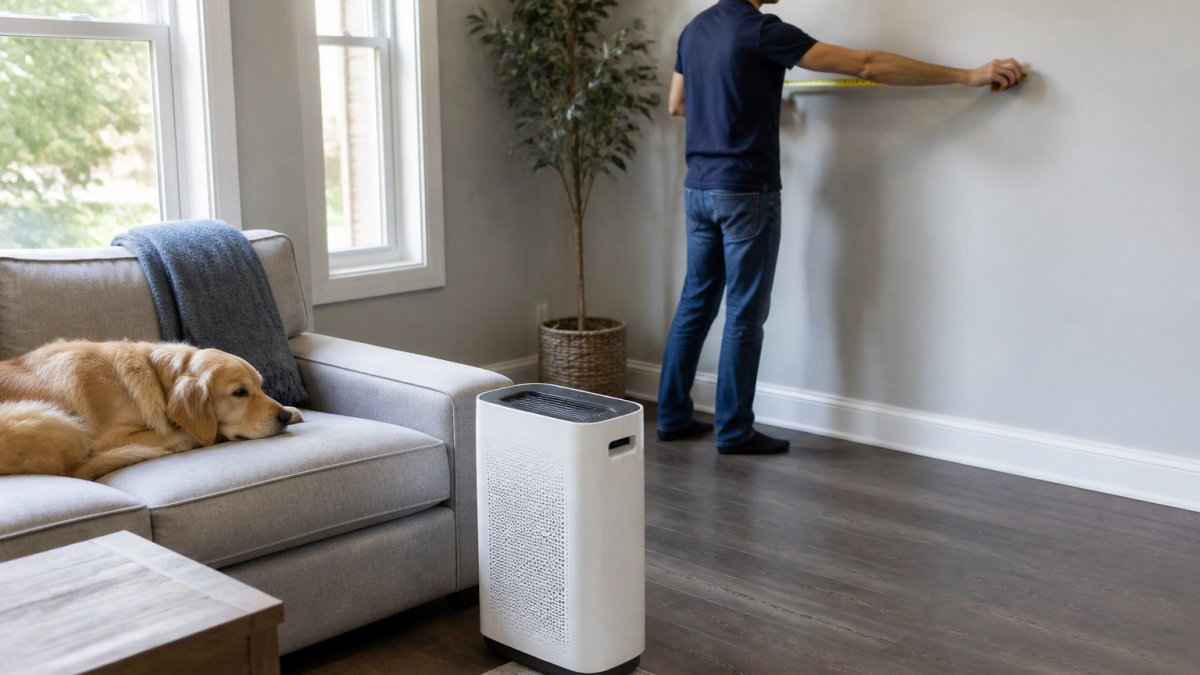
Air purifier CADR and room size are the two numbers that decide whether a unit works. CADR, or clean air delivery rate, measures how much filtered air a purifier delivers per minute, expressed in cubic feet per minute (CFM). It is reported separately for dust, pollen, and smoke, and the smoke number is usually the lowest, which makes it the most conservative figure to plan around.
The mistake most buyers make is matching CADR to floor area. Filtration works on volume, so ceiling height changes the math. A room with 8-foot ceilings and one with 12-foot ceilings can share the same square footage while the taller room holds 50% more air.
The Air Changes Per Hour Rule of Thumb
A practical target for allergy and asthma use is four to five air changes per hour (ACH) in the room where you spend the most time. To estimate whether a unit can hit that, use this relationship:
- CADR (CFM) x 60 = cubic feet of filtered air per hour.
- Divide that by the room’s cubic volume to get air changes per hour.
For example, a 300-square-foot room with 8-foot ceilings holds 2,400 cubic feet. A unit rated at 200 CFM delivers 12,000 cubic feet of filtered air per hour, which works out to five air changes per hour. The same unit in a 600-square-foot open living area with 9-foot ceilings (5,400 cubic feet) drops to roughly 2.2 air changes per hour, which is below the target.
Open Floor Plans and Ceiling Height
Open floor plans break the square-footage shortcut. Air moves freely between the kitchen, living room, and hallway, so the unit has to treat the combined volume, not just the room it sits in. Two options work: size one unit for the total open volume, or place two smaller units at opposite ends so each handles its own zone. Ceiling height matters for the same reason.
Placement Guidance That Actually Changes Results
Placement is as important as CADR. A few rules hold up across most homes:
- Put the unit where you breathe, not in a corner. Bedrooms and main living areas matter more than hallways.
- Keep at least a foot of clearance on all sides so intake and exhaust are not blocked by furniture or curtains.
- Avoid placing the unit directly against a wall or inside a cabinet; restricted airflow lowers real-world CADR below the label.
If you are between two sizes, size up. A larger unit running on low speed is usually quieter and more effective than a smaller unit running at maximum, and it gives you headroom for open doorways and seasonal smoke.
What CADR Does and Does Not Tell You
CADR is a verified performance number when it comes from an independent testing program, and it is the best single figure for comparing particle removal. It does not tell you how well the unit handles gases and odors, how loud it is, how much replacement filters cost, or whether the housing leaks air around the filter. Treat CADR as the starting filter for your shortlist, then check noise, filter cost, and seal quality before you buy.
How Often to Change an Air Purifier Filter and What It Costs
Filter replacement is where budgets quietly break, and it is the number most reviews leave out. A purifier’s sticker price tells you what you pay once. The filter schedule tells you what you pay every year you own it, and over a three-to-five-year horizon the filters can rival the purchase price.
A Realistic Replacement Cadence
Manufacturer intervals are a starting point, not a promise. Most HEPA main filters are rated for 6 to 12 months, and most carbon stages for 3 to 6 months. In practice, three factors shorten those intervals:
- Pets. Dander and hair load the pre-filter fast. Expect the main filter to need replacement toward the shorter end of the range.
- Smoke and candles. Carbon depletes by adsorption, not by visible loading. If odors return before the rated interval, the carbon is spent even if the HEPA looks clean.
- Constant runtime. A unit running 24/7 moves far more air than one running a few hours a day, so it reaches its rated hours sooner.
A workable habit: check the pre-filter monthly and rinse or vacuum it. That single step extends the main filter’s life and is the cheapest maintenance you can do. Then track the main filter by calendar and by performance, not by the indicator light alone.
What Drives Filter Cost
Filter price scales with filter size and media quality, not with the purifier’s price. A budget unit with a small, proprietary filter can cost more per year to run than a mid-priced unit with a larger, standard-size filter. Before you buy, look up the replacement filter’s price and its rated life, then divide price by months of rated life to get a monthly cost.
Building a Three-Year Cost of Ownership
A transparent way to compare units is to add four numbers:
- Purchase price. The upfront cost.
- Filter cost over three years. Multiply the annual filter spend by three, adjusting for pets or smoke.
- Energy use. Check the unit’s wattage at the speed you will actually run it, then estimate hours per day times watts times your electricity rate.
- Your time. Pre-filter cleaning is minutes per month; factor it in if you are comparing several units.
A purifier that costs more upfront but uses a larger, longer-lasting filter can be the cheaper unit by year three. Run the three-year math before you decide, not after.
When to Replace Early
Replace the main filter early if you notice reduced airflow, a musty smell from the unit, visible discoloration on the media, or allergy symptoms returning in a room that previously felt better.
A full replacement schedule and cost breakdown is covered in our guide to how often to replace air purifier filters, and our air purifier filter replacement cost guide helps you budget the yearly total.
Smoke, Odors, and VOCs: Matching Filtration to the Trigger
Smoke is a different problem from pollen. Wildfire smoke and household odors involve gases and volatile organic compounds alongside fine particles, so a HEPA-only unit handles half the job.
For wildfire-prone areas, run the unit continuously during smoke events and keep windows closed. A purifier helps most when the outdoor air is kept out. Odors fade as carbon does, so if smells return before the filter’s rated interval, replace it early.
Shop the SR100 and Match It to Your Room
The SR100 from Aero Essence LLC handles nine kinds of pollutants, including dust mites, pet dander, pollen, mold spores, and smoke. It handles nine kinds of pollutants, targeting dust mites, pet dander, pollen, mold spores, and smoke. It also provides visual confirmation of purification performance.
If you have pets, seasonal pollen, or smoke concerns, shop the SR100.
Frequently Asked Questions
Do air purifiers help with asthma and allergies?
They can reduce what you breathe in, but not always how you feel. A 2025 study in the Journal of Allergy and Clinical Immunology: In Practice found air cleaners lowered indoor pollutant levels compared with placebo yet did not improve asthma symptom days in either subgroup. Separate 2025 findings summarized by the AAAAI showed home HEPA air cleaners used for 12 weeks lowered levels of many indoor air pollutants.
What type of air purifier is best for asthma and allergies?
A sealed true HEPA unit with a carbon stage is the practical starting point, because HEPA media captures the particles that carry pollen, pet dander, dust mite debris, and mold spores. Look for a clean air delivery rate (CADR) rated for your room’s square footage, a pre-filter you can vacuum, and verified test results rather than marketing claims. Asthma triggers also include smoke and volatile organic compounds, so a carbon layer matters if you cook often, burn candles, or live where wildfire smoke drifts in.
Are HEPA air purifiers effective for pollen and pet dander?
Air filtration was the fourth most commonly used environmental-control strategy among surveyed patients with allergic respiratory disease, at 27.4%, according to a 2011 review by Sublett and colleagues.
How often should you replace an air purifier filter?
Budget for replacement media as a recurring cost before you buy, since the filter is the part doing the work. A unit with cheap filters that clog in weeks can cost more over three years than a higher-priced model with longer filter life.
What should you look for when comparing air purifier reviews?
Check whether the review names the test method, the room size tested, and the measured CADR, because a recommendation without those details cannot be reproduced. Consumer Reports says its ratings cover nearly 170 air purifiers, and outlets such as Wirecutter and Forbes publish their own picks, so compare methodology rather than star counts. Also weigh noise level on the highest speed, energy consumption, filter price and availability, and whether the brand publishes independent certification for particle removal.
Cleaning indoor air is a long game, and the right equipment makes it manageable. Aero Essence LLC built the SR100 to cover nine pollutant types with visual confirmation that it is actively working, so you are not left wondering. Get started with Aero Essence LLC and match a purifier to your actual triggers and room size.
