
Air Purifier Placement in Open Concept Homes
Table of Contents
- Why Air Purifier Placement in Open Concept Homes Is Different
- Step 1: Map Your Layout and Find the Central Location
- Step 2: Choose Air Purifier Floor or Table Placement
- Step 3: Set Clearance Around Air Intake and Outlet
- Step 4: Pick the Right Air Purifier for a Large Open Floor Plan
- Step 5: Position an Air Purifier Near Kitchen and Pollutant Sources
- Step 6: Decide on an Air Purifier with Windows Open or Closed
- Step 7: Test Whether Your Placement Is Working
- Frequently Asked Questions
Last Updated: October 21, 2026
Why Air Purifier Placement in Open Concept Homes Is Different
Air purifier placement in open concept homes follows one rule: put the unit where air actually moves through the whole space, not where it looks tidy. A purifier tucked against a far wall cleans that corner and little else. Open floor plans share one air mass across kitchen, dining, and living room, so one well-placed unit can serve all three zones.
How Open Floor Plans Change Airflow
Walls normally trap air in separate rooms. Remove them and you get one big volume with few barriers. Air drifts between zones, pushed by HVAC vents, ceiling fans, foot traffic, and temperature differences.
The catch: pollutants spread just as freely. Cooking smoke, pet dander, and pollen from an open window migrate across the whole space. A purifier in a closed bedroom can’t help; one in the middle of the action can.
The Cost of Getting Placement Wrong
Bad placement wastes the machine you paid for. A unit blocked by a sofa or jammed against curtains pulls in dirty air and pushes clean air into fabric. You run it louder and longer for weaker results.
The fix is cheap: move it. Most placement problems are solved with a few feet of repositioning, not a new purchase.
Step 1: Map Your Layout and Find the Central Location
Sketch your floor plan and mark the kitchen, living room, bedrooms, and every doorway. Then find the spot closest to the center of the shared space, your prime candidate.
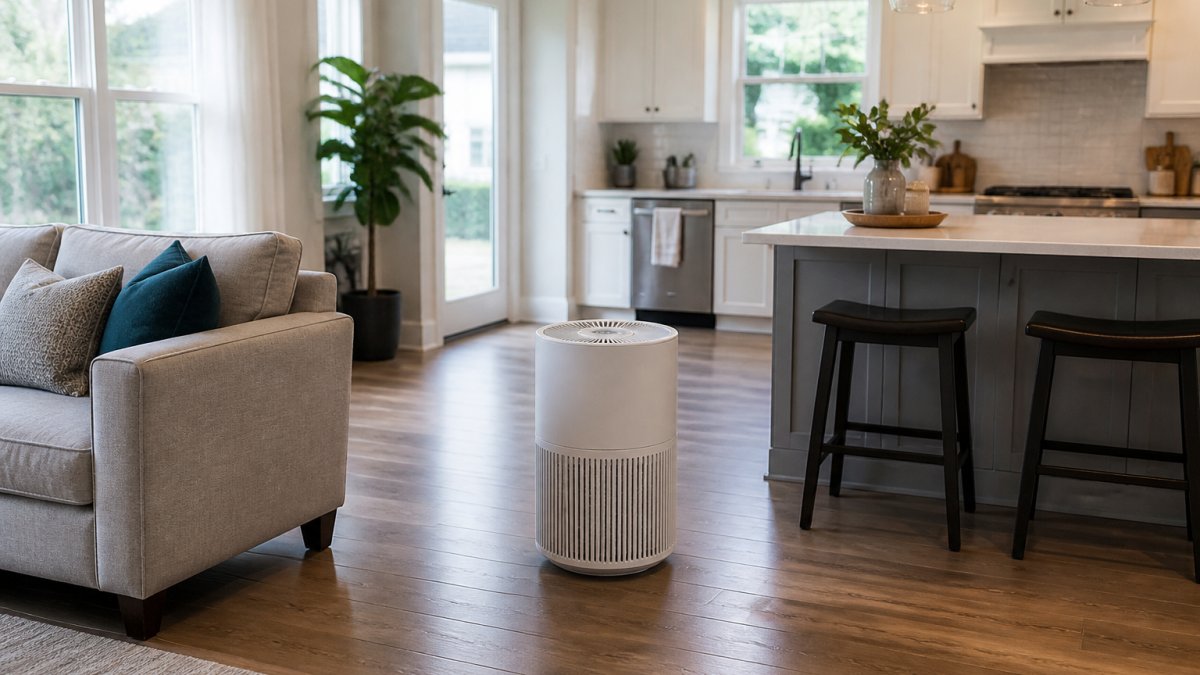
Central placement works because the purifier pulls air from all directions. A unit near the middle of a great room reaches more of the total air volume than one against a wall.
Central Placement Versus Wall Placement
Wall placement is easier to hide and keeps cords out of walkways. It also cuts the unit’s reach roughly in half, since the wall blocks intake on one side.
Central placement looks less tidy but performs better. Our advice: favor performance. If you must use a wall, choose an interior wall with open space on both sides, never a corner.
Step 2: Choose Air Purifier Floor or Table Placement
Floor placement wins in most open concept homes. Larger units sit on the floor, move more air, and stay stable on a hard, flat surface. Keep the base level and clear of rugs that bunch or block the intake.
Table placement suits small rooms or a secondary unit. It lifts the purifier closer to breathing height, which helps in a bedroom or home office.
A quick comparison:
| Placement | Best For | Watch Out For |
|---|---|---|
| Floor, central | Large open floor plans | Cords across walkways |
| Floor, wall-adjacent | Small rooms, tight layouts | Blocked intake on one side |
| Table or shelf | Bedrooms, offices | Too small for big spaces |
Step 3: Set Clearance Around Air Intake and Outlet
Give the unit breathing room. Most manufacturers specify a minimum clearance in the manual, often a foot or more on the intake side. Follow it exactly.
Then check for obstructions:
- Curtains that drape near the intake
- Sofa backs and chair legs
- Bookshelves and cabinets
Clean air can’t reach the filter if furniture blocks the path. A clear zone around the intake and outlet separates a working purifier from a noisy decoration.
Pushing a purifier into a corner or behind a couch starves the intake. The fan works harder, the filter loads unevenly, and you get less clean air for the same electricity.
Step 4: Pick the Right Air Purifier for a Large Open Floor Plan
Match the unit to the air volume, not the square footage of one zone. Here is a practical way to size coverage for connected spaces.
Estimate the Effective Area of an Open Plan
Start with the footprint of every connected zone that shares air: kitchen, dining, living, and any open hallway or loft that flows into the main volume. Add those square footages together.
Then adjust for the things a floor plan hides:
- Ceilings. A coverage rating is usually based on an 8-foot ceiling. A vaulted great room at 12 or 14 feet holds 50 to 75 percent more air than the same footprint at 8 feet. Multiply your square footage by the ceiling height divided by 8 to get a rough volume-adjusted figure.
- Partitions and half-walls. A pony wall or a bank of cabinets slows air exchange between zones. Treat a strongly divided area as two spaces and size each one, even if the floor is continuous.
- Airflow between zones. If a ceiling fan, HVAC return, or open stairwell moves air through the whole plan, one unit can serve more of it. If air pools in a back corner, that corner needs its own coverage.
A common pattern: a 600-square-foot open plan with 10-foot ceilings and a half-wall to the kitchen behaves closer to 800 square feet of rated coverage. Size up, not down, when the geometry is uncertain.
Match the Coverage Rating to the Real Volume
Coverage ratings assume a certain number of air changes per hour. For an open plan, aim for a unit whose stated coverage comfortably exceeds your volume-adjusted total, so it can cycle the shared air several times per hour even when a zone is blocked off.
Check the clean air delivery rate (CADR) on the box or in the manual, listed separately for smoke, dust, and pollen in cubic feet per minute. A higher smoke CADR matters most in an open plan where cooking and outdoor smoke migrate across zones.
One Large-Capacity Unit Versus Multiple Units
A single large-capacity unit is simpler and cheaper to maintain: one filter change, one power cord, one machine to place well.
Multiple smaller units win when half-walls, a long narrow plan, or an out-of-path zone breaks up the space.
Use this decision framework:
| Situation | Better Choice | Why |
|---|---|---|
| Wide-open plan, standard ceilings, free airflow | One large unit, centrally placed | Simplest maintenance, one air volume |
| Vaulted ceiling or very large volume | One large unit sized up, or two | Single unit may be undersized for the air mass |
| Half-walls, long narrow plan, or a stuffy back zone | Two smaller units, one per zone | Each zone gets its own air changes |
| Occupants split between distant zones | Two units near where people spend time | Clean air where it matters most |
Try one well-placed large unit first, sized to the volume-adjusted total. Add a second only if a zone stays stuffy after you have cleared the intake and repositioned toward the center.
Size for the air volume, not the floor plan. Add connected square footage, adjust for ceiling height and partitions, then choose a unit whose coverage and smoke CADR exceed that total. One large unit fits a truly open plan; two smaller units fit a divided one.
Step 5: Position an Air Purifier Near Kitchen and Pollutant Sources
Put a unit near the kitchen if cooking smoke and grease are your main concern. An air purifier near the kitchen catches particles at the source before they spread across the open plan.
The trick is getting close enough to catch pollutants without exposing the unit to conditions that damage it or load the filter unevenly. Source-adjacent placement is a balance, not a bullseye.
Place Around the Kitchen Without Fouling the Unit
Cooking produces two problems: smoke and fine particles a filter can capture, and grease and moisture that coat the filter and fan. A purifier directly over the stove or in the splash zone pulls in grease and loses efficiency fast.
A practical approach:
- Distance from the stove. Keep the unit several feet back from the cooking surface and out of the direct splash and steam path. Intercept smoke as it drifts into the room; don’t sit in the plume.
- Use the range hood first. The exhaust hood is the primary tool for cooking smoke. The purifier handles what escapes. Run the hood during cooking and let the purifier catch the remainder that spreads into the great room.
- Position between the kitchen and the living zone. Place the unit on the living-room side of the kitchen boundary, in the path of air moving from the stove toward seating. That way it filters smoke before it reaches the sofa, and it stays clear of grease.
Handle Pets, Fireplaces, and Other Sources
- Pets. A pet bed is a concentrated dander source. Place a unit near but not against the bed, so it pulls dander out of the air without ingesting hair and debris that clog the prefilter. Clean the prefilter more often in a pet-heavy home.
- Fireplaces. Wood smoke and ash are hard on filters. Keep the purifier out of the direct smoke path and away from the hearth, and run it on high while a fire is burning and for a while after. Never place it where ash or embers can reach it.
- Smoking areas. If smoking happens indoors, place the unit between the smoking zone and the rest of the open plan, and expect faster filter loading. Keep it clear of ashtrays and open flames.
The Source-Placement Rule of Thumb
Place the purifier downstream of the source, in the path the air actually travels, and far enough back to avoid grease, heat, moisture, and physical damage. If you can see smoke drifting toward the unit, it is in the right path. If the unit sits in the splash zone or against the hearth, move it back.
A purifier placed too close to a stove or fireplace pulls in grease, ash, and moisture that coat the filter and fan. It will run louder, load unevenly, and lose efficiency. Keep it in the smoke path, not in the source zone.
Step 6: Decide on an Air Purifier with Windows Open or Closed
Run the purifier with windows closed for the best results. Open windows bring a constant supply of new pollen, dust, and smoke, and the unit fights a losing battle against the outdoors.
There’s a real trade-off. The SR100 is built to handle smoke, pollen, dander, mold spores, and other invisible particles, and it gives you visual confirmation that it’s actively cleaning.
Step 7: Test Whether Your Placement Is Working
You can’t see most airborne particles, so test the result, not the machine. Watch for less visible dust on surfaces, fewer morning allergy flare-ups, cooking smells clearing faster, and the air-quality indicator staying green.
If a zone still feels stale, the unit may be too small or too far away. Move it closer to the center, clear the intake, or add a second unit.
Run the purifier on high for twenty minutes after cooking or when smoke rolls in, then drop to a lower setting. Short bursts at the source beat running low all day.
Frequently Asked Questions
Where should I set up an air purifier in an open-concept home?
Place it in a central location that reaches the rooms you use most, ideally on a hard, flat surface with at least a few feet of clearance on all sides. Avoid tucking it into a corner behind furniture or curtains, which blocks air intake. In an open floor plan, a spot near the boundary between the living room and kitchen often gives the best air purifier placement because airflow reaches both zones.
Should an air purifier be placed on the floor or on a table?
Both work, but floor placement on a hard surface is usually the most stable and effective choice for a large-capacity unit. Table placement can help in smaller zones or where floor space is tight, but make sure the unit is secure and the outlet is not blocked. Whichever you choose, keep the air intake and outlet unobstructed and away from heavy foot traffic.
Can one air purifier clean an entire open floor plan?
It depends on the unit’s coverage area and the size of the connected space. A single large-capacity purifier can handle many open floor plans if it is centrally placed and sized for the total square footage. For very large or L-shaped layouts with multiple connected rooms, two smaller units may circulate air more evenly than one large one. Check the rated coverage before you buy.
Should I keep my windows open or closed when using an air purifier?
Keep windows closed during peak pollen, wildfire smoke, or high outdoor pollution so the purifier can actually reduce indoor particles. Opening windows floods the room with new pollutants and forces the unit to work harder. On clear days, brief ventilation is fine, but run the purifier on a higher setting afterward to clear what came in.
Getting placement right in an open concept home takes a sketch, a central spot, and clear space around the intake. Aero Essence LLC built the SR100 for exactly this challenge: one high-performance unit that targets nine kinds of pollutants, from pet dander to wildfire smoke, with visual confirmation it’s working. If you’re tired of guessing whether your air is actually clean, get started with Aero Essence LLC and give your open floor plan the clean air it deserves.