
True HEPA Filter vs Washable Cost: Which Saves More?
Table of Contents
- True HEPA Filter vs Washable Cost: What the Sticker Price Misses
- Upfront Cost vs Long-Term Cost: A 5-Year Comparison
- True HEPA Filter Replacement Cost: What You’ll Actually Pay
- Air Purifier Filter Replacement Frequency: How Often Is Too Often?
- How to Clean a Washable Air Purifier Filter (Without Damaging It)
- Are Washable Air Purifier Filters Worth It? A Decision Guide by Household
- Filtration Performance After Washing: What the Data Shows
- Conclusion: Match the Filter to Your Air, Not the Price Tag
- Frequently Asked Questions
Last Updated: October 6, 2026
True HEPA Filter vs Washable Cost: What the Sticker Price Misses
A true HEPA filter is a pleated mechanical filter rated to capture at least 99.97% of airborne particles down to 0.3 microns, which is why its costs behave so differently from a washable filter’s.
Aero Essence LLC sells air purifiers, so we watch this decision play out constantly. The upfront price is the smallest number in the equation; replacement filters, electricity, and labor decide which option costs less over five years.
Below, we break down the five-year math, replacement schedules, and the cleaning mistakes that quietly destroy washable filters.
Upfront Cost vs Long-Term Cost: A 5-Year Comparison
The purchase price is the least useful number here. A washable filter usually costs less on day one, while a true HEPA purifier costs more upfront because the filter media is a precision component.
To make the comparison honest, model four cost streams over five years: purchase price, replacement filters, electricity, and labor. The last two are where washable filters quietly lose their advantage.
The Four Cost Streams, Explained
1. Purchase price. A true HEPA purifier costs more upfront because it ships with a sealed, pleated HEPA cartridge and a motor sized to push air through dense media.
2. Replacement filters. True HEPA owners buy replacements every six to twelve months, more often in heavy-use homes, five to ten main cartridges over five years.
3. Electricity. This is the most overlooked line. A clogged true HEPA filter forces the fan to work harder, raising wattage draw.
**4.
A Like-for-Like Five-Year Model
Instead of quoting invented prices, build the model with your own numbers:
| Cost Stream | True HEPA | Washable Filter |
|---|---|---|
| Upfront purchase | Higher | Lower |
| Replacement filters (5 yrs) | 5-10 main cartridges | $0 (but see labor) |
| Electricity | Varies with filter loading | Varies with airflow loss |
| Water and drying | None | Every wash cycle |
| Your labor | Minutes per swap | 15-30 min per wash |
| Performance over time | Stable until replacement | Declines with each wash |
| Best for | Allergen, smoke, pet concerns | Light dust control |
To fill in the dollar figures:
- Find your exact model’s replacement filter part number and current price
- Note the manufacturer’s recommended replacement interval
- Multiply filter price by replacements per year, then by five
- Check the unit’s wattage and multiply by your electricity rate and expected daily runtime
- Estimate your labor at whatever your time is worth, then multiply by washes per year
That total is your true five-year cost.
Why the Upfront Gap Shrinks Over Time
The upfront price difference between a true HEPA purifier and a washable-filter unit is usually the smallest gap between them. A washable filter that costs less on day one can cost more by year three once you account for rinsing and drying hours, before the performance decline that makes the unit work harder for the same result.
The upfront price difference between a true HEPA purifier and a washable-filter unit is usually the smallest gap between them. The five-year total, filters, electricity, water, and labor, is where the two options separate.
One insider note: buy replacements from the manufacturer or a verified seller. Counterfeit HEPA media is common online and will not deliver the particle capture you paid for.
True HEPA Filter Replacement Cost: What You’ll Actually Pay
True HEPA filter replacement cost depends on filter size, model, and how hard the purifier works. Larger filters for whole-room units cost more per replacement but often last longer, flattening the annual figure.
We will not quote you a number, because filter prices vary widely by manufacturer and model. Instead, price it yourself in four steps:
- Find your exact model’s replacement filter part number
- Note the manufacturer’s recommended replacement interval
- Multiply the filter price by the number of replacements per year
- Add electricity: check the unit’s wattage and your local rate
That total is your true annual cost.
Air Purifier Filter Replacement Frequency: How Often Is Too Often?
Air purifier filter replacement frequency is not a calendar rule. It depends on how dirty your air actually is.
A common mistake is waiting for a visible gray coating. By then, airflow has already dropped and the motor is straining.
Replace sooner if you notice any of these:
- Reduced airflow from the exhaust vent
- A musty or stale smell when the unit runs
- More dust settling on surfaces within days of cleaning
- Allergic symptoms returning despite regular use
For washable pre-filters, the schedule is different. Rinse those monthly. They exist to catch hair and large dust so the main filter lasts longer.
Running a clogged true HEPA filter does not just reduce cleaning. It forces the fan to strain against restricted airflow, which shortens motor life and can void your warranty. Replace on schedule, not on appearance.
How to Clean a Washable Air Purifier Filter (Without Damaging It)
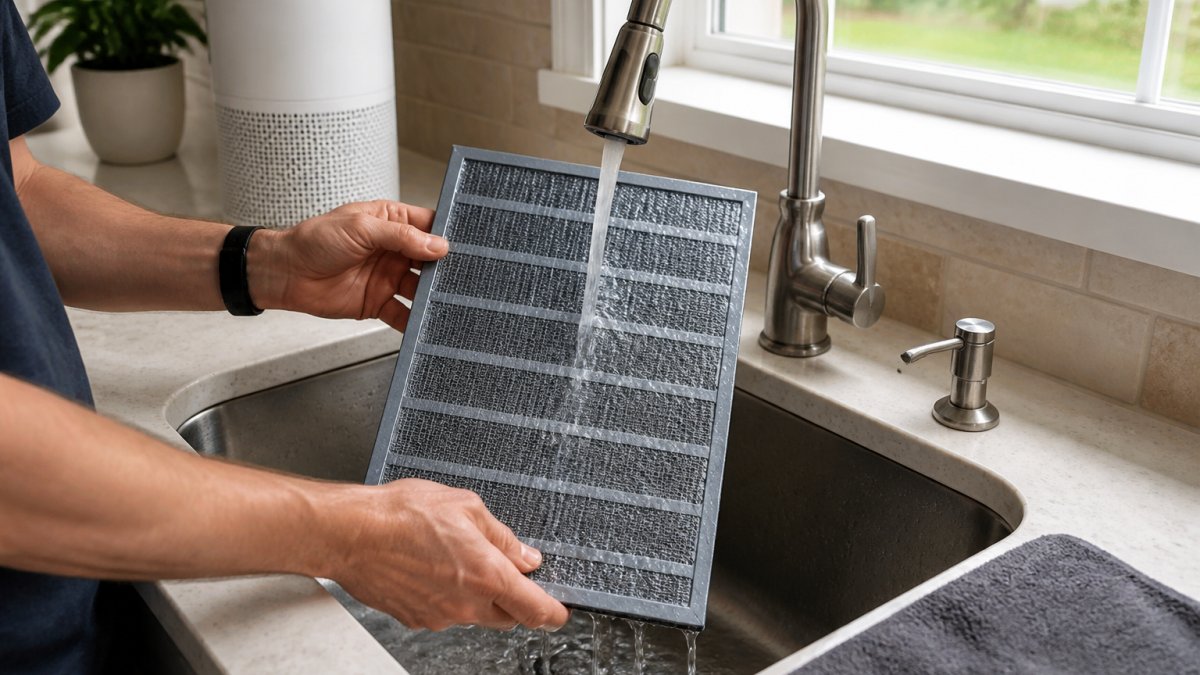
Cleaning a washable filter correctly takes about twenty minutes, and most of that is drying time. The cleaning is simple; the drying is where people ruin filters.
Follow this sequence:
- Unplug the purifier and remove the filter per the manual
- Vacuum loose dust and pet hair off both sides with a brush attachment
- Rinse under cool running water, gently working water through the pleats
- Never scrub, wring, or bend the media
- Never use soap, detergent, or vinegar unless the manual allows it
- Shake off excess water and air-dry completely, away from direct heat
- Reinstall only when bone dry
That last step matters most. A damp filter grows mold and mildew, and your purifier then spreads spores through the room instead of removing them.
Washable Pre-Filter vs Washable Main Filter: Know the Difference
This distinction trips up almost everyone. A washable pre-filter is a coarse mesh screen that catches pet hair, lint, and large dust before air reaches the main filter.
A washable main filter is different. It claims to do the fine-particle job itself. Some handle that reasonably well; many lose filtration efficiency with every wash as the media fibers relax and the pleats distort.
If your unit has both, treat them differently. Rinse the pre-filter monthly and let it dry fully. Replace the main filter on the manufacturer’s schedule even if it is labeled washable, because cleaning restores airflow but not particle capture.
Are Washable Air Purifier Filters Worth It? A Decision Guide by Household
Washable air purifier filters are worth it for light dust control in clean, low-traffic rooms, but a poor fit for allergy sufferers, pet owners, and anyone dealing with smoke or mold.
Here is how we would decide, by household:
- Apartment, no pets, mild dust: a washable filter unit is fine and cheap to run
- One or two pets, mild allergies: true HEPA pays for itself in symptom relief
- Multiple pets or a smoker in the home: true HEPA, no debate
- Wildfire smoke season: true HEPA, because fine smoke particles demand real capture efficiency
- Basement with any moisture or musty smell: true HEPA plus a moisture fix, not a filter swap
If you are coming from a washable unit and your symptoms never improved, that is the signal. You were cleaning the air, but not to the level your lungs needed.
Filtration Performance After Washing: What the Data Shows
Measured filtration performance after washing is the gap in most buying guides, and it should drive your decision. Manufacturers rarely publish post-wash efficiency: when a spec sheet lists efficiency but not efficiency after ten washes, assume the number would not help the sale.
What Actually Happens to Filter Media When You Wash It
True HEPA media is a mat of randomly oriented fibers, pleated and sealed into a frame. Particles are captured through interception, impaction, and diffusion, and the pleat structure keeps surface area high and airflow predictable.
Washable media is built differently. To survive rinsing, it uses coarser fibers and a looser structure, durable, but with wider fiber spacing and weaker capture.
Airflow Is Not the Same as Capture Efficiency
This is the distinction most guides miss. A washable main filter may still move air well after a year of washing, but moving air is not the same as capturing particles.
A filter that has lost capture efficiency can feel like it is working because you still feel air from the vent. But particles that used to stick to the fibers now pass straight through and back into the room.
Washable Pre-Filter vs Washable Main Filter: A Critical Distinction
This distinction trips up almost everyone, and it is the source of most bad advice online.
A washable pre-filter is a coarse mesh screen that catches pet hair, lint, and large dust before air reaches the main filter.
A washable main filter is different. It claims to do the fine-particle job itself. Some handle that reasonably well for light dust.
The practical rule: if your unit has both, treat them differently. Rinse the pre-filter monthly and let it dry fully.
How to Judge Post-Wash Performance Without a Lab
You cannot measure particle capture at home, but you can watch for signals that a washable main filter is past its useful life:
- Reduced airflow from the exhaust vent despite a recent wash
- A musty or stale smell when the unit runs
- More dust settling on surfaces within days of cleaning
- Allergic symptoms returning despite regular use
- Visible distortion, thinning, or fraying of the pleats
If any appear, replace the filter, or move to a true HEPA unit.
Why This Matters for Your Cost Math
A washable filter that loses capture efficiency is not saving you money. It costs you the difference between the air quality you thought you were buying and the air quality you are getting.
For households where the goal is verified particle removal, the SR100 from Aero Essence LLC targets nine kinds of pollutants, including dust mites, pet dander, pollen, mold spores, and smoke, and it gives you visual confirmation that purification is actually happening.
Conclusion: Match the Filter to Your Air, Not the Price Tag
The cheapest filter is the wrong filter if it does not address what is actually in your air. True HEPA costs more upfront and at every replacement; washable costs less upfront and quietly charges you in labor and declining performance.
If you are dealing with pet dander, seasonal pollen, wildfire smoke, or mold concerns, the SR100 is built for exactly those problems.
Frequently Asked Questions
Is a True HEPA filter better than a washable filter?
For particle capture, yes. True HEPA filters are rated to capture 99.97% of particles at 0.3 microns, which includes pet dander, pollen, smoke, and mold spores. Washable main filters typically capture larger particles and lose efficiency with each wash. Washable pre-filters, however, work well alongside True HEPA as a first stage that traps hair and dust before it reaches the main filter. The best setup often combines both.
How much does a True HEPA replacement filter cost?
Replacement filter cost varies by brand, unit size, and whether the filter includes a carbon layer. As a general rule, budget for filter replacements as part of your annual operating cost, not a one-time purchase. Units with washable pre-filters often extend the main filter’s life and reduce how often you buy replacements.
Which costs less over five years: a True HEPA filter or a washable filter?
It depends on replacement frequency and washing labor. A washable filter has a lower upfront cost but may need replacement anyway if filtration efficiency drops after repeated washing. A True HEPA filter costs more upfront and requires regular replacements, but performance stays consistent. Over five years, the washable option often wins on parts cost alone, while True HEPA wins on consistent particle capture. Factor in your time spent washing and drying when comparing.
Can a washable filter capture smoke, pollen, and pet dander as effectively as True HEPA?
Washable main filters generally capture larger particles like pet hair and visible dust, but they are less reliable for fine smoke particles and pollen under 2.5 microns. True HEPA filters are designed specifically for those smaller particles. If you live in a wildfire-prone area or have pets with heavy shedding, a True HEPA filter paired with a washable pre-filter gives you the best of both: pre-filter catches the bulk, HEPA handles the fine particles.