
Air Purifier Filter Replacement Cost Guide
Table of Contents
- Understanding Air Purifier Filter Replacement Cost
- Types of Air Purifier Filters and Their Costs
- Air Purifier Filter Replacement Frequency
- Calculating Total Cost of Ownership for Air Purifiers
- How to Save Money on Air Purifier Filters
- OEM vs. Generic Filters: Cost and Performance
- Signs Your Filter Needs Replacement
- Conclusion
- Frequently Asked Questions
Last Updated: September 3, 2026
Understanding Air Purifier Filter Replacement Cost
The cost of replacing air purifier filters is one of the most overlooked expenses when homeowners decide to invest in indoor air quality. Most people focus on the upfront purchase price of the unit itself, then get sticker shock when they realize filters need replacing every few months, sometimes more frequently depending on usage and air quality. Understanding air purifier filter replacement cost is essential to calculating the true total cost of ownership for any air purification system you bring into your home.
Filter replacement isn’t optional maintenance. A clogged filter loses its ability to capture pollutants effectively, which means your air purifier stops doing what you bought it for. The longer you delay replacement, the harder your unit works, consuming more energy and delivering less clean air. This creates a hidden cost spiral: poor air quality, increased energy consumption, and eventual unit failure if the filter gets too saturated.
The real question isn’t whether you’ll replace filters, it’s how much you’ll spend over the lifetime of your system. That number varies dramatically based on the type of filters you use, how often you replace them, and whether you opt for original equipment manufacturer (OEM) filters or generic alternatives.
Types of Air Purifier Filters and Their Costs
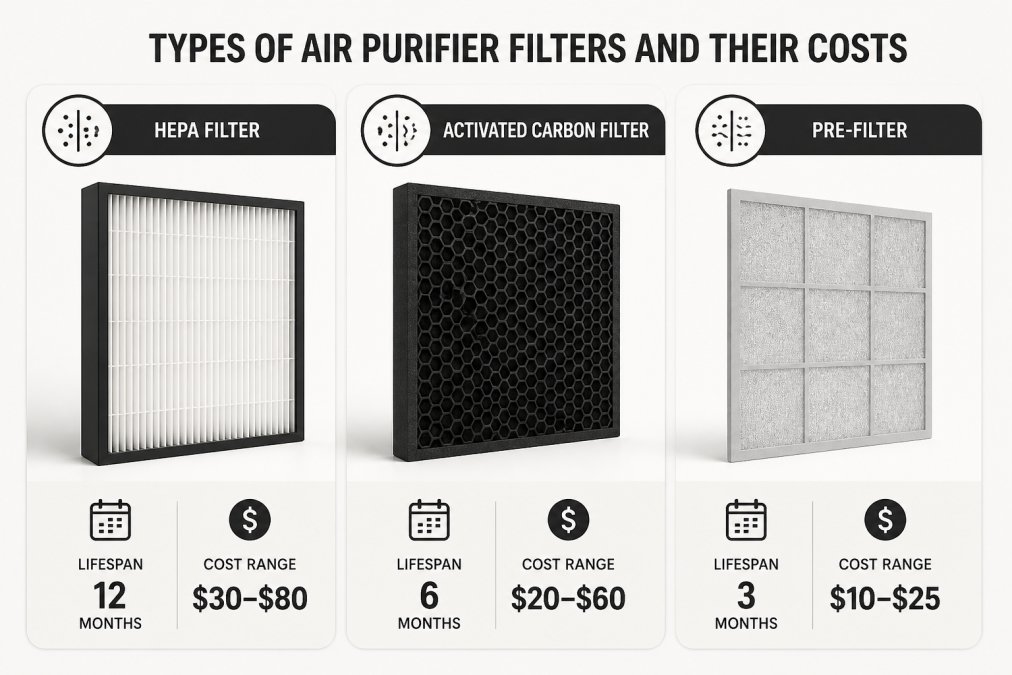
Air purifier filters fall into distinct categories, each with different performance characteristics and price points. Understanding what each type does helps you anticipate replacement costs and make informed decisions about long-term expenses.
HEPA Filters
HEPA filtration is the gold standard for particle capture in air purification. A true HEPA filter removes 99.97% of particles 0.3 microns or larger, a specification that matters if you’re dealing with pet dander, pollen, dust mites, or wildfire smoke. HEPA filters use dense media that creates significant airflow restriction, which is why they’re typically paired with other filter layers.
HEPA filters tend to be the most expensive component of a multi-stage filtration system. Because they capture such a high volume of particles, they also clog faster than pre-filters or carbon layers. In homes with pets or high pollution exposure, a HEPA filter might need replacement every 3-6 months. That frequency drives up annual costs substantially. The denser the filter media and the larger the surface area, the longer it lasts before saturation, but these premium versions cost more upfront.
Activated Carbon Filters
Activated carbon works through adsorption, trapping odors, gases, and volatile organic compounds (VOCs) that particle filters can’t capture. If you live near wildfire smoke, have pets, or deal with household odors, carbon filtration is essential. However, carbon filters don’t capture particles, they only address gases and odors.
Carbon filters typically cost less than HEPA filters but more than pre-filters. The trade-off is that they degrade gradually rather than clogging suddenly. A carbon filter loses effectiveness over time as its pores become saturated with absorbed compounds. Most carbon filters last 6-12 months before needing replacement, depending on air quality and usage patterns. In high-pollution environments or homes with strong odor sources, replacement might be needed every 3-6 months.
Pre-Filters
Pre-filters are the first line of defense in a multi-stage system. They capture larger particles like hair, dust, and lint before air reaches more expensive filters. Pre-filters extend the life of downstream filters by removing debris before it clogs the HEPA or carbon layers.
Pre-filters are the most affordable filter component. Many can be vacuumed and reused multiple times before requiring replacement, which significantly reduces long-term costs. When replacement is necessary, pre-filters cost far less than HEPA or carbon options. For most homes, a pre-filter might last 1-3 months before needing cleaning or replacement.
Air Purifier Filter Replacement Frequency
How often you replace filters depends on several factors that vary from household to household. Understanding these variables helps you predict your annual air purifier filter replacement cost more accurately.
Usage intensity is the primary driver. A unit running 24/7 will saturate filters faster than one running 8 hours daily. Homes with pets generate far more particulate matter than pet-free homes, accelerating filter clogging. Similarly, homes in areas with high outdoor pollution, wildfire smoke, industrial emissions, or seasonal pollen, require more frequent replacements than homes in cleaner air environments.
Filter size and surface area also matter. Larger filters with greater surface area can trap more particles before reaching saturation. A premium filter with 50% more surface area might last 50% longer than a standard filter, though it typically costs more upfront. This is where air quality sensors become valuable, they provide visual confirmation of when replacement is actually needed rather than guessing based on calendar dates.
Maintenance practices extend filter life. Regular vacuuming of pre-filters prevents larger debris from clogging downstream layers. Keeping your home relatively dust-free by reducing clutter, using washable bedding, and managing pet shedding all reduce the pollutant load on your filters. These practices won’t eliminate replacement costs, but they do stretch the time between replacements.
Most manufacturers recommend checking filters monthly and replacing them when they show visible dirt accumulation or when air quality sensors indicate reduced performance. In practice, most households replace HEPA filters every 3-6 months and carbon filters every 6-12 months, with pre-filters changed or cleaned more frequently.
Track your actual replacement dates and costs for three months. This real data is far more useful than manufacturer estimates for predicting your specific annual expenses. Seasonal variations matter too, wildfire smoke season or high pollen months will accelerate replacement frequency.
Calculating Total Cost of Ownership for Air Purifiers
Total cost of ownership includes the unit price, filter costs, and energy consumption. This is the number that actually matters when deciding whether an air purifier fits your budget.
Start with annual filter costs. If your HEPA filter costs roughly $40-60 and needs replacement every 4 months, that’s 3 replacements yearly. Add a carbon filter at similar cost replaced twice yearly, plus pre-filter replacements or cleanings. For a typical household, annual filter costs alone often run $150-300, depending on filter type and replacement frequency.
Energy consumption varies by model. Most air purifiers consume between 30-100 watts when running continuously. Operating 24 hours daily at 50 watts costs roughly $40-50 annually in electricity, though this varies by regional power rates. Larger units or those with higher CADR ratings consume more power.
The real calculation looks like this: unit purchase price divided by expected lifespan (typically 5-10 years) plus annual filter costs plus annual energy costs equals your true annual cost. A $500 unit lasting 7 years costs roughly $71 annually just for depreciation, plus $200 in filters, plus $45 in electricity. That’s roughly $316 per year in total cost of ownership.
This framework matters because it reveals that expensive units with long-lasting filters sometimes cost less annually than cheaper units that require frequent filter changes. A premium system with larger filters and better efficiency might actually be more economical over time than a bargain model that demands constant maintenance.
Total cost of ownership is what you actually spend per year, not just the purchase price or filter cost in isolation. Calculate it before buying to avoid surprises.
How to Save Money on Air Purifier Filters
Several strategies reduce filter replacement costs without compromising air quality.
Maximize pre-filter performance. Pre-filters are your cheapest line of defense. Vacuuming them weekly instead of immediately replacing them extends their life significantly. Some pre-filters can be washed and reused dozens of times before replacement. This single practice can save $50-100 annually.
Reduce pollutant sources. Fewer particles entering your home means filters stay cleaner longer. Use washable, lint-free bedding instead of high-shedding fabrics. Vacuum frequently with HEPA-filter vacuums that don’t recirculate dust. Manage pet grooming to reduce dander. Keep windows closed during high-pollen or smoke seasons. These aren’t free, but they’re cheaper than replacing filters constantly.
Monitor air quality actively. Running your air purifier on high speed 24/7 clogs filters faster than necessary. Units with air quality sensors and automatic speed adjustment use filters more efficiently. They ramp up during high-pollution periods and dial back when air is already clean. This extends filter life and reduces energy consumption simultaneously.
Buy filters strategically. Purchasing filters directly from manufacturers often costs less than retail channels. Some manufacturers offer subscription services that deliver replacement filters on a schedule, sometimes at modest discounts. Buying in bulk when possible also reduces per-unit cost.
Choose the right unit size. An oversized air purifier for your space cycles air more frequently than necessary, clogging filters faster. Conversely, an undersized unit runs constantly at maximum capacity. Matching your unit to your room size, measured by CADR rating and square footage, ensures efficient operation and optimal filter life.
OEM vs. Generic Filters: Cost and Performance
The choice between original equipment manufacturer filters and generic alternatives directly impacts your air purifier filter replacement cost over time.
OEM filters are designed specifically for your unit. They fit perfectly, match the exact specifications the manufacturer tested, and typically perform as advertised. The trade-off is cost, OEM filters often cost 30-50% more than generic alternatives. For a $50 OEM HEPA filter, you might find a generic version for $30-35.
Generic filters cost less upfront but carry real risks. Some generic filters don’t seal properly in the housing, allowing unfiltered air to bypass the media entirely, defeating the purpose of filtration. Others use lower-density media that captures fewer particles or saturates faster. A cheap filter that lasts half as long as an OEM filter actually costs more annually when you factor in replacement frequency.
The performance difference shows up in CADR ratings and filter longevity. A quality OEM filter maintains its CADR rating throughout its lifespan. A generic filter might start strong but degrade faster, meaning the last month of its life captures far fewer pollutants than the first month. This is particularly important for households with respiratory sensitivities, pet allergies, or asthma where consistent air quality matters.
For cost-conscious buyers, a middle ground exists: compatible filters from established manufacturers that aren’t the original brand. These third-party filters are often engineered to meet or exceed OEM specifications and cost 10-20% less. They’re worth considering if you’ve verified they fit your unit and match MERV or CADR ratings.
Signs Your Filter Needs Replacement
Waiting until a filter is completely clogged means you’re breathing suboptimal air and working your unit harder than necessary. Recognizing replacement signals keeps your system efficient.
Visual inspection is the simplest check. Hold the filter up to light. A clean filter shows light passing through. A filter that’s dark, discolored, or visibly caked with dust is nearing the end of its useful life. This is particularly obvious with pre-filters, which trap visible lint and hair.
Reduced airflow indicates filter saturation. If your air purifier seems quieter or you feel less air movement from the outlet, the filter is likely restricting flow. Clogged filters force motors to work harder, consuming more energy to push air through dense media.
Air quality sensor feedback is the most reliable signal. If your unit has an air quality indicator light or digital display, pay attention to it. Many modern purifiers show green, yellow, or red status based on detected particulate matter and filter saturation. When the indicator shifts from green to yellow, replacement is approaching. Red means replace immediately.
Odor persistence suggests carbon filter saturation. If odors that previously disappeared are returning despite the purifier running, your carbon layer has absorbed its maximum capacity and needs replacement.
Increased noise can signal filter problems. As filters clog, motors work harder and sound louder. If your unit suddenly sounds strained, check the filter before assuming mechanical failure.
Running an air purifier with a saturated filter is counterproductive. You’re consuming electricity without improving air quality. The motor works harder, increasing wear and potentially shortening unit lifespan. Replace filters when indicators suggest it, not when you remember.
Conclusion
Air purifier filter replacement cost is a significant ongoing expense that most homeowners underestimate when purchasing a unit. The true cost of ownership includes filter replacement frequency, energy consumption, and maintenance practices, not just the initial purchase price. By understanding filter types, calculating annual costs, and implementing cost-saving strategies, you can maintain excellent indoor air quality without breaking your budget.
At Aero Essence LLC, we designed the SR100 with total cost of ownership in mind. Our air purifier handles nine distinct types of pollutants, from pet dander and pollen to mold spores and wildfire smoke, with visual confirmation that your system is actively working. This transparency helps you understand when filters genuinely need replacement rather than guessing, which reduces unnecessary replacements and keeps your long-term costs predictable. When you’re investing in air quality for your family, knowing exactly what you’re getting and what it will cost to maintain matters.
EPA guidance on indoor air quality
ASHRAE standards for residential air filtration
American Lung Association recommendations for air purifiers
Frequently Asked Questions
How much does it cost to replace an air purifier filter?
Air purifier filter replacement costs vary by type and brand. HEPA filters typically range from $30 to $100+, while activated carbon filters cost $20 to $60. Pre-filters are usually the least expensive at $10 to $30. The total cost depends on your specific unit, filter quality, and whether you choose OEM or generic replacements. Check your purifier’s manual or manufacturer website for exact pricing on compatible filters.
How often do you actually need to change air purifier filters?
Replacement frequency depends on usage patterns, air quality, and filter type. Most HEPA filters last 6 to 12 months with regular use, while activated carbon filters typically need replacement every 3 to 6 months. Pre-filters may require monthly cleaning and replacement every 1 to 3 months. Homes with pets, smokers, or high pollution exposure may need more frequent replacements. Many modern purifiers include filter reset indicators to alert you when replacement is due.
Are generic air purifier filters as effective as brand-name replacements?
Generic and OEM filters differ in performance and durability. OEM filters are engineered specifically for your purifier’s housing and airflow restrictions, often delivering higher CADR ratings and filter efficiency. Generic filters may cost less but can have lower particulate matter capture rates and shorter lifespans. For optimal performance with pollutants like dust mites, pet dander, and mold spores, OEM filters typically provide better results, though they cost more upfront.
What factors influence how often I need to replace my air purifier filters?
Filter replacement frequency depends on several factors: air quality in your area (wildfire smoke, pollen, industrial pollution), household activities (pets, cooking, smoking), purifier usage hours per day, and your home’s size. Homes with multiple pets or in wildfire-prone areas may need replacements every 3 to 4 months. Usage patterns and filter saturation levels directly impact replacement cycles. Using a purifier with air quality sensors helps track when filters degrade and need changing.
How can I extend the life of my air purifier filters?
Extend filter life by pre-filtering larger particles before they reach your main filters. Regularly clean or replace pre-filters monthly to reduce load on HEPA filters. Run your purifier at appropriate fan speeds rather than maximum continuously, as this slows filter saturation. Maintain your home’s HVAC system separately to reduce overall particulate matter entering your purifier. Avoid exposing your unit to excessive dust or smoke when possible. These practices can add 1 to 3 months to filter longevity.
What is the total cost of ownership for an air purifier over five years?
Total cost of ownership includes the initial unit purchase plus replacement filters, electricity, and maintenance. If you replace filters 2 to 4 times annually at $30 to $80 per filter, annual filter costs range from $60 to $320. Over five years, filter expenses alone could total $300 to $1,600. Add electricity costs (typically $10 to $30 monthly depending on usage) and occasional maintenance. Calculate your specific annual operating cost by multiplying replacement frequency by filter cost, then multiply by five years.
Should I buy subscription filter replacements or purchase filters one at a time?
Subscription services often offer discounts of 10 to 20% compared to one-time purchases, making them cost-effective if you use your purifier consistently. One-time purchases provide flexibility if your replacement frequency changes due to seasonal air quality variations. For households with pets or in high-pollution areas requiring frequent replacements, subscriptions typically save money annually. For occasional users, one-time purchases may be more economical. Compare your expected annual replacement frequency against subscription pricing to determine which saves more.
This article was written using GrandRanker