
Air Purifier Energy Consumption: Cost Analysis Guide
Table of Contents
- Understanding Air Purifier Energy Consumption
- Factors Influencing Air Purifier Power Usage
- Calculating Annual Operating Costs with an Air Purifier Electricity Cost Calculator
- Cost of Running Air Purifier 24/7
- How to Reduce Air Purifier Energy Usage
- Life-Cycle Cost Analysis and Long-Term Savings
- Conclusion
Last Updated: August 26, 2026
Understanding Air Purifier Energy Consumption
Air purifier energy consumption directly impacts your monthly electricity bills and long-term operating costs. Most homeowners don’t realize that an air purifier running continuously can consume as much electricity as several household appliances combined. At Aero Essence LLC, we help customers understand these real costs upfront, so they can choose equipment that balances air quality improvements with energy efficiency.
How Wattage and Power Draw Affect Your Bill
The wattage rating on your air purifier’s specifications tells you the maximum power it consumes during operation. A typical residential air purifier draws between 30 and 200 watts depending on fan speed and filtration technology. Power draw varies significantly across fan speed settings: lowest setting uses roughly 30-50% of maximum wattage, medium speeds consume 60-80%, and maximum fan speed draws full wattage.
To calculate your monthly electricity cost, multiply the wattage by hours of operation, divide by 1,000 to convert to kilowatt-hours, then multiply by your local electricity rate. A 100-watt unit running 24 hours daily for 30 days consumes 72 kilowatt-hours, translating to meaningful monthly costs that compound over a year.
The Role of Fan Speed in Electricity Usage
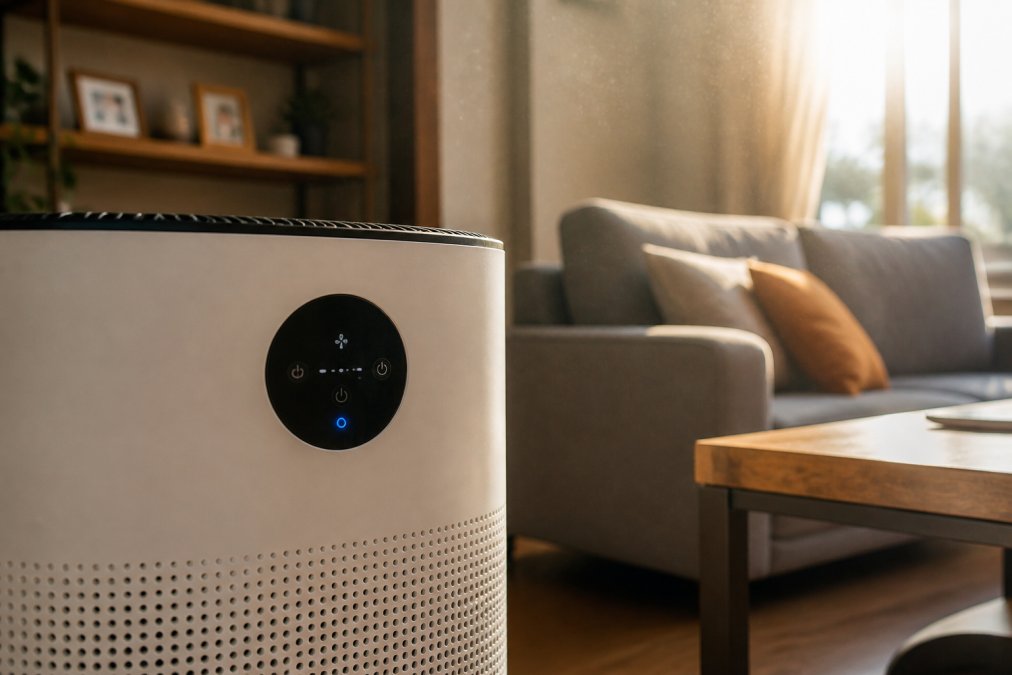
Fan speed is the primary variable controlling energy consumption in air purifiers. Doubling your fan speed increases power draw exponentially because motor efficiency drops at higher speeds. A unit on medium speed might draw 60 watts, but pushing it to maximum could require 150+ watts.
Running at medium speed for extended periods often delivers superior air quality improvements compared to high-speed operation because air passes through filters more slowly, allowing better particle capture. Optimizing fan speed settings can reduce monthly electricity costs by 30-40% without sacrificing air quality.
Factors Influencing Air Purifier Power Usage
Several variables beyond wattage rating affect how much electricity your air purifier actually consumes. Room size, filter condition, and filtration strategy all play measurable roles in determining your true energy costs.
HEPA Filtration and Pressure Drop
HEPA filters capture 99.97% of particles 0.3 microns and larger (the EPA). This performance comes at an energy cost: HEPA filtration creates significant air resistance that forces motors to work harder. A clean HEPA filter has moderate resistance, but as particles accumulate, pressure drop increases steadily. A heavily soiled filter can double the energy required to maintain the same airflow.
Different filter technologies carry different energy penalties. Standard mechanical filters have lower pressure drop than HEPA filters. Activated carbon layers add additional resistance. Choosing the right filtration strategy for your specific pollutants matters: if you’re primarily addressing dust and pet dander, a high-efficiency mechanical filter might serve you well; if you need HEPA-level particle capture plus odor removal, you’ll accept the higher energy cost as a trade-off.
Filter Maintenance and Energy Spikes
Filter maintenance directly impacts energy efficiency. Most manufacturers recommend filter replacement every 6-12 months. A neglected filter creates measurable energy spikes as the motor compensates for increased resistance by working harder, drawing more current without improving air quality.
Regular filter inspection and replacement on schedule maintains consistent energy efficiency and prevents the gradual performance degradation that catches homeowners off guard when electricity costs unexpectedly increase.
Calculating Annual Operating Costs with an Air Purifier Electricity Cost Calculator
Estimating your actual annual operating costs requires three pieces of information: unit wattage, hours of daily operation, and your local electricity rate.
Step-by-Step Cost Calculation
Step 1: Identify your unit’s wattage. Check the specifications on your air purifier or user manual.
Step 2: Determine daily operating hours. Decide how many hours per day you’ll run the unit.
Step 3: Calculate monthly kilowatt-hours. Multiply wattage by daily hours, then by 30 days, then divide by 1,000. Example: 100 watts × 8 hours × 30 days ÷ 1,000 = 24 kilowatt-hours per month.
Step 4: Find your electricity rate. Check your most recent utility bill for the per-kilowatt-hour rate, typically ranging from $0.10 to $0.18 per kilowatt-hour.
Step 5: Calculate monthly and annual costs. Multiply kilowatt-hours by your rate. For the example above: 24 kWh × $0.14 = $3.36 monthly, or roughly $40 annually.
| Operating Scenario | Daily Hours | Monthly kWh | Annual Cost (at $0.14/kWh) |
|---|---|---|---|
| Low-speed 8 hours | 8 | 12 | $20 |
| Medium-speed 12 hours | 12 | 36 | $61 |
| High-speed 24 hours | 24 | 144 | $241 |
| Maximum-speed 24 hours | 24 | 216 | $362 |
Real-World Cost Examples
A household running a 100-watt air purifier on medium speed for 12 hours daily spends roughly $60 annually on electricity. A family with three air purifiers operating on medium speed 12 hours daily would spend approximately $180 annually, while the same setup running 24/7 on high speed would cost closer to $1,000 annually.
Cost of Running Air Purifier 24/7
Continuous operation represents the maximum energy consumption scenario. A 150-watt unit running continuously costs roughly $180-250 annually. Over a five-year period, electricity costs alone reach $900-1,250 for that single unit.
Continuous Operation vs. Intermittent Use
Intermittent operation, running the unit during sleeping hours or when air quality is noticeably poor, reduces electricity costs by 50-75% while often delivering nearly equivalent air quality improvements. A unit running 8-10 hours daily costs $50-80 annually. Continuous operation makes sense for severe air quality problems but represents energy waste for routine maintenance.
Energy Star Certification Benefits
Energy Star certified air purifiers meet strict EPA efficiency standards and consume 10-30% less electricity than non-certified models while delivering equivalent performance (energystar.gov). An Energy Star certified unit rated at 100 watts might deliver the same filtration performance as a non-certified 130-watt model. Over 10 years, that 30-watt difference saves roughly $500.
How to Reduce Air Purifier Energy Usage
Reducing energy consumption doesn’t require sacrificing air quality. Strategic adjustments to operation, maintenance, and equipment selection can meaningfully lower your electricity costs.
Optimizing Fan Speed Settings
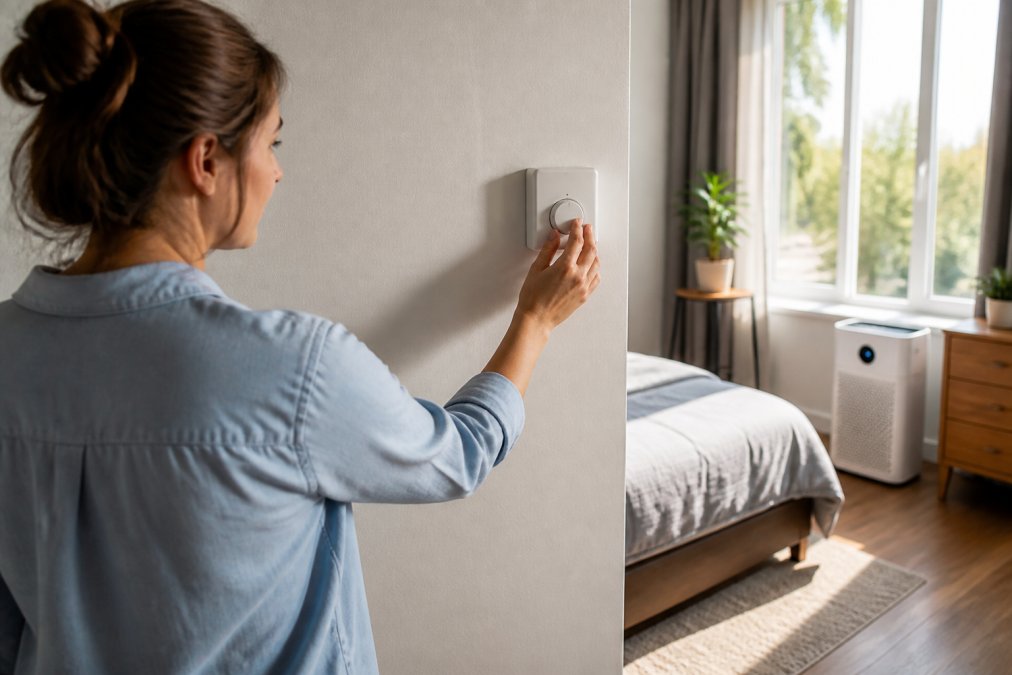
The most immediate way to reduce energy consumption is adjusting fan speed to match actual air quality conditions. Medium speed delivers 70-80% of maximum filtration performance while consuming 50-60% of maximum power. Use high speed only when air quality is severely compromised. Run medium speed during normal daily operation and low speed during sleeping hours.
Smart Home Integration and Automation
Smart air purifiers with automation capabilities optimize energy consumption based on occupancy patterns and air quality sensors. An air purifier with built-in air quality monitoring adjusts fan speed automatically when sensors detect changing pollution levels. Integration with smart home systems enables motion sensors to trigger operation when rooms are occupied and disable operation when empty.
These automation features typically add 15-25% to equipment cost but can reduce electricity consumption by 20-35% through optimized operation patterns. For households running multiple units, the payback period is often 2-3 years.
Life-Cycle Cost Analysis and Long-Term Savings
Evaluating an air purifier’s true cost requires looking beyond the purchase price to include electricity costs, filter replacement expenses, and potential maintenance over the equipment’s lifespan.
Filter Replacement Costs Over Time
Most air purifiers require filter replacement every 6-12 months. Premium filters cost between $40 and $100 per replacement. Over a five-year ownership period, filter costs accumulate significantly. A unit requiring $60 annual filter replacement costs $300 in filter expenses over five years. A household with three units faces $900 in filter expenses alone over that period.
Choosing filters wisely reduces long-term costs. Some manufacturers offer multi-layer filter designs that last longer than single-layer alternatives, reducing replacement frequency.
Environmental Impact Beyond Operating Costs
Air purifier energy consumption contributes to your household’s carbon footprint. A unit consuming 100 watts continuously generates roughly 0.9 metric tons of CO2 annually (the EPA). Over a decade, that’s 9 metric tons of carbon emissions for a single unit.
Choosing energy-efficient models reduces environmental impact proportionally. An Energy Star certified unit consuming 30% less electricity generates 30% lower emissions. Over a five-year lifespan, selecting an efficient model prevents roughly 2 metric tons of CO2 emissions while simultaneously reducing electricity costs.
At Aero Essence LLC, the SR100 is engineered to balance high-performance filtration with efficient operation. Its advanced motor design and optimized airflow architecture deliver superior particle capture while maintaining reasonable energy consumption. For homeowners managing multiple pollutants, dust mites, pet dander, pollen, mold spores, and smoke, the SR100’s visual confirmation of active purification combined with efficient operation makes it a practical choice for long-term air quality management.
Understanding air purifier energy consumption helps you make purchasing decisions aligned with both your air quality needs and your budget. The real cost of ownership extends far beyond the initial equipment purchase, encompassing years of electricity expenses and filter replacements. By optimizing fan speed settings, using smart home automation, and selecting energy-efficient models, you can maintain excellent indoor air quality while controlling operating costs. When choosing an air purifier, evaluate the complete cost picture, wattage, electricity rates, filter expenses, and your actual usage patterns, to identify the solution that delivers the best long-term value for your household.
Frequently Asked Questions
How much does an air purifier add to an electricity bill?
The cost depends on wattage, runtime, and local electricity rates. A typical 50-watt air purifier running 8 hours daily costs roughly $15-25 monthly, or $180-300 annually at average utility rates. Running it 24/7 increases costs to $40-60 per month. Check your electricity bill for your kilowatt-hour rate to calculate precisely using the formula: (Wattage ÷ 1,000) × Hours × Rate = Monthly Cost.
What is the cost of running air purifier 24/7?
Continuous operation multiplies your energy expenses significantly. A 50-watt purifier running around the clock costs approximately $40-60 monthly, depending on regional electricity rates. Higher-wattage models (100+ watts) can reach $80-120 monthly. Most users find intermittent operation, running during peak pollution hours or when home, reduces costs while maintaining air quality. Energy Star certified models consume 40% less power than standard units.
How does HEPA filtration efficiency impact power draw?
HEPA filters create airflow resistance that forces motors to work harder, increasing power consumption. As filters accumulate dust and debris, pressure drop rises, causing energy usage to spike. A clean HEPA filter draws less power than a clogged one, sometimes 20-30% more energy is needed as filters age. Regular maintenance and timely filter replacement keep your air purifier electricity cost stable and prevent unnecessary energy waste from degraded filtration efficiency.
Is it expensive to run an air purifier all day?
Running an air purifier continuously costs more than intermittent use, but it's generally affordable. Most models consume 30-100 watts, comparable to a laptop or desk lamp. At typical electricity rates, daily operation adds $0.50-2 to your bill. The real expense comes from filter replacement every 6-12 months, which can cost $30-100 depending on the model. Smart scheduling, running during high-pollution periods or when home, balances air quality benefits with operational costs.
This article was written using GrandRanker