
How to Use Activated Carbon Filters for Paint Fumes
Quick Summary
Activated carbon filters for paint fumes trap odor molecules and many volatile organic compounds through adsorption as air passes through their porous media. They reduce paint and solvent odors but do not capture overspray or fine solid particles, so they work best as one stage in a ventilated setup with a separate overspray pre-filter.
- Carbon filters capture vapors and odors by adsorption, not by trapping particles.
- Activated carbon does not catch overspray, so a separate pre-filter may be needed.
- Odor reduction alone does not prove that the air is safe to breathe.
- Size the carbon stage using the fan’s CFM at actual duct pressure, not free-air rating.
- Replace filters based on run hours, pressure drop and discharge odor, not room smell alone.
Table of Contents
- How Activated Carbon Filters Trap Paint Odors and VOCs
- What Carbon Filters Can and Cannot Do for Paint Fumes
- How to Use Activated Carbon Filters for Paint Fumes
- Best Activated Carbon Filters for Paint Fumes Compared
- Homemade Activated Carbon Filters for Paint Fumes: Pros, Cons and Limits
- Filter Replacement, Pricing and Yearly Cost of Ownership
- Choosing Your Next Step for a Paint-Safe Workspace
- Frequently Asked Questions
How Activated Carbon Filters Trap Paint Odors and VOCs
Last Updated: November 20, 2026
Activated carbon filters for paint fumes work by adsorption, not filtration. Carbon media is porous, and its large internal surface area binds odor molecules and many volatile organic compounds (VOCs) as air passes through.
A 2014 PubMed-indexed study on carbon scrubbers for odor and VOC control investigated how to improve the efficiency and economy of carbon scrubbers for odors and volatile organic compounds.
Paint fumes are mostly gases and vapors rather than solid particles. That is why carbon behaves differently from a HEPA filter, which traps particles.
What Carbon Filters Can and Cannot Do for Paint Fumes
Carbon filters reduce paint and solvent odors. They do not stop everything in a paint fume cloud. Activated carbon is chemically formulated for specific vapors, so its performance depends on the target compound and the carbon formulation. Air Science’s chemical filtration guide explains that carbon granules can be formulated to capture one or more specific vapors, so a filter’s suitability cannot be assumed for every paint-fume mixture.
Overspray is a separate problem. Spray Booth Shop notes that activated carbon controls odor and VOCs but does not capture overspray, so separate particle or overspray filtration may be needed.
Odor reduction versus health protection
Odor reduction and health protection are not the same goal. A filter that removes the smell of a solvent may still let harmful concentrations pass through. Treat carbon as an odor and vapor control stage, not as proof that the air is safe to breathe during spraying.
For anyone with asthma, COPD or other respiratory conditions, work with a qualified professional and follow the paint manufacturer’s ventilation and respirator guidance. An air purifier or carbon filter alone does not replace those precautions.
How to Use Activated Carbon Filters for Paint Fumes
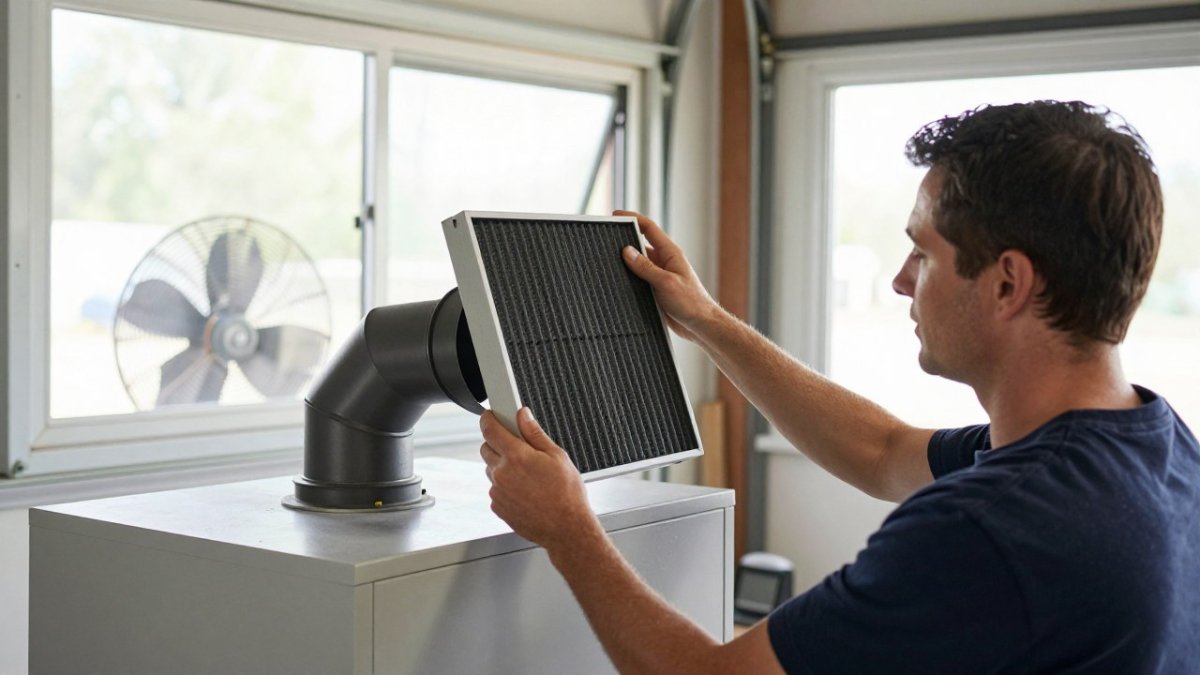
A carbon filter works best as one stage in a larger setup. Place it where the contaminated air is drawn through it, usually in the exhaust path after overspray has been captured.
!Homeowner fitting a pleated carbon filter into an exhaust duct beside an open garage window
Sizing the filter and estimating carbon capacity
Most sizing mistakes come from treating a carbon filter like a box fan: people pick a unit that moves a lot of air and assume more airflow means more odor control. The opposite is often true.
A practical way to size a carbon stage is to work backward from three numbers you can actually measure or look up:
- The airflow through the carbon stage, in cubic feet per minute (CFM). Use the fan’s rated CFM at the actual static pressure of your duct run, not its free-air rating. A fan rated at 400 CFM free-air may move far less once it pushes through a pre-filter, a carbon bed, and ductwork.
- The face area of the carbon bed, in square feet. Face area is the cross-section the air passes through. A larger face area lowers the velocity through the media and buys contact time without forcing you to slow the fan.
- The depth and mass of carbon, in inches and pounds. More carbon mass holds more vapor before breakthrough, but a deeper bed also raises pressure drop and can starve the fan.
If you cannot find a rated contact time from the filter maker, ask for the pressure-drop curve at your target CFM and compare it to your fan’s fan curve.
Carbon capacity is usually expressed as a mass of vapor adsorbed per mass of carbon before breakthrough, and it varies widely with the compound. Because vapor capacity and airflow limits matter just as much when selecting respiratory protection, choosing welding respirators also calls for matching the equipment to the specific exposure.
Watch out: a filter that is oversized for the fan can choke airflow so much that the workspace stops being ventilated at all, which is worse than a smaller filter running at its rated point.
Placement, ventilation and filter sequencing
Use a sequence that handles the largest particles first. A common approach is a pre-filter for overspray, followed by the carbon stage, then exhaust outside the work area.
Airflow direction matters. Air should enter the pre-filter face, pass through the carbon bed in the direction the manufacturer specifies, and discharge outdoors, away from windows, doors, and air intakes.
Commission the system before you rely on it. With the fan running and no spraying, check for air leaks at every joint, confirm the fan is moving air in the intended direction, and verify that discharge is actually leaving the building.
Best Activated Carbon Filters for Paint Fumes Compared
Choosing a filter depends on whether you need odor control alone or odor control plus overspray capture. The table below summarizes the main filter types discussed in the research.
| Filter type | What it removes | Best for | Limitation |
|---|---|---|---|
| Charcoal-coated polyester filter blanket | Overspray and paint/solvent odors | Paint booths needing both | Overspray captured by the blanket; media must be replaced |
| Carbon filter stage in exhaust | Paint-fume odor and VOCs | Adding odor control to existing extraction | Does not capture overspray |
| Standalone HEPA-type purifier | Solid particles | Dust and particulate | Does not remove gaseous vapors |
Homemade Activated Carbon Filters for Paint Fumes: Pros, Cons and Limits
Some people build their own carbon filter boxes using bulk activated carbon granules. This can lower upfront cost, but it has real limits.
- Pros: Lower material cost, and you control the media depth.
- Cons: Harder to get even airflow, harder to verify performance, and easy to leave gaps that let air bypass the carbon.
- Limits: A homemade unit cannot be rated the way a tested commercial filter can, so you cannot confirm how long it will last.
If you go this route, build a sealed housing, use a pre-filter for overspray, and replace the carbon on a fixed schedule.
Filter Replacement, Pricing and Yearly Cost of Ownership
Replacement cost depends on filter size, media type, spray volume and how often you run the system. Pricing depends on quantity, dates, and delivery, so check current prices directly with Aero Essence LLC for an accurate quote.
Why odor is an unreliable replacement signal
Odor is the signal most people use, and it is the one most likely to mislead. Activated carbon can keep adsorbing a compound after you can no longer smell it, and it can also release a previously captured compound as the bed loads and the incoming concentration changes.
Breakthrough is the point at which vapor starts exiting the carbon bed at a meaningful concentration. In practice, breakthrough moves through the bed as a front: the upstream carbon saturates first, and the downstream carbon keeps cleaning the air until the front reaches the exit face.
Measurable replacement criteria
Instead of relying on smell alone, use a combination of checks:
- Run hours against the rated service life. Track hours with a simple timer on the fan circuit. Filter manufacturers often publish a rated life at a stated airflow and concentration; if your concentration or run hours exceed those assumptions, shorten the interval.
- Pressure drop. A rising pressure drop across the carbon stage usually means the pre-filter is loading or the bed is channeling or wet. A sudden drop can mean a bypass or a collapsed bed. Compare readings to the baseline you recorded at commissioning.
- Visual inspection of the pre-filter and carbon face. Loaded pre-filters let more particulate reach the carbon, where it can blind the pores. Replace the pre-filter on its own schedule rather than waiting for the carbon.
- Odor checks at the discharge, not the room. If you can detect solvent odor at the exhaust discharge while spraying, the carbon stage is not keeping up, regardless of what the room smells like.
- Moisture and contamination. Water-based coatings raise humidity in the airstream, and adsorbed water competes with solvent vapors for pore space. A carbon bed that has been exposed to high humidity or liquid water may need replacement earlier than its hour rating suggests.
What drives yearly cost
Yearly cost of ownership is mostly a function of how much carbon you consume, and carbon consumption scales with spray volume, solvent load, and run hours.
Build the estimate from three line items: replacement carbon or filter cartridges, pre-filter media, and fan energy. Pre-filter media is usually the cheapest line item and the one that most directly protects the carbon, so under-buying it is a false economy. Fan energy rises if the filter is undersized and the fan has to work against a high pressure drop.
Watch out: buying a larger carbon filter than your fan can pull through does not extend service life in practice, because the fan stalls, airflow falls, and the workspace ventilation degrades before the carbon is exhausted.
Plan for ongoing replacement rather than treating the filter as a one-time purchase.
Choosing Your Next Step for a Paint-Safe Workspace
Activated carbon filters are a useful odor and vapor control stage for paint and solvent work, but they are not a complete safety system. For a closer look at how carbon removes VOCs, read 7 Facts on Whether Activated Carbon Filters Remove VOCs. For the broader mechanics of how carbon handles odors and gases, see how activated carbon purifiers work.
When you are ready to compare filter types for your setup, review how to choose air purifier filter types. Keep ongoing costs in view by comparing replacement filter prices before you commit.
Frequently Asked Questions
Can activated charcoal be used to remove paint fumes?
Activated charcoal adsorbs many volatile organic compounds, including the solvent vapors that give paint its odor, so it can reduce paint smell in a room or workshop. It does not capture overspray or fine particles, so it works best alongside a particulate filter. Performance depends on the carbon formulation, the vapors involved and how much carbon the filter holds. Carbon filters also saturate over time, which means they need regular replacement once odors start to return. For reliable protection during spraying, pair carbon media with proper ventilation and respiratory protection rated for solvent vapors.
Do activated carbon filters remove VOCs from paint?
Yes, activated carbon is effective at adsorbing many volatile organic compounds released by paints and solvents. The filter traps these vapors in its pores rather than destroying them, so the carbon eventually becomes saturated. How well a specific filter performs depends on the carbon formulation and the target vapors, and a filter suited to one solvent may capture another less efficiently. Users should not assume a single filter removes every paint-related compound at the same rate. Check the manufacturer’s stated vapor applications before purchase.
Is a HEPA filter enough to remove paint fumes?
A HEPA filter captures fine particles such as overspray and dust, but it does not adsorb gaseous vapors. Paint fumes are largely gases, so a HEPA-only setup will leave most solvent odor in the air. Activated carbon handles the vapor side, which is why many spray setups combine a particulate filter with a carbon stage. Using both gives better coverage of overspray and odor than either alone, though neither replaces proper ventilation and breathing protection.
How long does an activated carbon filter last when used for paint fumes?
Service life depends on how much paint and solvent the filter handles, the concentration of vapors, and the carbon capacity of the filter. Heavy spraying saturates carbon far faster than occasional touch-up work. The most reliable signal is odor breakthrough: when paint smell returns through the filter, the carbon is spent. Keep records of projects and check the filter regularly, and replace it sooner if odor returns or airflow drops. Manufacturer guidance on capacity and replacement intervals should be followed for safety.
