
How to Use an Air Purifier to Reduce Dog Smell at Home
Last Updated: November 5, 2026
Quick Summary
Yes, an air purifier can help with dog smell, but it works best combined with source cleaning. A purifier with both HEPA and activated carbon filters captures particles and absorbs odor gases, while air purifier dog smell is reduced most when you also wash bedding and clean accident spots.
- HEPA filters capture hair, dander and dust but do not remove odor gases.
- Activated carbon is needed to address the gases and VOCs behind pet smells.
- Wash the dog bed and blankets weekly in hot water.
- Clean accident spots with an enzymatic cleaner, not just soap.
- Run the purifier continuously on medium-to-high speed for best odor control.
Table of Contents
- How HEPA Filters and Activated Carbon Handle Different Problems
- Find and Remove the Odor Source Before You Filter
- Choosing the Best Air Purifier for Dog Smell
- Does an Air Purifier for Pet Odor Also Help with Pet Hair?
- Urine Odor: Why an Air Purifier Alone Often Falls Short
- Setting Up Your Air Purifier and Setting Realistic Expectations
- Set Up Your Dog-Odor Plan This Week
- Frequently Asked Questions
Yes, an air purifier can help with dog smell, but only part of the job. An air purifier captures airborne particles, which is useful for dog owners who want to reduce air purifier dog smell in the home.
A study published in the Journal of Allergy and Clinical Immunology found that HEPA air cleaners reduced airborne Can f 1, a major dog allergen, in homes with dogs airborne dog allergen study in the Journal of Allergy and Clinical Immunology.
Many people find that a purifier cuts down on the dust and dander that cling to the air. Fewer particles in the air can mean a room feels cleaner, even if the air purifier dog smell is still there.
How HEPA Filters and Activated Carbon Handle Different Problems
A HEPA filter traps physical particles such as hair, dander and dust. Odors are different. They come from gases and volatile organic compounds (VOCs), and a HEPA filter does not remove them on its own.
Activated carbon handles those gases. Industry testing from 2026 confirms that an activated carbon filter is required to address the gases and VOCs behind pet smells 2026 testing on HEPA versus activated carbon for pet odors.
So a purifier for dog smell usually needs both:
- HEPA: captures hair, dander and dust
- Activated carbon: adsorbs odor-causing gases
- Pre-filter: catches large fibers so the other filters last longer
Watch out: a unit with only a HEPA filter will clean the air of particles but leave most odor untouched.
The table below sums up which filter handles which problem, so you can see at a glance what a purifier can and cannot do for dog smell.
| Filter or step | Handles | Limitation |
|---|---|---|
| HEPA | Hair, dander and dust | Does not remove gases or VOCs |
| Activated carbon | Gases and VOCs behind pet smells | Needed alongside HEPA for odor |
| Pre-filter | Large fibers | Protects the other filters |
| Odor source cleaning | Bed, carpet and spot odors | Purifier cannot reach the source |
Find and Remove the Odor Source Before You Filter
A purifier works on air, not on the source. If the smell comes from a dog bed, a carpet or a soiled spot, the source keeps releasing odor back into the room.
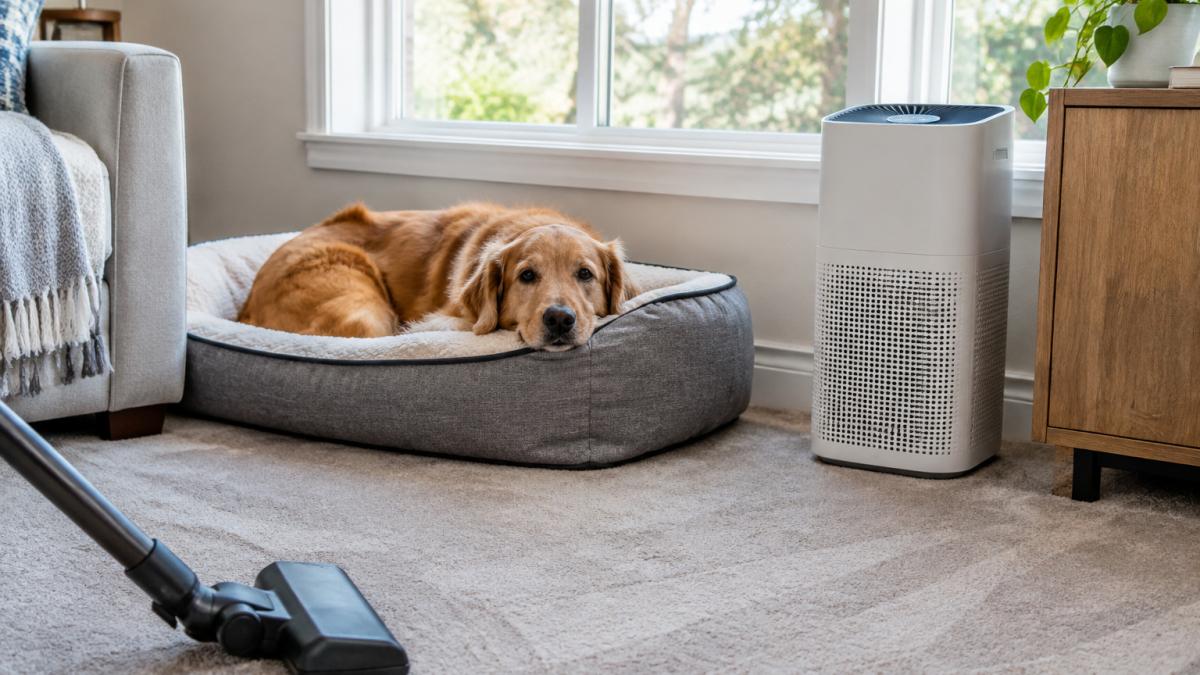
Start with these steps:
- Wash the dog bed and blankets every week in hot water.
- Vacuum carpets and upholstery where the dog sleeps.
- Clean any accident spots with an enzymatic cleaner, not just soap.
- Groom and bathe the dog on a regular schedule.
Once the source is under control, the purifier has much less work to do.
Choosing the Best Air Purifier for Dog Smell
Most buying guides for pet odor stop at “get one with a carbon filter.” That advice is true but incomplete, because two units that both advertise an activated carbon stage can differ enormously in how much odor they can actually adsorb. The specification that matters is not whether carbon is present but how much carbon is there and how the air moves through it.
Read the carbon spec, not the carbon claim
A thin carbon-coated sheet or a light carbon mesh is common in budget units. It can knock down a faint odor for a short time, but its capacity is limited, and once the surface sites are occupied it stops working. A substantial activated-carbon bed, often a refillable canister or a thick honeycomb block, presents far more surface area and lasts longer between replacements. When you compare products, look for:
- Carbon weight or volume, if the manufacturer publishes it. A heavier carbon load generally means more odor capacity.
- Filter depth and construction. A deep, refillable canister or a thick block holds more carbon than a fabric-like sheet.
- Whether the carbon is separate from the HEPA. A dedicated carbon stage can be replaced on its own schedule, which matters because carbon exhausts faster than HEPA in a smelly home.
- Replacement cost and interval for the carbon stage specifically. A cheap unit with a costly, frequently replaced carbon filter can cost more over a year than a pricier unit with a longer-lasting bed.
Watch out: a product page that says “carbon filter” without any weight, depth, or replacement interval is usually a thin layer, and it will not carry a dog-odor load for long.
Match CADR and room size to the space
Clean air delivery rate (CADR) tells you how much filtered air the unit moves, measured separately for smoke, dust, and pollen. For odor, the smoke CADR is the closest proxy because it reflects gas-and-fine-particle movement. A common rule of thumb is to choose a CADR roughly two-thirds of the room’s floor area in square feet for a single air exchange per hour, and to size up if the room is open to a hallway or the dog sleeps there. A unit rated for a small bedroom will not keep up in an open-plan living area, no matter how good its carbon is.
Check the practical details
- True HEPA, not “HEPA-type,” for dander and hair capture.
- A pre-filter you can vacuum or rinse, so the HEPA and carbon stages are not clogged by dog hair.
- Noise at the speed you will actually run it. Odor control usually means running the fan higher than the quiet setting.
- Filter availability. Confirm replacement filters are in stock and reasonably priced before you buy.
Many reviewers note that no purifier removes pet odors entirely on its own. Consumer reports from 2026 advise choosing a well-sized unit with an activated carbon filter to reduce the smell significantly 2026 consumer testing of air purifiers with activated carbon. The SR100 from Aero Essence LLC is built to handle nine kinds of pollutants, including pet dander and smoke, and it shows visually when it is working. Check the product page for the exact filter stages and carbon specification before you buy.
Does an Air Purifier for Pet Odor Also Help with Pet Hair?
Yes, a HEPA filter captures pet hair and dander that float in the air. Pet hair that has already settled on floors and furniture needs vacuuming, though, not filtration.
A purifier and regular cleaning work well together. The purifier handles what is airborne, and your routine handles what has landed.
Urine Odor: Why an Air Purifier Alone Often Falls Short
Urine smell soaks into fabric, carpet pads and subfloors. Those materials keep releasing odor long after the accident. An air purifier can lower the smell in the air, but it cannot reach the material where the urine sank in.
Clean the affected area thoroughly with an enzymatic cleaner first. Then run the purifier to help with what is left in the air. If the smell returns after cleaning, the urine may have reached the subfloor, and a professional cleaner may be needed.
Setting Up Your Air Purifier and Setting Realistic Expectations
Placement and run time decide more of the result than most buyers expect. A well-chosen purifier run badly will underperform a modest unit run well, so treat setup as part of the odor plan rather than an afterthought.
A step-by-step setup for dog owners
- Pick the room where the dog actually spends time. That is usually the living area or the bedroom, not a hallway. If the dog sleeps in your room, put the unit there overnight.
- Give it breathing room. Place the unit on the floor or a low table with several inches of clearance on all sides and nothing blocking the intake or exhaust. Corners and behind furniture choke airflow.
- Aim for air movement across the room. Position the exhaust so filtered air sweeps toward the dog’s bed or the main seating area rather than into a wall.
- Run it continuously on a medium-to-high fan speed during the day, and drop to a lower speed at night if noise is a problem. Odor control depends on air exchanges per hour, so intermittent use on low rarely keeps up.
- Use auto mode only if the sensor responds to odors. Many particle sensors react to dust and smoke but not to gases, so auto mode can idle while odor lingers.
Watch out: sealing the room to “trap” the smell usually backfires, because the source keeps emitting and the concentration builds. Ventilate while you clean, then let the purifier polish the air.
Set realistic expectations and measure results
A purifier works on what is in the air, so it can lower the intensity of a room’s odor without eliminating the source. A common pattern is a noticeable reduction in background smell within hours to a few days of continuous running, with the biggest gains coming after source cleaning.
A simple way to measure without instruments:
- Rate the room on a 1-5 scale at the same time each day, before and after running the purifier.
- Note when the smell spikes, after the dog comes in wet, after a nap on the bed, after vacuuming, to find the source.
- Check the pre-filter and carbon stage on schedule; a loaded carbon filter stops helping and can even release odor.
Plan for filter costs. Replacement filters, especially carbon filters, are an ongoing expense. Check the manufacturer’s guidance for replacement intervals and current pricing. For details on replacement timing, see our guide on how often to replace air purifier filters. To estimate what filters will cost over a year, read our air purifier filter replacement cost guide.
Set Up Your Dog-Odor Plan This Week
Here is a simple plan to start now:
- Wash the dog bed and blankets this week.
- Vacuum carpets and furniture where the dog spends time.
- Clean any accident spots with an enzymatic cleaner.
- Place the purifier in the main room and run it continuously.
- Set a reminder to check and replace filters on schedule.
To learn more about carbon filters and what they can do, read the benefits of activated carbon air purifiers. If you are still choosing a model, our guide to air purifier filter types for 2026 walks through your options.
Frequently Asked Questions
Do air purifiers really get rid of dog smell?
Air purifiers can reduce dog odor, but not eliminate it on their own. HEPA filters capture physical particles like pet dander and hair, but they do not remove odor gases. Odors need an activated carbon filter with enough carbon to adsorb those compounds. Even a well-sized unit with a substantial carbon filter works best alongside regular cleaning, washing bedding, and vacuuming, which remove the sources producing the smell in the first place.
Which type of air purifier filter helps with pet odor?
An activated carbon filter is the component that targets pet odor. HEPA filtration is effective for trapping pet dander, hair, and other airborne particles, which helps with allergy symptoms but not smell. For odor control, look for a unit that combines a HEPA stage with a substantial activated carbon stage. Check the carbon weight, since more carbon generally means more capacity to adsorb odor compounds before it saturates.
Can an air purifier remove dog urine smell?
An air purifier can help reduce airborne odor compounds from urine, but it cannot clean the source. Urine soaks into carpet, subfloors, and upholstery, and that material keeps releasing odor long after the air is filtered. Enzymatic cleaners designed for pet urine break down the compounds at the source. Use the purifier as a supplement once the affected surfaces are treated and the odor source is removed.
Do air purifiers help with pet hair and dander?
Yes. HEPA filters are designed to capture particles such as pet dander, hair fragments, and dust, which are common allergy triggers. Research published in the Journal of Allergy and Clinical Immunology found that HEPA air cleaners reduced airborne dog allergen in homes with dogs. Pet hair itself is larger and settles quickly, so regular vacuuming and grooming still matter. The purifier keeps finer airborne dander from circulating.
Get started with the SR100 from Aero Essence LLC, which handles nine kinds of pollutants and shows you that it is working. Shop now to see the full range.
