
How to Get More From an Air Purifier Beyond Allergies
Quick Summary
Air purifier benefits go beyond allergy relief because a portable unit cleans the air itself, so it reduces airborne dust, pet dander, pollen, mold spores and smoke in any room where those particles are a problem. Its effect is a cleaner breathing zone, not a particle-free home, and it works best alongside source control and ventilation.
- A 2020 PubMed Central study reported HEPA purifiers significantly reduced medication requirements for house-dust-mite allergic rhinitis.
- Compare a unit’s CADR against your room, and convert it to air changes per hour by multiplying CADR by 60 and dividing by room cubic feet.
- Ask for noise at the speed you will actually run, since the lowest setting does little cleaning.
- Standard particle filters do not remove carbon monoxide, radon or most gases, so they need separate solutions.
- Mold, combustion and off-gassing must be addressed at the source, with ventilation, not filtration alone.
Table of Contents
- What Air Purifier Benefits Look Like Beyond Allergies
- Air Purifier for Dust: Capturing Everyday Household Particles
- Pet Dander, Pollen and Mold Spores: Matching Pollutants to Filters
- Air Purifier for Smoke: What Wildfire and Cooking Smoke Require
- How to Choose an Air Purifier for Your Home
- How Long to Run an Air Purifier Each Day
- What Air Purifiers Cannot Remove and Realistic Health Expectations
- Booking Your Aero Essence SR100 Demo and Next Steps
- Frequently Asked Questions
What Air Purifier Benefits Look Like Beyond Allergies
Last Updated: October 31, 2026
Air purifier benefits extend well past allergy relief, and the research supports that more clearly than most product pages admit. A 2020 study published through PubMed Central reported that HEPA air purifiers significantly reduced medication requirements for patients with house-dust-mite-induced allergic rhinitis, which is the allergy-focused result most buyers already know about (Effects of Air Purifiers on Patients with Allergic Rhinitis). The broader case is that a portable unit works on the air itself, so its effects show up in any situation where airborne particles are the problem.
The useful question is not whether a purifier “helps” but which pollutants it removes and what that changes in your home. Dust, pet dander, pollen, mold spores and smoke all travel as airborne particles, and a filter that captures them does not care which one it is catching. To see how that capture works mechanically for pollen, read how air purifiers work for pollen removal. That is why the benefits below are organized by pollutant rather than by symptom.
Air Purifier for Dust: Capturing Everyday Household Particles
Household dust is the pollutant most people encounter daily, and it is the easiest place to see a purifier’s effect. Dust settles on surfaces and gets stirred back into the air by walking, vacuuming and opening doors. A purifier running in the room where you spend the most time pulls those circulating particles out of the breathing zone.
The practical gain is a cleaner indoor environment rather than a dust-free one. Expect fewer particles drifting through the room, not a home that never needs dusting. The EPA guide to air cleaners in the home states that portable air cleaners can reduce indoor air pollution, which is the realistic scope of what a unit delivers.
Pet Dander, Pollen and Mold Spores: Matching Pollutants to Filters
Different pollutants call for different expectations. Pet dander and pollen are relatively large particles that a HEPA filter captures well. Mold spores are also airborne, but a purifier reduces the spores floating in the air without addressing the moisture or growth that produced them. If mold is growing on a wall or in a basement, the purifier is a supplement to fixing the source, not a replacement for it.
Pet owners are often the clearest beneficiaries. A purifier in a bedroom or the room where a pet spends most of its time keeps dander concentrations lower where you breathe while you sleep. The American College of Allergy, Asthma & Immunology guidance on air filtration notes that filtration may provide some relief from airborne allergens, though it is not presented as a guaranteed fix.
Air Purifier for Smoke: What Wildfire and Cooking Smoke Require
Smoke is a harder job than dust. Wildfire smoke and cooking smoke both contain very fine particles, so the filter and the airflow matter more than the unit’s marketing. Keep windows closed during smoke events, run the purifier continuously and choose a model sized for the room. A unit rated for a smaller space will struggle to keep up with smoke that keeps entering the house.
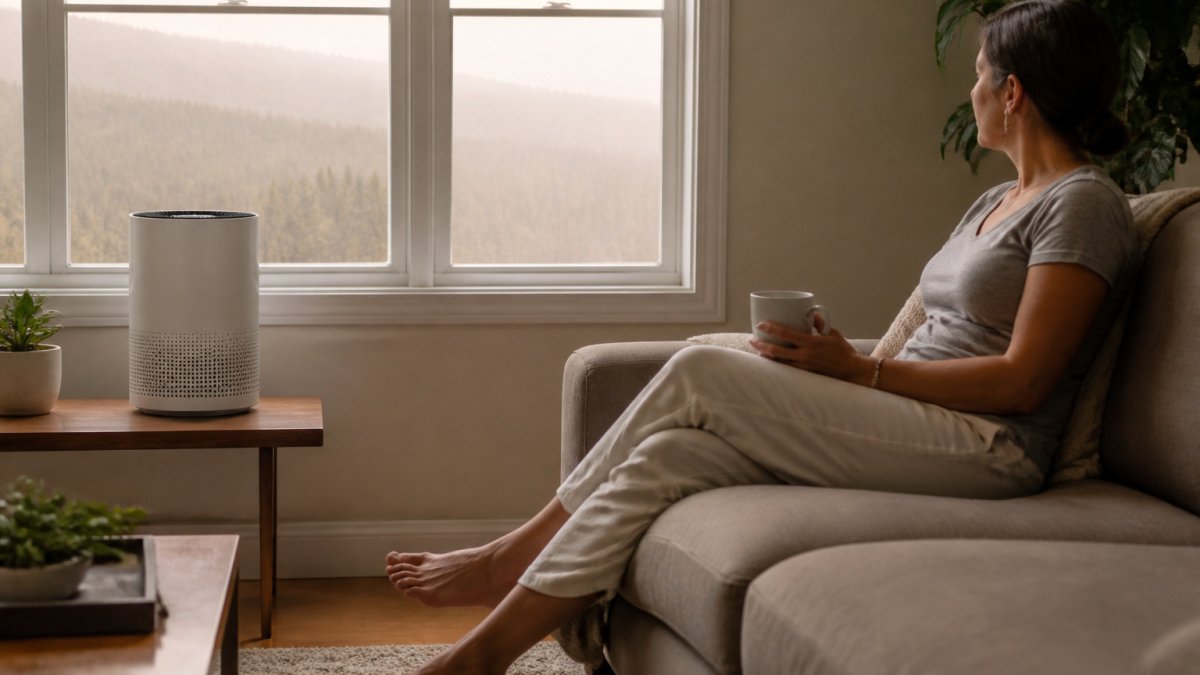
Treat smoke as a situation where a purifier is one layer of protection. It reduces what gets into the breathing zone, but it cannot make a smoky outdoor day clean on its own. To see how long an air purifier takes to clear smoke particles, read the dedicated article.
How to Choose an Air Purifier for Your Home
Most buying guides tell you to “match the unit to the room” and stop there.
Start with CADR, not room size. Clean Air Delivery Rate (CADR) is the volume of filtered air a unit delivers per minute, expressed in cubic feet per minute (cfm) and reported separately for dust, pollen and smoke.
Convert CADR into air changes per hour. Air changes per hour (ACH) is how many times the unit turns over the room’s air volume in an hour.
Treat noise as a performance spec. Manufacturers often quote decibels at the lowest setting, where the unit does little. Ask for the noise level at the speed that produces the CADR you need.
Budget for the filter, not just the unit. Filter replacement is the cost that continues after purchase. Check the recommended replacement interval, the price of a genuine replacement filter, and whether the unit uses a single combined filter or separate pre-filter and HEPA stages.
Match the unit to the pollutant you care about most. A true HEPA filter is the baseline for particles, dust, dander, pollen, mold spores and smoke.
Use a simple checklist before you buy:
- CADR for smoke, dust and pollen, in cfm
- Calculated ACH for your actual room at the speed you will run
- Noise in decibels at that same speed
- Filter type, replacement interval and replacement price
- Wattage at low and high speed
- Whether an activated carbon stage is included, and how much carbon
Price varies with model, capacity and filter type, so check Aero Essence LLC’s website for current pricing or a quote rather than relying on comparisons elsewhere. For a breakdown of what different air purifier price ranges cost before you decide, see the cost guide. For more on the features that matter in a purchase decision, read 7 smart air purifier features for allergy sufferers before you narrow your list.
The article breaks the buying decision into a few measurable numbers, which you can compare across models before you buy.
| Spec | What it measures | How to use it |
|---|---|---|
| CADR | Filtered air delivered per minute, in cfm | Compare against the room you plan to clean |
| ACH | Air changes per hour in your room | Multiply CADR by 60, divide by room cubic feet |
| Noise | Decibels at the speed you will run | Ask for the level at working speed, not the lowest |
| Filter cost | Replacement price and interval | Budget for it; it continues after purchase |
| Wattage | Power draw at low and high speed | Check both speeds for running costs |
| Carbon stage | Activated carbon for odors and gases | Check how much carbon is included |
How Long to Run an Air Purifier Each Day
Running time depends on the pollutant and the room. For ongoing dust and dander, continuous operation at a low setting is the simplest approach, since the air is always being cleaned. During a smoke event or a spike in pollen, a higher fan speed for the affected period clears particles faster. Some units show air quality readouts that help you decide when to step the speed up or down.
Keep the filter maintained no matter how you schedule the unit. A clogged filter moves less air and captures less, so the schedule only works if the filter is clean. Noise is the usual reason people switch units off at night, so a bedroom unit should run comfortably quiet on its sleep setting.
What Air Purifiers Cannot Remove and Realistic Health Expectations
Most articles stop at “a purifier is not a cure.” The more useful framing is pollutant by pollutant: what a particle filter physically cannot capture, and what has to be handled by ventilation or source control instead.
Gases and odors pass through a particle filter. A HEPA filter is a physical mesh that traps particles; gases are molecules far smaller than the gaps between fibers, so they pass straight through.
Carbon monoxide and radon need their own solutions. Carbon monoxide is a combustion product and an immediate health hazard; the response is proper venting, a working CO alarm, and source control, not filtration.
Source control beats filtration for many pollutants. Mold needs moisture control, fixing the leak, drying the basement, running the exhaust fan. Cooking smoke and fumes need a range hood that vents outdoors. VOCs from new furniture and paint need ventilation and time.
Ventilation is the step filtration cannot replace. Opening windows, running exhaust fans and using a mechanical ventilation system exchange indoor air for outdoor air. A purifier recirculates the air already in the room; it does not bring in fresh oxygen or dilute accumulated gases.
Set expectations around particles, not cures. A purifier can lower the concentration of airborne particles in a room, which is a real and measurable effect. It is not a treatment for asthma, COPD or a mold problem, and it does not remove every irritant.
A purifier with an activated carbon stage is not a carbon monoxide or radon safety device. Keep working CO alarms, test for radon, and address combustion and soil-gas sources directly.
A realistic summary of what a purifier does and does not do:
- Captures airborne particles, dust, dander, pollen, mold spores, smoke, when sized and run correctly
- May reduce some odors and gases if an activated carbon stage is present and maintained
- Does not remove carbon monoxide, radon or all VOCs
- Does not fix mold, moisture, combustion or off-gassing at the source
- Does not replace ventilation, alarms, mitigation systems or medical care
Booking Your Aero Essence SR100 Demo and Next Steps
If you want to see how the SR100 handles your home’s pollutants, the next step is to look at the full range on the Aero Essence LLC product page and reach out for a demo. Ask about the filter replacement schedule and the total cost of ownership before you decide, since those costs continue after the purchase.
Frequently Asked Questions
What are the benefits of an air purifier besides helping with allergies?
Air purifiers with HEPA filtration can capture airborne particles such as dust, pet dander, pollen, mold spores and smoke particles, which lowers the amount of these pollutants circulating in a room. Beyond allergy relief, many households use them to reduce visible dust on surfaces, limit the spread of smoke odors and particles during wildfire season, and create a cleaner environment for people with asthma. Results depend on room size, filter quality and how consistently the unit runs. Purifiers reduce particles in the air but do not remove gases or every type of pollutant, so they work best as one part of a broader indoor air quality plan.
Do air purifiers remove mold spores from indoor air?
Air purifiers can capture airborne mold spores, which are particles small enough to be filtered by a HEPA filter. They do not fix the moisture source that allows mold to grow, so visible mold on walls, in basements or around leaks still needs to be cleaned and the water problem corrected. Using a purifier alongside moisture control, such as a dehumidifier kept between 30 and 50 percent relative humidity, gives better results than relying on a purifier alone. For extensive mold growth, consult a qualified professional.
How long should you run an air purifier each day?
Many manufacturers recommend running an air purifier continuously on a low or auto setting, especially in bedrooms and in homes with pets or children. Running it at a higher speed during cooking, cleaning or wildfire smoke events will clear the air faster. Check the specific guidance in your product manual, and remember that filter life shortens when the unit runs for longer periods. Replacement filter costs vary by model, so check current pricing directly with Aero Essence LLC before budgeting for a year of use.
What should you look for in an air purifier for everyday use?
Look for a true HEPA filter, a clean air delivery rate (CADR) that matches your room size, a quiet operating noise level for bedrooms and a filter replacement schedule you can realistically maintain. Consider whether you need activated carbon for odors and gases, and whether the unit gives you visible feedback on how it is performing. Compare total cost of ownership, including filters, over the first year rather than only the purchase price.
