
How Air Purifiers Work for Pollen Removal (2026 Guide)
Table of Contents
- What Pollen Removal Actually Requires
- HEPA Filter Efficiency for Pollen: Why Micron Rating Matters
- Air Purifier Placement for Maximum Pollen Capture
- Best Air Purifier Settings for Allergy Season
- How to Maintain Air Purifier Filters for Consistent Results
- Real-World Airflow Dynamics: Why Your Room Layout Matters
- Conclusion: Matching the Machine to Your Pollen Problem
- Frequently Asked Questions
Last Updated: September 9, 2026
What Pollen Removal Actually Requires
Pollen removal is the process of capturing airborne pollen grains before they reach your respiratory system, and it demands a filtration approach different from what handles dust or pet dander. Most pollen grains range from 10 to 100 microns in diameter, but their irregular shapes and electrostatic properties let them cling to surfaces and stay suspended in airflow for extended periods. A purifier must move enough air through a fine enough filter to intercept these particles continuously.
At Aero Essence LLC, we evaluate purification systems on capture efficiency and air exchange rate, because both determine whether a room actually clears during allergy season. The engineering challenge is balancing filtration density against airflow resistance; a filter that catches everything but strangles airflow cleans nothing. This guide explains the mechanics behind effective pollen removal, the placement strategies that maximize capture, and the maintenance habits that keep performance consistent.
The core insight that changes how you shop: pollen removal is a rate problem, not a one-pass problem. EPA guidance on indoor air quality and particle reduction confirms that continuous air cleaning through the space matters more than the single-pass efficiency of any filter. You need a machine sized to your room that runs consistently, placed where airflow reaches the breathing zone rather than a corner behind furniture.
HEPA Filter Efficiency for Pollen: Why Micron Rating Matters
HEPA filter efficiency for pollen is exceptionally high because true HEPA standards require capturing 99.97% of particles at 0.3 microns, which is the most penetrating particle size (MPPS). Pollen grains are far larger, so they are caught with near-total effectiveness, but the why behind that capture rate is more nuanced than a simple size comparison.
The Physics of Capture: Impaction, Interception, and Diffusion
HEPA media is a randomly arranged mat of sub-micron glass fibers. It captures particles through three primary physical mechanisms, not by acting like a sieve:
- Impaction: This is the dominant mechanism for particles larger than roughly 1 micron. Because of their mass and inertia, larger particles like pollen grains (10-100 microns) cannot follow the airstream as it bends around the filter fibers. They break from the airflow path and slam directly into a fiber, where they stick. This is why pollen is captured with near-100% efficiency on the first pass.
- Interception: Mid-sized particles (roughly 0.1 to 1 micron) follow the airstream but come close enough to a fiber that they make contact and adhere. This mechanism also plays a role in capturing the smaller end of the pollen spectrum.
- Diffusion: This mechanism applies to the smallest particles (below 0.1 microns), where random gas molecule collisions cause them to bounce around and eventually contact a fiber. This is not a significant mechanism for pollen capture.
The 0.3-micron test standard is the worst-case particle size because it is small enough to avoid impaction but large enough to resist diffusion, making it the hardest to catch. Particles larger than 0.3 microns are actually easier to capture due to the impaction mechanism. This means a true HEPA filter’s single-pass efficiency for ragweed pollen (around 15-20 microns) is effectively 100%.
Why Single-Pass Efficiency Isn’t the Whole Story
What most guides miss is that this near-perfect single-pass efficiency means nothing without sufficient airflow passing through the media. A filter that captures 99.97% of particles but processes only a fraction of the room’s air per hour leaves pollen circulating. The real-world metric that matters is the Clean Air Delivery Rate (CADR), which measures the volume of filtered air delivered per minute. Look for a unit whose pollen-specific CADR matches your room’s square footage.
Pollen Particle Size vs. Filter Capture Rate
Pollen particle size varies by plant source, and this has practical implications for filter loading and pre-filter strategy:
- Grass pollen: Typically 20-25 microns (e.g., Bermuda, Timothy).
- Tree pollen: Ranges from 30 to 100 microns (e.g., Oak, Pine, Birch).
- Ragweed pollen: Roughly 15-20 microns, one of the most common and potent allergy triggers.
All of these fall well above the 0.3-micron test standard, meaning true HEPA filters capture them through direct impaction. The practical takeaway: if a purifier uses genuine HEPA media, pollen capture is not the limiting factor, airflow and placement are. However, the larger pollen grains (like pine pollen at 80+ microns) can clog a pre-filter faster, which is why a washable pre-filter protects the HEPA media’s service life.
Check the filter’s published CADR rating for pollen specifically, not just the generic dust rating. A unit with a pollen CADR of 200 or higher will clear a 300-square-foot room noticeably faster than one rated at 100, even if both use identical HEPA media. Also, verify the filter is labeled ‘True HEPA’, terms like ‘HEPA-type’ or ‘HEPA-like’ do not meet the 99.97% standard.
Air Purifier Placement for Maximum Pollen Capture
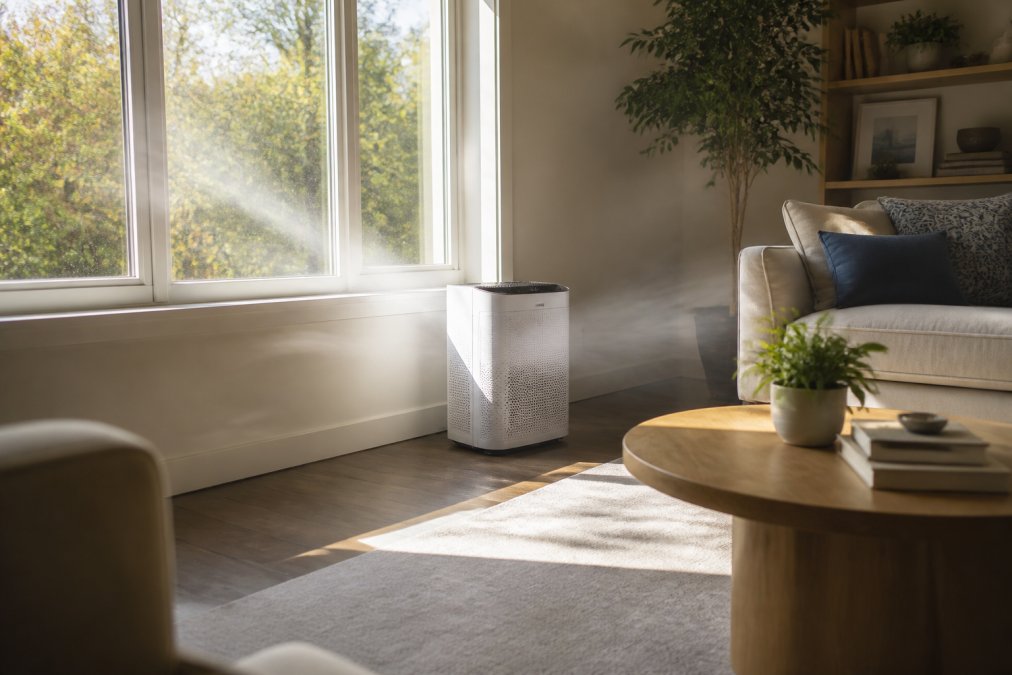
Air purifier placement for maximum pollen capture starts with positioning the unit 3 to 5 feet off the floor, away from walls and corners, with at least 12 inches of clearance on all sides for intake and outflow. Pollen enters through windows, doors, and ventilation, so place the purifier between the dominant air source and the areas where you spend the most time. Central placement outperforms corner placement because it establishes a room-wide circulation pattern.
Room-by-Room Placement Strategy
The single biggest placement mistake is shoving the purifier behind a sofa or in a tight corner to keep it out of sight. This blocks intake, reduces airflow circulation, and cuts effective clean air delivery by a substantial margin. Here is a more precise approach for the two rooms that matter most:
Bedroom (Nighttime Exposure): This is where you spend 6-8 hours continuously, making it the highest-priority room. Place the unit on a nightstand or low dresser, 3-5 feet off the floor, positioned so the outflow is directed toward the head of the bed but not directly at your face (to avoid the sensation of a draft). If the unit has a 360-degree intake, it can sit closer to the wall; if it has a rear intake, it needs the full 12-inch clearance. Keep the bedroom door closed at night to concentrate the purifier’s effect on the space you are occupying.
Living Room (Daytime Exposure): This is typically the largest volume of air you occupy during waking hours. Place the unit near the primary seating area but not behind a large sofa or armchair. The ideal spot is along the wall opposite the main seating zone, with the outflow pointing across the room’s open center. If the room connects to a kitchen or hallway, position the purifier near that opening to help draw air from a larger volume.
Diagnosing Your Room’s Airflow Patterns
Real-world airflow dynamics determine whether a purifier cleans your breathing zone or just recirculates air in an unused corner. Every room has air currents driven by HVAC vents, windows, doors, and temperature differences, and these currents carry pollen along predictable paths. Before committing to a final position, do a simple test: hold a lit incense stick or a piece of tissue near the purifier’s intake and observe how air moves across the room.
Furniture placement disrupts airflow more than most people expect. Tall bookshelves, room dividers, and large sofas create dead zones where pollen settles and stays, and a purifier on the opposite side of the room cannot effectively pull air from behind a partition. ASHRAE guidance on residential air cleaning and ventilation effectiveness notes that room geometry and furniture layout materially affect how well portable air cleaners distribute cleaned air. Keep pathways between the purifier and the room’s main activity areas clear, and consider running a ceiling fan on low to help distribute filtered air without stirring up settled dust.
A purifier placed in the center of a room with clear airflow paths will outperform the same unit tucked into a corner, even if the corner unit is closer to the allergy sufferer. The goal is to create a circulation loop that passes the entire room’s air through the filter multiple times per hour, not to clean a single localized pocket.
Best Air Purifier Settings for Allergy Season
The best air purifier settings for allergy season prioritize continuous operation on a medium-to-high fan speed over short bursts on the maximum setting. Running the unit 24 hours a day at a moderate speed maintains a consistent air exchange rate, which keeps pollen concentrations suppressed rather than allowing them to build between cleaning cycles.
The ‘Max Setting’ Trade-Off: Fan Speed vs. Noise
The max setting trade-off between fan speed and noise is real: maximum airflow captures pollen fastest but generates sound levels that many people find disruptive for sleep or conversation. A common approach is running the purifier on high during the day when you are out of the room, then dropping to a lower speed an hour before bedtime.
Consistency beats intensity for pollen removal. A purifier running 24 hours a day on medium will outperform the same unit running two hours a day on high, because pollen constantly enters through open windows, door traffic, and ventilation.
For allergy sufferers, the trade-off often resolves around the bedroom: run the unit on medium throughout the night and use the high setting during daytime hours when outdoor activity stirs up more pollen. If the noise bothers you, position the purifier farther from the bed and point the outflow away from your head.
How to Maintain Air Purifier Filters for Consistent Results
How to maintain air purifier filters for consistent results comes down to a simple maintenance cycle: vacuum or wipe the pre-filter every two to four weeks and replace the HEPA filter according to the manufacturer’s schedule or when you notice reduced airflow. The pre-filter catches large particles like pet hair and visible dust, protecting the HEPA media from premature clogging. Filter saturation happens faster during pollen season, so check the pre-filter more frequently in spring and summer.
A common mistake is waiting for the filter indicator light before addressing airflow loss, which means you have already been breathing reduced-quality air for days. Monitor the unit’s performance by placing your hand near the outflow vent; if airflow feels noticeably weaker, check the pre-filter first. Replacement frequency depends on usage hours and pollutant load.
Never wash a HEPA filter with water or vacuum it aggressively with a brush attachment. Washing destroys the fiber structure that provides filtration efficiency, and aggressive vacuuming can tear the media. Replace the HEPA element when it reaches the end of its service life rather than trying to extend it.
Real-World Airflow Dynamics: Why Your Room Layout Matters
Real-world airflow dynamics determine whether a purifier cleans your breathing zone or just recirculates air in an unused corner of the room. Every room has air currents driven by HVAC vents, windows, doors, and temperature differences, and these currents carry pollen along predictable paths. Place the purifier where its outflow intersects the room’s natural airflow patterns.
Furniture placement disrupts airflow more than most people expect. Tall bookshelves, room dividers, and large sofas create dead zones where pollen settles and stays, and a purifier on the opposite side of the room cannot effectively pull air from behind a partition. ASHRAE guidance on residential air cleaning and ventilation effectiveness notes that room geometry and furniture layout materially affect how well portable air cleaners distribute cleaned air. Keep pathways between the purifier and the room’s main activity areas clear, and consider running a ceiling fan on low to help distribute filtered air without stirring up settled dust.
Conclusion: Matching the Machine to Your Pollen Problem
Matching the machine to your pollen problem means evaluating your room size, pollen exposure levels, and sensitivity before choosing a purifier, then committing to continuous operation and regular maintenance. The technology behind HEPA filtration is mature and effective for pollen, but the results you experience depend on airflow, placement, and filter care. A purifier that runs consistently in the right location will reduce airborne pollen concentrations and ease the allergic rhinitis symptoms that make spring and summer uncomfortable. American Lung Association recommendations on air cleaners for allergies and asthma emphasizes choosing a unit sized for your room and maintaining it properly for sustained benefit.
For homeowners dealing with seasonal pollen alongside pet dander, mold spores, or smoke, the Aero Essence LLC SR100 addresses nine distinct pollutant types and provides visual confirmation that purification is actively occurring. That confirmation matters when you cannot feel the difference and need assurance the unit is protecting your home. Set it up in your main living space, run it continuously during allergy season, and replace the filter on schedule.
Frequently Asked Questions
Do air purifiers actually help with pollen allergies?
Yes, but only if the unit has a true HEPA filter and is sized correctly for the room. HEPA filters capture 99.97% of particles at 0.3 microns, which includes most pollen grains. For noticeable symptom relief, the purifier needs to cycle the room’s air at least 4 times per hour. Running it continuously during peak pollen times, usually early morning, makes the biggest difference.
How many hours a day should you run an air purifier in your house?
Run it 24/7 for best results. Pollen settles and re-suspends throughout the day, so intermittent use allows particle levels to climb back up between cycles. Modern units are designed for continuous operation, and the energy draw is comparable to a standard light bulb. If noise is a concern, use the lowest fan speed at night and a higher setting when you are away.
Is there a downside to using an air purifier?
The main downsides are filter replacement costs and noise. Filters typically need replacing every 6 to 12 months depending on usage and pollutant load, so factor that into the total cost of ownership. Some units also produce ozone, which can irritate lungs. Finally, a purifier only cleans air that passes through it; it will not remove pollen settled on surfaces.
Why is my room still dusty with an air purifier?
A dusty room usually means the air purifier is undersized for the space, poorly placed, or running on too low a setting. Check that the unit’s CADR rating matches your room’s square footage. Also, ensure the purifier is not tucked behind furniture or curtains, which blocks airflow. Dust on surfaces comes from particles settling, so you still need to dust and vacuum regularly; the purifier only captures what is airborne.
Choosing the right air purifier comes down to matching filtration capability with your specific indoor air quality challenges. The Aero Essence LLC SR100 handles pollen, dust mites, pet dander, mold spores, and smoke while giving you visible proof it is working. Get started with Aero Essence LLC and breathe easier through every allergy season.