
How Long an Air Purifier Takes to Clean Smoke
Table of Contents
- How Long Does It Take an Air Purifier to Clean Smoke Particles?
- Particles vs. Odors: Two Different Timelines
- The Factors That Decide How Fast Your Air Clears
- CADR Rating for Smoke Removal: The Number That Matters Most
- Air Purifier Placement for Maximum Efficiency
- How to Improve Indoor Air Quality After a Smoke Event
- Why Continuous Operation Beats Intermittent Use
- The Saturation Point: When Your Filter Stops Working
- Conclusion
- Frequently Asked Questions
Last Updated: September 13, 2026
How Long Does It Take an Air Purifier to Clean Smoke Particles?
For air purifier smoke removal, visible smoke particles typically clear from a single room in 20 to 60 minutes, depending on room size, the unit’s CADR rating, and how much smoke is present. Odors and surface residue take far longer to resolve. This guide from Aero Essence LLC breaks down the exact variables that decide how long does it take an air purifier to clean smoke particles, so you can set realistic expectations instead of guessing.
The short answer: particle removal is fast, but complete smoke remediation is a two-part problem. Most people assume one pass through a filter solves everything. It doesn’t.
Below, we’ll show you exactly how to calculate your own clearance time, why odor lingers after the haze clears, and the mistakes that quietly double your wait.
Particles vs. Odors: Two Different Timelines
Smoke removal happens in two distinct phases. Particulate matter, the visible haze, is captured by a mechanical filter within minutes to an hour. Odor neutralization is a slower chemical process that can take days.
Smoke contains solid particles and gaseous compounds. A HEPA filter traps the particles. Activated carbon adsorbs the gases that cause smell. These are separate mechanisms with separate speeds.
- Particle reduction: fast, driven by airflow and filter efficiency
- Odor neutralization: slow, driven by the amount of carbon media and dwell time
- Surface residue: slowest, because settled particles keep off-gassing
If your air smells clean but looks hazy, you’re mid-cycle. If it looks clear but still smells, your carbon stage is saturated or undersized.
The Factors That Decide How Fast Your Air Clears
Four variables control your clearance time: room volume, air changes per hour, particle size, and starting pollutant concentration. Change any one and the timeline shifts.
A small bedroom clears fast. An open-concept living space with a kitchen nearby clears slowly, even with the same unit.
Room Size and Air Changes Per Hour
Air changes per hour (ACH) is the number of times a purifier cycles the full room volume in one hour. Higher ACH means faster cleaning. Most manufacturers target four to five ACH for smoke.
To estimate ACH, divide the unit’s airflow in cubic feet per minute by the room’s volume, then multiply by 60. A room with more volume needs more airflow to hit the same ACH.
Smoke Particle Size and Filter Efficiency
Wildfire smoke particles are mostly fine and ultrafine, often under 2.5 microns. That’s the PM2.5 range, and it’s exactly what a HEPA filter is built to capture.
A true HEPA filter captures 99.97% of particles at 0.3 microns (the EPA). Cigarette smoke skews even smaller, so filter quality matters more than fan speed alone.
[EPA guidance on indoor air(/how-to-improve-indoor-air-quality/) and smoke | epa.gov]
CADR Rating for Smoke Removal: The Number That Matters Most
CADR, or Clean Air Delivery Rate, measures how much filtered air a unit delivers per minute. For air purifier smoke performance, the CADR rating for smoke removal is the single most useful spec on the box.
Here’s the practical rule: match the smoke CADR to your room’s square footage, and aim higher than the minimum. A purifier rated for exactly your room size will clear smoke, but slowly.
| Room Size | Recommended Smoke CADR | Typical Clearance Time |
|---|---|---|
| Small bedroom (up to 150 sq ft) | 100-150 | 15-30 minutes |
| Standard bedroom (150-300 sq ft) | 150-250 | 30-45 minutes |
| Living room (300-500 sq ft) | 250-350 | 45-90 minutes |
| Open concept (500+ sq ft) | 350+ | 90+ minutes |
A common mistake is buying on price and ignoring CADR. The cheaper unit runs longer, louder, and still leaves haze.
Air Purifier Placement for Maximum Efficiency
Placement decides whether your purifier works at full capacity or fights itself. Air purifier placement for maximum efficiency means clear intake and output paths, away from walls and corners.
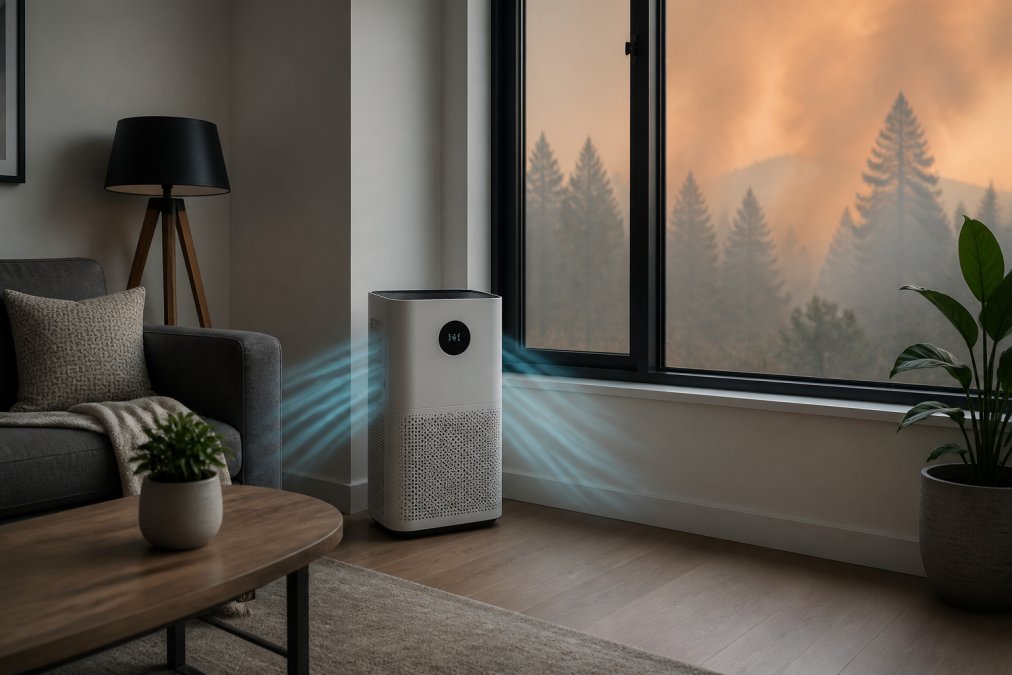
Airflow dynamics in non-ideal rooms matter more than most guides admit. Furniture, curtains, and closed doors create dead zones where smoke lingers.
- Keep the unit at least a few feet from walls
- Avoid corners, which trap exhaust and recirculate stale air
- Don’t block the intake with furniture or drapes
- Run ceiling fans on low to stir stratified air
Placing a purifier in a corner can cut its effective coverage dramatically. The unit keeps running, but the room never fully clears because treated air short-circuits back into the intake.
How to Improve Indoor Air Quality After a Smoke Event
Clearing the air is only half the job. To improve indoor air quality after smoke clears, you also need to address what settled on surfaces.
Settled particles keep releasing odors and fine dust back into the air. A purifier can’t reach them until they’re airborne again.
- Run the purifier continuously for at least 24 hours after visible haze clears
- Wipe hard surfaces with a damp cloth to lift settled particles
- Wash curtains, bedding, and pet bedding that absorbed odor
- Vacuum with a HEPA-equipped vacuum, not a standard one
- Replace or inspect your pre-filter, which catches the bulk of the load
CDC information on wildfire smoke and indoor air
Why Continuous Operation Beats Intermittent Use
Continuous operation clears smoke faster and keeps it clear. Intermittent use lets pollutant concentration rebuild between cycles, so you restart from a higher baseline every time.
Think of it as cumulative clean. Each pass removes a fraction of what remains. Turning the unit off resets your progress.
Real-time monitoring helps here. An air quality sensor shows pollutant concentration dropping in real time, which tells you when to keep running and when the room is genuinely clear.
Run your purifier on a lower fan speed continuously rather than max speed in bursts. Lower speeds are quieter, use less energy, and still deliver steady cumulative cleaning.
The Saturation Point: When Your Filter Stops Working
Every filter has a saturation point, the moment it can no longer hold more contaminants. Past that point, the unit keeps running but stops cleaning. What most guides skip is why smoke pushes a filter toward that point far faster than ordinary household dust, and how that quietly stretches your clearance time long before the filter looks dirty.
Why Smoke Clogs Filters Faster Than Dust
Smoke particles are not just small; they are sticky and plentiful. Combustion produces a mix of solid carbonaceous particles, condensed organic compounds, and oily tars. When these hit a HEPA media, they don’t just sit on the surface the way a lint or dander particle does. They embed into the fiber matrix and, over time, form a thin film that bridges the gaps between fibers.
That film is the problem. A HEPA filter works by forcing air through a dense maze of fibers; particles are trapped by interception, impaction, and diffusion. As smoke residue coats those fibers, the effective pore size shrinks. Airflow drops. The blower has to work harder to push the same volume, and the unit’s real-world CADR, the number that actually determines your clearance time, falls with it.
A common pattern reported by long-time purifier owners: a unit that cleared a room in 30 minutes when new takes 45 to 60 minutes after a heavy smoke season, even though the filter indicator hasn’t tripped yet. The filter isn’t full in the “no more room” sense. It’s loaded, restricted enough to throttle airflow without being visibly clogged.
The Carbon Stage Saturates on a Different Clock
HEPA and activated carbon fail on separate timelines, and conflating them is a frequent mistake.
- HEPA media loads with particulate. Its decline is gradual and shows up as slower particle clearance.
- Activated carbon adsorbs gases and odors. It has a finite number of binding sites, and once they’re occupied, odor breakthrough happens suddenly, the air can smell clean one day and smoky the next with no gradual warning.
Smoke accelerates carbon exhaustion because combustion gases include a wide range of volatile organic compounds (VOCs) that compete for the same adsorption sites. A carbon filter sized for general household odors may be undersized for repeated smoke events. While activated carbon effectively traps these gaseous pollutants, biological agents offer a different mechanism for removing stubborn odors that linger in porous household materials.
Signals That You’ve Hit the Saturation Point
Watch for these, in roughly the order they tend to appear:
- Airflow from the output feels weak compared to when the filter was new
- Clearance times creep upward, the same room takes noticeably longer to clear
- Odors return while the unit is still running, especially the sharp, acrid notes
- The filter looks gray or matte with trapped residue rather than uniformly dusty
- The unit runs hotter or louder as the blower compensates for restriction
Filter lifespan depends on smoke exposure, not just calendar time. A filter rated for 12 months of normal use may need replacement after a single severe wildfire season. Check your pre-filter monthly during smoke events, and treat “clearance times getting longer” as a replacement signal even if the indicator light hasn’t come on.
What This Means for Your Time-to-Clean Number
The honest takeaway: any clearance-time estimate assumes a filter operating near its rated efficiency. As the filter loads, that estimate drifts. If you’re comparing a new unit’s performance to your own experience six months in, you may be measuring a saturated filter, not a weak purifier. Replacing media on schedule, or early after heavy smoke, is often the single fastest way to restore the clearance time you remember.
Conclusion
The honest answer to how long does it take an air purifier to clean smoke particles is: faster than you’d fear for haze, slower than you’d hope for odor. Sizing, CADR, and placement decide the particle timeline. Carbon media and surface cleaning decide the rest.
At Aero Essence LLC, the SR100 is built for exactly this problem. It targets nine kinds of pollutants, including smoke, and provides visual confirmation that purification is actively working, so you’re never guessing whether the unit is doing its job. For households dealing with wildfire smoke, pet dander, or mold spores, that visibility matters.
Get started with Aero Essence LLC and take the guesswork out of your indoor air quality.
Frequently Asked Questions
Do air purifiers clear out smoke?
Yes, air purifiers with HEPA filters capture smoke particles as small as 0.3 microns, including PM2.5 from wildfire and cigarette smoke. A unit with activated carbon also removes odors and VOCs. The key is matching the CADR rating for smoke removal to your room size and running the unit continuously. Most rooms show noticeable particle reduction within 30 to 60 minutes, though odor removal takes longer.
What is the CADR rating and why does it matter for smoke?
CADR (Clean Air Delivery Rate) measures how many cubic feet of filtered air a purifier delivers per minute for smoke, dust, and pollen. Higher CADR means faster smoke particle removal. For smoke, aim for a CADR at least two-thirds of your room’s square footage. A 300-square-foot room needs a smoke CADR of 200 or higher. This rating is the single best predictor of how quickly your air clears.
Does an air purifier remove smoke odors or just particles?
Most purifiers remove particles quickly but leave odors behind unless they have substantial activated carbon. Smoke odor comes from gas-phase VOCs that HEPA filters cannot trap. A thin carbon pre-filter saturates fast and stops neutralizing odors. Look for a unit with a dedicated gas and odor cartridge. Even then, odor neutralization takes longer than particle reduction, often hours after the visible haze is gone.
Is it okay to leave my air purifier on 24/7?
Yes, continuous operation is recommended for smoke-prone areas. Running your purifier nonstop maintains low pollutant concentrations and prevents particles from settling on surfaces. Modern units are designed for 24/7 use with minimal energy draw. The trade-off is faster filter replacement. During wildfire season or heavy smoke events, keep it on the highest fan speed, then drop to a lower setting once air quality sensors show improvement.
This article is for general informational purposes and does not constitute medical advice. Consult a qualified healthcare professional about respiratory concerns.