
How to Choose Pollen Filter Screens That Actually Work?
Last Updated: November 19, 2026
Quick Summary
Choose pollen filter screens by aperture size in microns or millimeters rather than mesh count, since the actual opening determines what gets through. Standard insect screens leave openings 30 to 60 times larger than typical pollen grains, so look for a finer weave and confirm the fit with accurate measurements. Balance filtration against airflow for each room.
- Standard insect screens have openings around 1.0 to 1.2 millimeters, far larger than pollen grains.
- Ask sellers for aperture in microns or millimeters, not just the mesh count.
- Finer mesh filters more pollen but reduces airflow, so match it to each room’s needs.
- Measure the opening at top, middle and bottom, and seal gaps so pollen cannot bypass the mesh.
- Pair window screens with an HVAC filter or air purifier, since screens do not stop indoor-circulated air.
Table of Contents
- Pollen Filter Screens vs. HVAC Air Filters: Know What You’re Buying
- How Mesh Size Compares to Pollen Particle Size
- Pollen Screen Effectiveness: What Test Results Tell You
- Pollen Blocking Window Screen Options: Materials and Trade-Offs
- Pollen Screen Airflow and Daylight: Balancing Protection and Ventilation
- Pollen Screen Installation: Measuring and Sealing to Prevent Bypass
- Booking Your Next Step: Choosing the Right Screen for Your Home
- Frequently Asked Questions
Pollen gets through a window screen more easily than most homeowners expect. A standard fiberglass screen is built to keep insects out, not to stop airborne grains that are a fraction of its opening size. If you want a screen that actually reduces pollen, you need to choose it deliberately. This guide walks through how to choose pollen filter screens that perform, and where their limits are.
The core question is whether a screen will filter the pollen that’s actually drifting into your home. The answer depends on mesh density, material, fit, and how much airflow you need. Pollen screens are the first line of defense, and they work best alongside good indoor habits. Once your screen is in, you can learn how to keep pollen from building up on window screens over the season.
Pollen Filter Screens vs. HVAC Air Filters: Know What You’re Buying
Pollen filter screens are installed in a window or door frame and block outdoor pollen before it enters. HVAC air filters sit inside your ducted system and clean air as it circulates. They solve related but different problems, and buying one when you need the other is a common mistake.
| Option | Where it installs | Main job | Trade-off |
|---|---|---|---|
| Pollen window screen | Window or door frame | Blocks pollen at the opening | Reduces airflow |
| HVAC air filter | Inside the duct system | Cleans recirculated air | Does not stop outdoor pollen at the window |
| Portable air purifier | Freestanding in a room | Cleans room air | Works only where it runs |
Use a window screen when pollen enters through open windows during the season. Use an HVAC filter to clean what your system circulates. Many homes need both. If you are weighing a whole-room unit, our guide on how air purifiers work for pollen removal explains how they compare with screens.
How Mesh Size Compares to Pollen Particle Size
Mesh size is the specification most shoppers fixate on, and it is also the one most often misunderstood. The number printed on a screen label, 18×16, 20×20, 17×14, is a mesh count: the number of openings per linear inch in each direction. It is not the opening size. Two screens with the same mesh count can have different aperture sizes if the wire diameter differs, because thicker wire eats into the opening. For pollen selection, the aperture (the actual clear opening) is what determines whether a grain passes through.
Pollen grains vary widely by plant type, but most fall in a measurable range. Common tree pollens such as oak and birch are typically in the 20-40 micron range. Grass pollens such as timothy and Bermuda are often 20-35 microns. Weed pollens such as ragweed and parthenium tend to be smaller, frequently in the 15-25 micron range. Mold spores, which often peak alongside pollen, can be smaller still. These are approximate ranges, not fixed values, grain size varies by species and by hydration, but they give you a working target.
A standard insect screen with an 18×16 mesh count typically has an aperture around 1.0-1.2 millimeters, or roughly 1,000-1,200 microns. That is 30 to 60 times larger than a typical pollen grain. This is why a standard screen does not stop pollen: the grains are not caught by the mesh at all. They drift through the openings on air currents. A finer pollen screen narrows the aperture, but even the finest practical window mesh does not approach the size of a single pollen grain, and it does not need to. What matters is how the weave, fiber surface, and any electrostatic charge interact with particles carried in an airstream.
This is the key mechanism most buying guides skip. Pollen capture in a window screen is not simple sieving. Particles that small follow airflow around individual wires rather than flying in straight lines, so capture depends on interception, impaction, and electrostatic attraction, not just aperture size. A tighter weave increases the chance a grain touches a fiber. An electrostatic screen adds a charge that pulls grains onto the fiber surface. Both approaches can improve capture without requiring an aperture smaller than the grain.
When you compare products, ask for the aperture in microns or millimeters, not just the mesh count. A screen sold as ’20×20′ with thin wire may have a larger opening than a ’18×16′ screen with thick wire. If the seller cannot state the aperture, treat the mesh count as marketing shorthand rather than a filtration specification. Also ask about weave type: a plain weave has simple over-under intersections, while a twill weave packs more fibers into the same area and can produce a tighter, more uniform opening. Twill weaves are common in fine filtration screens for that reason.
Watch out: a finer aperture is not automatically better for every window. Below a certain aperture, airflow drops sharply and the screen becomes prone to clogging with lint and fine dust, which effectively closes the openings and can reduce performance more than the finer mesh improves it. Match the aperture to the pollen you actually face, ragweed and grass seasons may justify a finer screen than a short tree-pollen season, and accept that no window screen is a HEPA-class barrier. Use the aperture and weave as your selection criteria, and treat the mesh count as a starting point only.
Pollen Screen Effectiveness: What Test Results Tell You
Performance claims for pollen screens range from rigorous to meaningless, and the difference usually comes down to whether the seller can describe a test method. A useful claim tells you what was tested, how it was tested, and under what conditions. A weak claim says ‘allergy friendly’ or ‘blocks pollen’ with no method behind it.
Laboratory studies add another layer.
This is the distinction that matters most when you evaluate claims. Laboratory tests typically use a controlled airstream, a known particle concentration, and a clean screen. Real windows see gusting wind, humidity that can affect electrostatic charge, and gradual clogging from lint, dust, and pollen itself. A screen that captures a high percentage in a lab may capture less in a dirty, humid window frame. Neither result is wrong, they answer different questions. Lab data tells you the design’s potential; field experience tells you what you will actually get.
When you ask a seller for evidence, request four things. First, the test standard or protocol used, by name. Second, the pollen types tested and their approximate sizes. Third, the airflow or pressure-drop measurement, because capture without airflow data is incomplete. Fourth, whether the test was run on a clean screen or an aged one, and whether cleaning was evaluated. A seller who can answer all four is giving you something you can compare. A seller who cannot answer any of them is asking you to trust a label.
Watch out: do not treat a high capture percentage as a complete performance picture. A screen that captures 90 percent of one pollen type in a lab but cuts airflow in half may be a worse choice for a bedroom you rely on for ventilation than a screen with lower capture and better airflow. Weigh capture, airflow, cleanability, and durability together, and ask for the method behind every number.
Pollen Blocking Window Screen Options: Materials and Trade-Offs
Screen material affects both filtration and durability. Fine woven mesh blocks more pollen but restricts more air. Coarser mesh lets air through easily but lets more pollen pass. Electrostatic screens add a charge to capture particles, which can improve filtration without the full airflow cost of denser mesh.
Consider these points when comparing options:
- Fineness: Finer mesh filters more pollen but reduces airflow.
- Material: Stronger materials hold up to cleaning and weather.
- Construction: A sturdy frame keeps the screen seated and sealed.
- Cleanability: Screens that rinse clean keep performing through pollen season.
Many people find that a mid-range mesh balances these factors. Match the choice to the pollen levels where you live.
Pollen Screen Airflow and Daylight: Balancing Protection and Ventilation
The more pollen a screen blocks, the more it can limit airflow and reduce the light coming through. Denser mesh generally keeps out more pollen and fine debris, but it restricts airflow.
Decide what matters most for each room. A bedroom may need maximum filtration during peak season, while a living room may need more daylight and airflow. You can also use a finer screen on windows facing high-pollen areas and a standard screen elsewhere.
Pollen Screen Installation: Measuring and Sealing to Prevent Bypass
A good screen does little if pollen slips around its edges. Measure the window opening carefully, including width and height at top, middle, and bottom, and order a screen sized to fit that opening. Pollen that has already settled indoors can be lifted from soft furnishings with natural cleanup methods for upholstery. Gaps at the sides or top let pollen bypass the mesh entirely.
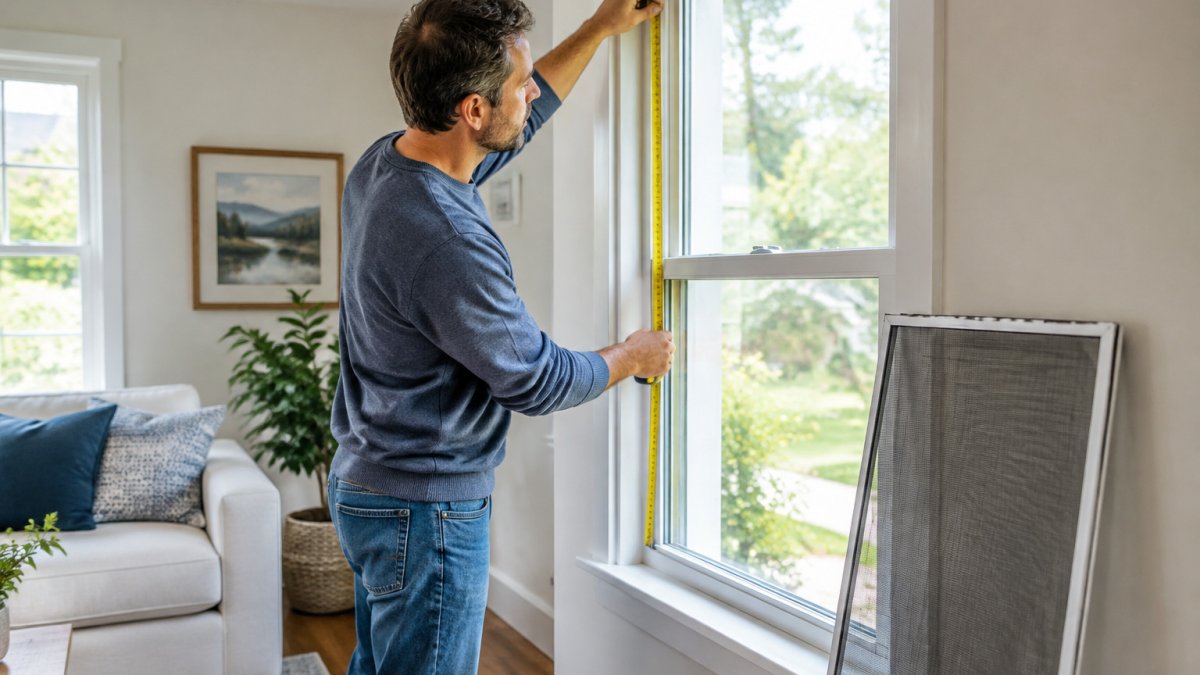
Once installed, check the frame seals. Close any open gaps with weatherstripping or a sealing strip, and confirm the screen sits flush in its track. Re-check the fit after the first few weeks, since frames can shift with temperature changes.
Watch out: a screen that fits loosely will let pollen in around the edges, even if the mesh itself is fine. Take the time to measure twice.
Booking Your Next Step: Choosing the Right Screen for Your Home
Start with the pollen you are trying to block and the rooms it affects most. Choose a mesh that matches that pollen, confirm the fit, and weigh the airflow cost against how much protection you need. If pollen is coming through the whole house, a screen is only one part of the solution. Read our guide on how to improve indoor air quality for a broader plan.
Frequently Asked Questions
Is there a window screen that keeps pollen out?
Standard window screens do little to stop pollen. Typical household window and door screens generally do little to prevent pollen from entering, so a screen only helps if it is designed for pollen. Look for a fine, dense mesh, check whether the product has third-party testing, and confirm the seal around the frame.
Do pollen screens reduce airflow?
Yes, a denser mesh restricts airflow to some degree. Denser mesh generally reduces pollen and fine outdoor debris, but it restricts airflow to some degree. If you need strong airflow, consider a screen that balances filtration with ventilation rather than the finest mesh available.
What mesh size should I look for in a pollen screen?
Mesh size should be read alongside pollen particle size. Finer mesh blocks more pollen but reduces airflow and can dim the view through the window. Because mesh specifications vary by manufacturer, compare the stated opening size and the tested performance rather than relying on a single number. Measured capture results and documented test methods are more useful than a generic claim that a screen ‘blocks pollen.’
How do I measure a window for a replacement pollen screen?
Measure the width and height of the opening at the top, middle and bottom, then use the smallest figure so the screen fits without forcing. Record the frame type and depth, since these affect sizing and sealing. Gaps at the edges let pollen bypass the mesh, so choose a screen with a snug frame and secure fastening. Check whether the manufacturer offers custom sizing for nonstandard openings before ordering.
