
Smart Air Purifier Scheduling for Lower Electric Bills
Quick Summary
Smart air purifier scheduling lowers your electric bill by matching fan speed and runtime to when you actually need clean air, running high speeds only when you are home and active, and dropping to a lower setting or switching off when a room is empty. Start the schedule 30 to 60 minutes before a room is used, and review it after one week.
- Monthly cost equals wattage times daily hours times 30, divided by 1,000, times your rate per kilowatt-hour.
- Fan speed is the biggest lever: higher speeds pull more power and move more air.
- Start the schedule 30 to 60 minutes before a room is typically used.
- Keep the unit on low rather than off during wildfire smoke season.
- Measure real savings with a plug-in energy meter over a week on each pattern.
Table of Contents
- How Much Electricity Does an Air Purifier Use Per Month?
- How Much Does It Cost to Run an Air Purifier 24/7?
- How Fan Speed and Room Size Change Your Power Use
- How Smart Air Purifier Scheduling Lowers Your Bills
- Smart Air Purifier Auto Mode and Energy Use
- When Reducing Runtime Costs You Clean Air
- Setting Up Your SR100 Schedule for Pets, Allergies and Smoke Season
- Frequently Asked Questions
Last Updated: November 7, 2026
Running an air purifier all day feels like the responsible choice, especially with pets, allergies, or wildfire smoke in the air. But the electric bill can creep up quietly.
Consumer Reports has tested more than 150 air purifiers, so there is plenty of hands-on data on how these machines perform (Consumer Reports’ 2026 air purifier roundup). Before you build a schedule, though, you need to know what the machine actually draws. That starts with the monthly electricity math.
How Much Electricity Does an Air Purifier Use Per Month?
An air purifier’s power draw depends on its fan speed and the size of its motor. Your monthly cost is simply the wattage, multiplied by the hours it runs, divided by 1,000 to get kilowatt-hours, then multiplied by your electricity rate.
- Wattage: Check the label on the back or bottom of the unit.
- Runtime: Hours per day times 30 days.
- Rate: Find your price per kilowatt-hour on your utility bill.
Air purifiers are generally light on electricity compared with an air conditioner or dryer. For a step-by-step way to turn your numbers into a dollar figure, see How to Calculate Smart Air Purifier Electricity Rates.
How Much Does It Cost to Run an Air Purifier 24/7?
Running a purifier nonstop adds up over a year. The total depends on the wattage, the fan speed you choose, and your local rate in dollars per kilowatt-hour.
A continuous-run estimate is easy to work out: take the monthly kilowatt-hours, multiply by 12, then multiply by your rate. Your utility’s rate in USD is the number that matters most. To run the math for your own home, follow 5 Steps to Calculate Your Air Purifier’s Annual Electricity Cost.
How Fan Speed and Room Size Change Your Power Use
Fan speed is the biggest lever you control. Higher speeds pull more power and move more air. Environmental Protection Agency says an air cleaner filters less air when set at a lower speed, so energy savings can come with less air filtered (EPA’s Guide to Air Cleaners in the Home).
Room size matters too. A purifier sized for a small bedroom will run harder in a large open-plan space. For more on how room size shapes energy use, read How Room Size Affects Air Purifier Energy Use.
How Smart Air Purifier Scheduling Lowers Your Bills
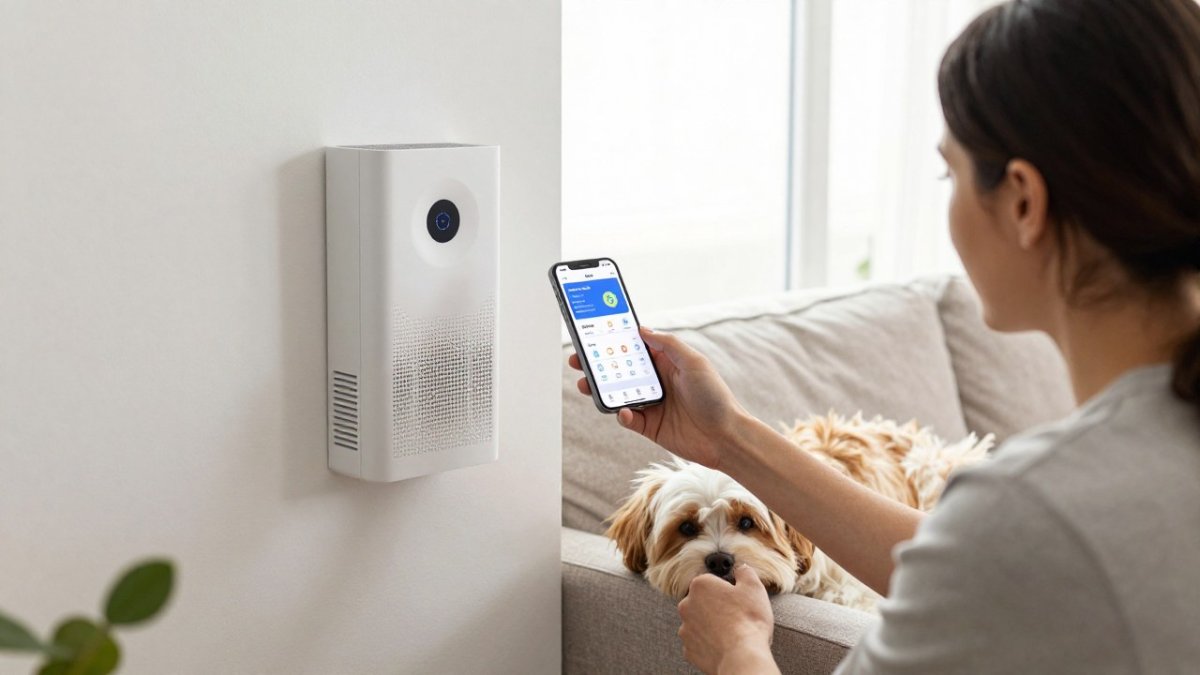
Scheduling works by matching runtime to when you actually need clean air. You can run the unit on higher speed when you are home and active, then drop to a lower setting or switch off when the room is empty. The savings come from two levers: fewer hours at high wattage and lower fan speeds during the hours you do run.
Step-by-Step: Building a Schedule That Fits Your Home
A schedule that actually lowers bills without leaving you with stale air has to account for occupancy, pollution sources, and how quickly the purifier can clean a room after it starts.
- Step 1: Map occupancy and pollution sources by room. Write down when each room is used and what generates particles there. A kitchen produces cooking smoke and grease; a bedroom collects dust mites and pet dander overnight; a home office may see pollen from an open window. Note the hours when windows are open, when pets are most active, and when anyone smokes or vapes indoors.
- Step 2: Match fan speed to the job, not to the clock alone. Higher speeds pull more power and move more air, so reserve them for the hours when pollution is actively generated or when someone with allergies is in the room. For empty rooms, the lowest setting that keeps odor and dust acceptable is usually enough. The U.S. Environmental Protection Agency notes that an air cleaner filters less air at lower speeds, so energy savings can come with less air filtered (EPA’s Guide to Air Cleaners in the Home).
- Step 3: Build in response time before occupancy. A purifier does not clean a room instantly. If you turn it on when you walk in, you breathe the particles that were already there. Start the schedule 30 to 60 minutes before the room is typically used, especially for bedrooms and home offices. That pre-run can be at a moderate speed rather than the highest setting, which keeps wattage lower while still giving the filter time to cycle the air.
- Step 4: Use off periods only when the room is truly empty and the outdoor air is clean. Switching off saves the most energy, but it also lets particles accumulate. On days with wildfire smoke, high pollen, or construction dust outside, an off period can mean the purifier has to run at high speed for longer when it comes back on, erasing the savings. A common pattern is to keep the unit on low rather than off during smoke season.
- Step 5: Review after one week and adjust one variable at a time. Check for dust on surfaces, lingering odors, and allergy symptoms. If air quality is fine, try trimming 30 minutes from a high-speed block or dropping one speed level. If you notice problems, add time before occupancy rather than raising the peak speed, because pre-running at moderate speed is usually cheaper than a short burst at maximum.
Watch out: If you set a schedule and never revisit it, seasonal changes in pollen, wildfire smoke, and occupancy can leave you either over-filtering an empty house or under-filtering during a bad-air week. Recheck the schedule when seasons change and when household routines shift.
Scheduling Across Multiple Purifiers and Rooms
If you run more than one unit, give each room its own schedule and stagger the high-speed blocks so they do not all run at once. A bedroom may need steady overnight running at low speed, while a home office only needs coverage during work hours. A living room might need a high-speed block during cooking and a lower setting in the evening.
The article breaks scheduling into five steps, each with a timing or frequency you can follow.
| Step | What to do | Time or frequency |
|---|---|---|
| 1. Map occupancy and sources | Note when each room is used and what generates particles | Track by room |
| 2. Match fan speed to the job | Reserve high speeds for active pollution or allergy hours | Lowest acceptable speed for empty rooms |
| 3. Build in response time | Start the schedule before the room is used | 30 to 60 minutes before |
| 4. Use off periods carefully | Switch off only when the room is empty and outdoor air is clean | Keep on low during smoke season |
| 5. Review and adjust | Check dust, odors and allergy symptoms, change one variable at a time | After one week |
Smart Air Purifier Auto Mode and Energy Use
Auto mode adjusts fan speed based on the air-quality reading. Keep in mind that auto mode still uses power whenever the unit is on, so pairing it with a sensible schedule gives the best results.
What Triggers Auto Mode
Most smart purifiers use a particulate sensor, typically a laser-based optical sensor, to read airborne particles and adjust fan speed. Some units add a separate gas or volatile organic compound sensor for odors and cooking fumes. When the reading crosses a threshold, the fan ramps up; when the air clears, it steps down. Keeping the sensor clean and its threshold sensible prevents needless fan runtime, and Grace Mechanical Services connects that same attention to everyday energy use with lowering summer electric bills.
Smart-Home Automation and Schedule Reliability
App routines and smart-home integrations add convenience, but they introduce failure points. If the purifier loses Wi-Fi, a cloud-based schedule may not run at all, and the unit may default to whatever speed it was last set to. A power outage can reset the schedule or leave the unit off when power returns.
Watch out: Before you rely on a cloud schedule, test what happens when you unplug the router for a few minutes. If the purifier keeps running its last setting, you have a fallback.
Measuring Real-World Savings
Generic estimates are a starting point, but the only way to know what your schedule saves is to measure it. A plug-in energy meter, available at most hardware stores, sits between the outlet and the purifier and logs kilowatt-hours over time.
Pairing auto mode with a schedule works best when you treat the schedule as the floor and auto mode as the ceiling: the schedule keeps the unit from running at high speed in an empty room, while auto mode lets it respond when smoke or pollen actually appears.
When Reducing Runtime Costs You Clean Air
Cutting runtime saves money, but it has a trade-off. Continuous operation can give more consistent air quality, while potentially increasing electricity costs. (Rabbit Air’s guide on air purifier electricity use).
The right answer depends on your situation. If someone in the home has asthma, COPD, or severe allergies, you may want continuous filtration at a modest speed rather than long off periods. Wildfire smoke season is another time to avoid cutting runtime.
Setting Up Your SR100 Schedule for Pets, Allergies and Smoke Season
The SR100 is built to handle dust mites, pet dander, pollen, mold spores, and smoke. For a homes-with-pets setup, run higher speeds during the day when pets are active and shed more dander.
For guidance on which approaches suit pets, allergies, and smoke, see Air Purifiers for Pet Allergies and Smoke: What Works.
Ready to stop guessing about your electric bill? The SR100 from Aero Essence LLC helps you keep the air clean with app-based scheduling and a clear view of how it is working.
Frequently Asked Questions
How much electricity does an air purifier use per month?
Energy use depends on the model, fan speed and runtime, and the figures for specific models should be checked against their rated wattage on the label or product page. As a practical method, multiply the purifier’s average wattage by the hours it runs each day, divide by 1,000 to get kilowatt-hours, multiply by 30 days, then multiply by your electricity rate in dollars per kilowatt-hour. Your utility bill lists your rate. Running a unit on a lower fan speed for part of the day usually reduces the monthly total, but less airflow means less air filtered.
How much does it cost to run an air purifier 24/7?
Running a purifier around the clock costs the same formula as any appliance: wattage times 24 hours, divided by 1,000, times your rate in dollars per kilowatt-hour, for one day. Multiply that by 30 for a monthly estimate. Your cost will vary with the purifier’s power draw at its chosen speed and with your local electric rate, which you can read on your utility bill. Scheduling or lowering speed during unoccupied hours can reduce this figure, but confirm that the air quality you need is still maintained.
Can scheduling a smart air purifier lower energy costs?
Scheduling can lower energy costs because the purifier draws power only during the hours you set. The savings depend on how much runtime you cut and how the fan speed is set, and no figure is guaranteed. An air cleaner generally filters less air at a lower speed, so energy savings can come with less air filtered. Balance the schedule against the air quality needs of your household, especially if someone has asthma or allergies.
Should an air purifier run all day or only when someone is home?
The answer depends on your air quality needs. Continuous operation can give more consistent air quality, while running only when people are home lowers electricity use. Some people prefer continuous operation for consistent air quality, though it may result in higher energy bills. A common approach is to run the purifier continuously in bedrooms or rooms where people with allergies or asthma spend the most time, and use a schedule elsewhere.
