
How to Choose a Medical Air Purifier for Waiting Rooms
Last Updated: November 22, 2026
Quick Summary
To choose a medical air purifier for a healthcare waiting room, match its clean-air delivery rate to your room’s volume rather than its square footage. Calculate room volume, target 4 to 6 air changes per hour, and confirm the unit’s smoke CADR meets the required figure. Then check the filter grade, noise level and replacement costs.
- Calculate room volume by multiplying length, width and ceiling height, not floor area alone.
- Aim for at least 4 to 6 air changes per hour during occupied hours.
- Required CADR equals room volume times target ACH, divided by 60.
- Add roughly 10 to 20 percent to the required CADR as a buffer for peak occupancy.
- Portable purifiers work best as an addition to building ventilation, not a replacement.
Table of Contents
- Why Waiting Rooms Need More Than Standard Air Filtration
- What Filtration Standards Matter: HEPA, H13 and H14 Explained
- How to Size a Medical Air Purifier for Your Waiting Room
- Placement, Airflow and HVAC Integration
- Best Medical Air Purifier for Healthcare Waiting Rooms: What to Compare
- Medical Air Purifier Cost: Upfront Price and Total Cost of Ownership
- Evaluating Medical Air Purifier Reviews and Performance Claims
- Choosing Your Waiting Room Air Purifier: Next Steps with Aero Essence LLC
- Frequently Asked Questions
Waiting rooms are where sick and healthy patients share the same air for long stretches, which makes medical air purifier for healthcare waiting rooms selection a practical decision, not a formality. Start with our guide to medical-grade purification for viruses and how it differs from standard home units.
The sections below explain how to judge any unit against your room, not just against a brochure.
Why Waiting Rooms Need More Than Standard Air Filtration
A waiting room concentrates people who are coughing, sneezing or simply anxious, all within a closed space with limited air exchange. Standard home filters are designed for light household dust, so they are rarely matched to that load.
Manufacturer guidance on hospitals and clinics notes that critical areas usually call for filters with MERV ratings of 14 or higher, with MERV 8A or 9A prefilters recommended ahead of them (Camfil guidance on air filters in hospitals and clinics).
What Filtration Standards Matter: HEPA, H13 and H14 Explained
HEPA filters are the reference point for particle removal, and H13 and H14 are higher efficiency grades within that family. Our HEPA filter vs activated carbon comparison for large rooms explains how each performs in spaces of this size.
Portable units are not a substitute for building ventilation. Researchers who studied air purifiers alongside hospital heating, ventilation and air-conditioning systems reported that the combination may reduce microbial load (2022 Journal of Hospital Infection study on air purifiers in intensive care units).
How to Size a Medical Air Purifier for Your Waiting Room
Sizing is where most waiting-room purifier purchases go wrong, because buyers match a unit to square footage on the box instead of to the air the room actually contains and the number of people breathing it. The method below turns a brochure claim into a check you can run in about ten minutes with a tape measure and a calculator.
Step 1: Calculate room volume, not floor area
Measure the length, width and ceiling height of the waiting area and multiply them. A room that is 20 feet by 30 feet with a 9-foot ceiling holds 5,400 cubic feet. Do this for each connected space, a separate consultation alcove or a vestibule open to the waiting area adds volume that the unit has to serve.
Step 2: Set a target for air changes per hour
Air changes per hour (ACH) is how many times the unit moves a volume of air equal to the room through its filter in one hour. There is no single mandated number for a waiting room, but a common pattern in clinical settings is to aim for at least 4 to 6 ACH from portable filtration during occupied hours, with higher targets where the room is crowded or serves patients with respiratory symptoms.
Step 3: Convert the target into a required CADR
The clean-air delivery rate (CADR) a unit must deliver is:
Required CADR (cubic feet per minute) = (Room volume in cubic feet × Target ACH) ÷ 60
For the 5,400-cubic-foot room at 5 ACH, that is (5,400 × 5) ÷ 60 = 450 CFM. Compare that figure with the unit’s rated smoke CADR, which is the most demanding of the three standard CADR figures (smoke, dust and pollen) and the one to use for healthcare spaces. A unit rated at 450 CFM smoke CADR or higher is the minimum match; a unit rated well below it will not hit the target no matter where you place it.
Step 4: Adjust for occupancy and peak load
CADR ratings are measured under test conditions, not in a room full of people. Each seated patient adds exhaled particles and body heat that change airflow patterns, and a full waiting room at 9 a.m. is a different load from an empty one at 4 p.m. A practical adjustment is to size for peak occupancy rather than average: count the seats, assume every one is filled during your busiest hour, and add roughly 10 to 20 percent to the required CADR as a buffer.
Step 5: Decide between one large unit and several smaller ones
A single unit rated for the whole volume is the simplest choice, but it only cleans the air that reaches its intake. In a long or L-shaped waiting room, two smaller units placed at opposite ends usually distribute clean air more evenly than one large unit in a corner.
Watch out: manufacturers sometimes quote coverage in square feet based on a single air change per hour, which is far below what an occupied waiting room needs. A suitable CADR is only part of the decision, since the chemical-free air purification rules also shape which technologies make sense for an occupied waiting room.
Once you have the required CADR, carry that number into the comparison section below so every unit is judged against the same benchmark rather than against its own marketing.
Required CADR for a 5,400 cu ft waiting room at 5 ACH
Placement, Airflow and HVAC Integration
Run it continuously during opening hours rather than only when the room looks busy, since airborne particles build up between patients.
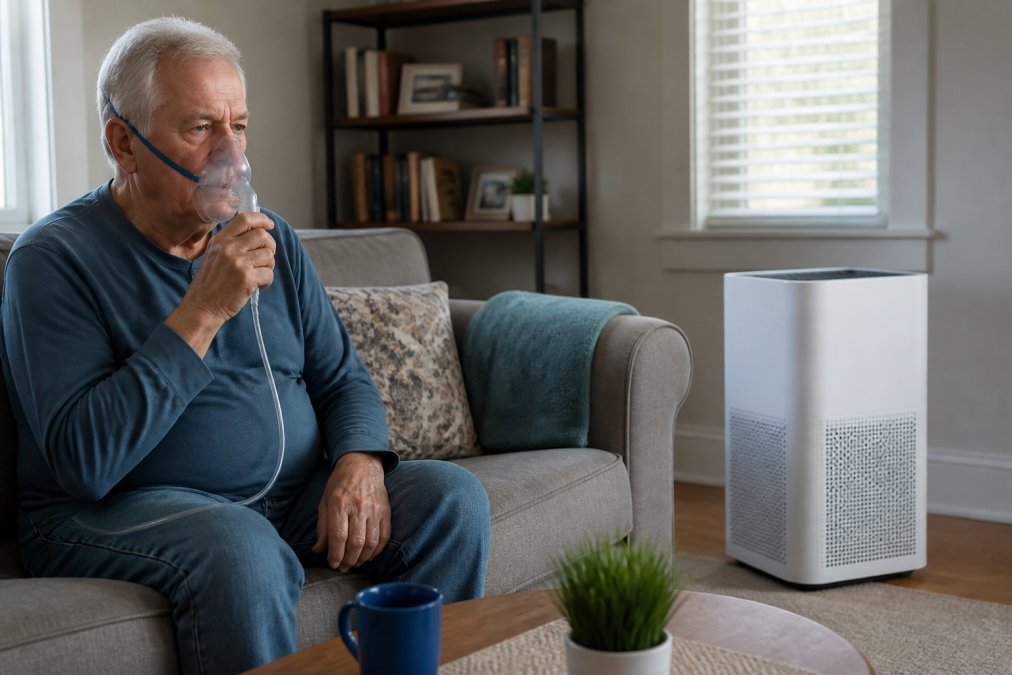
Where you place a unit and how it works alongside the building’s ventilation both affect how well it cleans the air, as summarised below.
| Factor | Recommended practice | Why it matters |
|---|---|---|
| Placement | Away from entrance and reception desk | Captures air before it reaches seated patients |
| Intake | Clear of furniture and walls | Keeps airflow path unobstructed |
| Supply vents | Avoid direct airstream | Prevents short-circuiting of airflow |
| Operation | Run continuously during opening hours | Airborne particles build up between patients |
| HVAC role | Addition to building system | Works best alongside existing ventilation |
Best Medical Air Purifier for Healthcare Waiting Rooms: What to Compare
Compare units on the same short list of criteria: filter grade, rated coverage for your square footage, noise level at the setting you will actually run, filter replacement cost and warranty. A unit that is quiet on low but noisy on high may be a poor fit for a room where patients are trying to rest.
Confirm the filter grade and coverage of any unit against your room using the sizing steps above before deciding.
Medical Air Purifier Cost: Upfront Price and Total Cost of Ownership
Pricing depends on the model, quantity, filter configuration and delivery. Please check the current price on the Aero Essence LLC website or request a quote for your specific room.
When you compare quotes, include the cost of replacement filters over a full year, the energy the unit draws at its normal setting and any prefilter replacement, since these recurring costs usually outweigh the purchase price over time. For a more detailed look at energy use, see our article on how room size affects air purifier energy use, and review the air purifier energy consumption cost analysis for a breakdown of running costs.
Evaluating Medical Air Purifier Reviews and Performance Claims
The phrase “medical grade” is a marketing term, not a regulated certification, so a unit that carries it is not automatically better than one that does not. What separates a defensible claim from a label is whether it can be traced to a named standard, a tested figure and the conditions under which that figure was measured. The checklist below lets you compare units on evidence rather than adjectives.
HEPA classifications: what H13 and H14 actually mean
HEPA is a performance class, not a brand. Under the widely used European filter standard EN 1822, an H13 filter removes at least 99.95 percent of particles at the most penetrating particle size, and an H14 filter removes at least 99.995 percent. In the United States, filters are often described against the IEST-RP-CC001 standard or simply as “HEPA” meaning 99.97 percent at 0.3 microns.
CADR versus ACH: two numbers, two jobs
CADR tells you how much clean air the unit delivers per minute, and it is the number you compare against your sizing calculation. ACH tells you how many times that clean air equals the room’s volume in an hour, and it is the number that tells you whether the result is adequate for occupancy. A high CADR in a large room can still produce a low ACH, so always convert one to the other using the room volume rather than trusting either figure alone.
Reading a review without being misled
Reader reviews are useful for noise, build quality and filter availability, things a spec sheet cannot tell you. They are weak evidence for filtration performance, because a reviewer cannot see particles and has no baseline to compare against. When you read reviews, look for comments about the setting the reviewer actually uses, how often they replace filters and whether the unit stayed quiet enough for a waiting room.
What independent evidence does and does not show
Independent studies of portable purifiers in real clinical settings have produced mixed results. A study from the United Kingdom reported that portable air purifiers did not prevent respiratory infections among nursing-home residents, which is a reminder that purification supports good practice rather than replacing it (CIDRAP report on air purifiers in nursing homes(https://www.cidrap.umn.edu/covid-19/can-air-purifiers-prevent-flu-and-covid-19-nursing-homes-only-if-they-re-used-properly)). Researchers who studied air purifiers alongside hospital heating, ventilation and air-conditioning systems reported that the combination may reduce microbial load (2022 Journal of Hospital Infection study on air purifiers in intensive care units).
A five-line claim audit
Before you accept any performance claim, confirm that the listing states: the filter grade and the standard it was tested to; the CADR for smoke, dust and pollen, ideally AHAM-certified; the room volume or ACH the CADR is based on; the noise level in decibels at each fan speed; and the filter replacement interval and cost.
For reader reviews of Aero Essence LLC products, see the Aero Essence LLC reviews page and weigh them alongside the specifications using the audit above.
Choosing Your Waiting Room Air Purifier: Next Steps with Aero Essence LLC
Measure your room, decide on the filter grade you need, check the coverage against your volume and confirm the running cost before you buy. If you are considering the SR100 or want help matching a unit to your waiting room, visit Aero Essence LLC to see the product details and current pricing.
Frequently Asked Questions
What kind of air purifier do hospitals use?
Hospitals typically rely on HEPA-based filtration, often with H13 or H14 filters for critical areas, combined with existing HVAC systems. Portable medical-grade units are often added to supplement central systems. For a waiting room, the same filtration principles apply, though the specific equipment should be chosen based on room size and occupancy.
What is the best air purifier for a healthcare waiting room?
The best choice depends on room size, occupancy, and how the space is ventilated. Look for a unit with a true HEPA filter, a clean-air delivery rate matched to the room, and independently verifiable performance data. Compare specifications side by side rather than relying on a single brand claim.
What features should a medical air purifier have for a waiting room?
Prioritize a sealed HEPA filtration stage, quiet operation so it does not disrupt conversation, continuous-run capability, and clear filter-change indicators. Visual confirmation of performance, such as an air-quality display, helps staff and visitors confirm the unit is running. Check the sound rating in decibels and confirm the filter replacement schedule and its cost before purchase.
How large an air purifier do I need for a waiting room?
Start with the room’s square footage and ceiling height to calculate its volume. Then check the unit’s clean-air delivery rate and aim for enough capacity to achieve several air changes per hour in that volume. Crowded waiting rooms with high occupancy typically need a higher rate than quiet spaces. Portable units should be placed where airflow reaches the seating area, and multiple units may be needed in open layouts.
