
Can HEPA Filters Reduce Snoring From Allergies?
Last Updated: November 14, 2026
Quick Summary
HEPA filters can reduce snoring from allergies by capturing airborne particles that inflame nasal passages overnight, but only when allergies are the actual cause. Filtration cleans the air and does not treat the nose directly, so it works as one part of allergy management rather than a snoring cure.
- HEPA filters can remove up to 99.97% of airborne particles 0.3 microns in size, covering most bedroom triggers.
- Track snoring and congestion for two weeks; if they rise and fall together, allergens are likely involved.
- Place the purifier between the bed and the door where air moves, and keep the bedroom door closed.
- Wash bedding weekly in hot water and encase mattresses and pillows in allergen-proof covers.
- See a doctor for gasping, choking, or pauses in breathing, which point to sleep apnea.
Table of Contents
- Can HEPA Filters Reduce Snoring From Allergies?
- How Airborne Allergens Cause Nasal Congestion and Snoring
- Do Air Purifiers Help With Allergies and Asthma?
- How Fast Can HEPA Filters Reduce Snoring From Allergies?
- How to Stop Snoring Caused by Allergies
- Best Air Purifier for Allergies and Asthma: What to Look For
- Limits of HEPA Filtration and When to See a Doctor
- Choosing the Right Air Purifier for Your Bedroom
- Frequently Asked Questions
Can HEPA Filters Reduce Snoring From Allergies?
Can HEPA filters reduce snoring from allergies? The honest answer is that they can help, but only when allergies are the actual cause. HEPA filters can reduce snoring from allergies by capturing airborne particles that inflame nasal passages overnight, and that distinction matters more than any marketing claim.
That gap tells you something important. Filtration cleans the air; it does not treat the nose directly.
Below, we break down what the evidence supports, how to set up a bedroom that actually helps, and how to tell whether your snoring is allergy-driven at all.
What the Evidence Actually Shows
HEPA filtration is generally regarded as one part of allergy management, not a snoring cure.
The Allergy & Asthma Network’s review of HEPA filter claims is blunt about this. Air filtration is one of several measures that may help people with allergies and asthma, and its benefits should not be treated as guaranteed.
For the broader evidence on sleep apnea and snoring, see our breakdown of whether air purifiers help with snoring and sleep apnea.
How Airborne Allergens Cause Nasal Congestion and Snoring
Airborne allergens can contribute to snoring when particles land in the nose, the immune system responds, and nasal passages swell.
The main culprits in a bedroom are:
- Dust mites, which live in bedding, pillows, and mattresses
- Pet dander, which sticks to fabric and floats when you move
- Pollen, which rides in on clothing and through open windows
- Mold spores, which thrive in humid rooms and bathrooms
When these particles trigger allergic rhinitis, the lining of the nose inflames and mucus production rises. A stuffy nose forces mouth breathing, and mouth breathing produces the harsh, vibrating snore most people recognize. The American College of Allergy, Asthma & Immunology guidance on air filters notes that HEPA filters can remove up to 99.97% of airborne particles 0.3 microns in size, which covers most of these triggers.
Distinguishing Allergy-Related Snoring From Other Causes
Allergy-related snoring has tells. It tends to be seasonal or tied to a specific room, it comes with congestion, itchy eyes, or sneezing, and it improves when you sleep somewhere cleaner.
Snoring from other causes looks different:
- Obstructive sleep apnea produces gasping, choking, or pauses in breathing. This needs medical evaluation, not a purifier.
- Structural causes like a deviated septum or large tonsils snore consistently, regardless of air quality.
- Positional snoring happens mainly on your back and resolves when you roll over.
A simple test: track your snoring for two weeks alongside your congestion. If they rise and fall together, allergens are likely involved. If snoring is constant while your nose is clear, look elsewhere.
Do Air Purifiers Help With Allergies and Asthma?
Air purifiers help with allergies and asthma by lowering airborne allergen exposure, which reduces the total load your immune system reacts to. They do not replace medication, and they cannot remove allergens from surfaces. Because airborne allergens are only part of the picture, Air Secure Co can help you consider how filtration fits alongside other steps for reducing allergy exposure.
The Allergy & Asthma Network frames filtration as one of several measures rather than a standalone treatment. That matches what we see: purifiers work best alongside source control, ventilation, and medical care.
If nighttime asthma is your concern, our guide to the best air purifier for nighttime asthma symptoms covers the specific criteria that matter.
How Fast Can HEPA Filters Reduce Snoring From Allergies?
Measure it rather than guess. Rate your congestion and snoring on a simple one-to-five scale each morning, and compare a week before the purifier with two weeks after. If nothing moves in three weeks, allergens probably are not your main trigger.
How to Stop Snoring Caused by Allergies
How to stop snoring caused by allergies comes down to reducing allergen exposure at the source and in the air. Filtration handles the airborne portion; the rest is bedding, humidity, and cleaning habits.
Start with the bedroom, since that is where you spend the most consecutive hours breathing the same air.
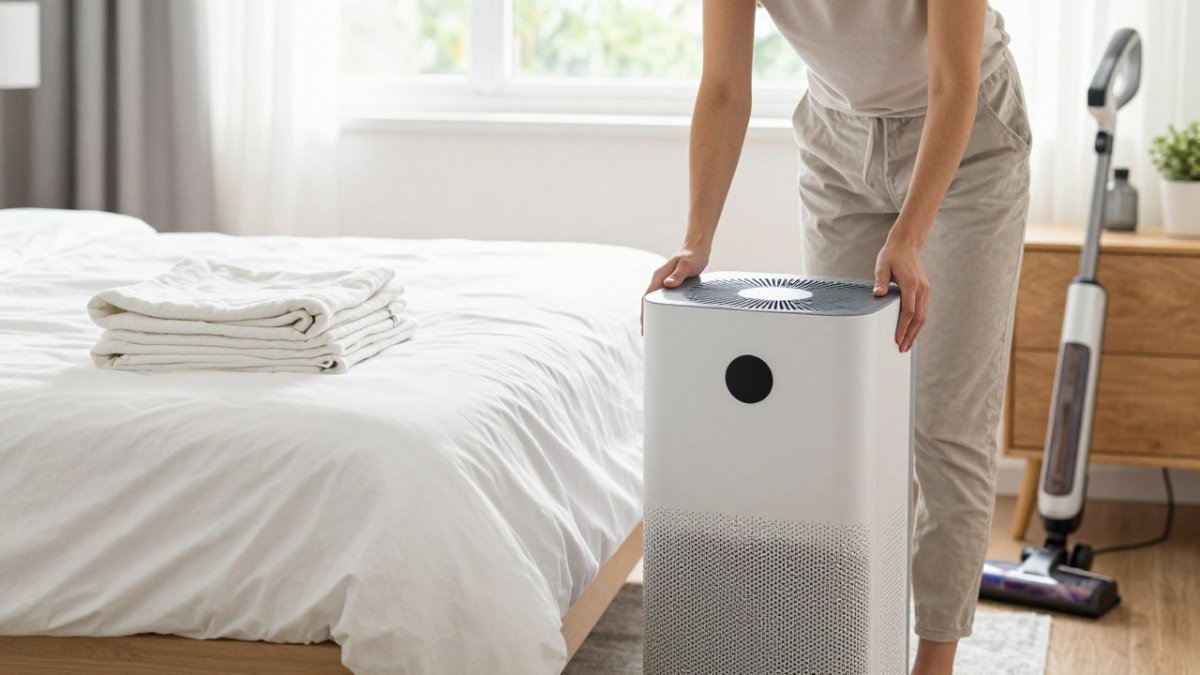
The woman is American.
Set Up the Bedroom for Cleaner Air
Placement and settings decide whether a purifier helps. Put the unit where air circulates freely, not tucked behind a curtain or against a wall.
- Run it on a higher setting for an hour before bed, then drop to a quieter speed overnight
- Keep the bedroom door closed so the unit treats one defined space
- Position the purifier between the bed and the door, where air moves
- Change or clean the pre-filter regularly so airflow stays strong
Cut Allergen Sources Filtration Cannot Reach
Filtration does not reach allergens settled in fabric and carpet, which need separate cleaning.
Wash bedding weekly in hot water, encase mattresses and pillows in allergen-proof covers, and vacuum with a HEPA-equipped machine. Keep indoor humidity in check to limit mold growth. Our guides to reducing indoor dust mites and reducing pollen in your home naturally walk through both in detail.
Watch out: a purifier running in a room with unwashed bedding and carpet full of dander is fighting a losing battle. Source control first, filtration second.
Best Air Purifier for Allergies and Asthma: What to Look For
The best air purifier for allergies and asthma is one with a true HEPA filter, a clean air delivery rate matched to your room size, and a noise level you can sleep through. Those three specs matter more than any feature list.
What to check before buying:
- True HEPA filtration, rated to capture particles at 0.3 microns
- CADR rating that matches or exceeds your room’s square footage
- Low nighttime noise, ideally under 30 decibels on low
- Filter replacement cost over a full year, not just the purchase price
- Number of pollutants handled, since dander, pollen, mold spores, and smoke behave differently
The SR100 targets nine kinds of pollutants, including dust mites, pet dander, pollen, mold spores, and smoke, and provides visual confirmation that purification is actively running.
Limits of HEPA Filtration and When to See a Doctor
HEPA filtration has real limits. It reduces airborne particles in one room; it does not treat the immune response, remove settled allergens, or address structural causes of snoring.
See a doctor if you notice:
- Gasping, choking, or pauses in breathing during sleep
- Daytime fatigue despite a full night in bed
- Snoring that continues after allergy symptoms are controlled
- One-sided nasal blockage or facial pain
Those signs point to sleep apnea or a structural issue that no purifier will fix.
Choosing the Right Air Purifier for Your Bedroom
Choosing the right air purifier for your bedroom starts with matching clean air delivery rate to room size, then considering noise and running cost.
Use this checklist:
- Measure your bedroom in square feet
- Confirm the CADR rating covers that area
- Check the low-speed decibel rating for sleep
- Add up annual filter replacement cost
- Confirm it handles dander, pollen, mold spores, and smoke
- Look for a visual indicator that shows the unit is working
For quiet operation specifically, our guide to a quiet air purifier for bedroom allergies covers what to check.
| What to Check | Why It Matters | What to Avoid |
|---|---|---|
| True HEPA filter | Captures fine particles at 0.3 microns | “HEPA-like” or “HEPA-type” claims |
| CADR rating | Confirms air cleaning capacity | Ratings below your room size |
| Nighttime noise | Determines whether you keep it running | Units that only run loud |
| Filter cost | Drives total yearly ownership cost | Cheap units with costly filters |
| Pollutant coverage | Handles dander, pollen, mold, smoke | Single-purpose units |
Allergy-driven snoring is frustrating because the fix is partly mechanical and partly habit. A purifier handles the air, while bedding, humidity, and cleaning habits are handled separately.
The SR100 covers nine kinds of pollutants in one unit, with visual confirmation that it is actively running.
Frequently Asked Questions
Do HEPA filters help people with allergies?
Allergy management generally combines filtration with source control and bedding hygiene rather than relying on filtration alone.
Do air purifiers reduce snoring?
Air purifiers do not treat snoring directly. They reduce airborne allergen exposure, which may lower nasal irritation in some people. Snoring with pauses, gasping or daytime fatigue needs a medical evaluation, not just a purifier.
How quickly can a HEPA filter reduce allergy-related snoring?
Results from allergy-related changes are generally gradual rather than immediate, so tracking congestion and snoring over several weeks can help you judge whether filtration is addressing your triggers.
What are the two disadvantages of HEPA filters?
Filtration works on air passing through the unit, so allergens settled in carpet, bedding and upholstery need separate cleaning. Filters also need regular replacement to keep airflow and efficiency up.
