
Do Air Purifiers Help With Snoring and Sleep Apnea?
Table of Contents
- Do Air Purifiers Help With Snoring and Sleep Apnea?
- Do Air Purifiers Help You Sleep Better?
- The Best Air Purifier for Snoring: What to Look For
- Allergies, Congestion, and the Snoring Connection
- Air Purifier CADR and Room Size: Getting the Math Right
- How Often to Run an Air Purifier in a Bedroom
- When Snoring or Breathing Symptoms Need Medical Evaluation
- Frequently Asked Questions
Last Updated: October 12, 2026
Do Air Purifiers Help With Snoring and Sleep Apnea?
Do air purifiers help with snoring and sleep apnea? The honest answer is: partly, and only for one of them. An air purifier can reduce the airborne allergens and irritants that cause nasal congestion, and congestion is a real contributor to snoring. It cannot open a collapsed airway, which is what obstructive sleep apnea actually is.
The distinction matters because the two problems get lumped together constantly. Snoring is a sound. Sleep apnea is a breathing disorder where the airway closes repeatedly during the night. One responds to a cleaner bedroom. The other needs medical care.
Below, we cover what filtration can realistically do, what the sleep research suggests, how to size a unit correctly, and the warning signs that mean you should stop shopping and start calling a doctor.
What Air Purifiers Can and Cannot Do
An air purifier pulls air through a filter and traps particles suspended in it. A true HEPA filter captures fine particulate matter, including dust, pollen, pet dander, and mold spores (the EPA). That is its entire job, and it does it well.
What it cannot do is change the shape of your airway. Snoring happens when air moves past relaxed tissue in the throat and makes it vibrate. Obstructive sleep apnea happens when that tissue collapses and blocks airflow completely. No filter reaches inside your throat.
So the realistic split looks like this:
- Can help: allergy-related congestion, dust and dander exposure, smoke and odor irritants
- Cannot help: structural snoring, airway collapse, sleep apnea
- Might help indirectly: milder snoring driven by nasal blockage
An air purifier treats the air, not the airway. If congestion is part of why you snore, filtration can reduce a trigger. If your airway collapses, filtration is irrelevant to the root cause.
Do Air Purifiers Help You Sleep Better?
Cleaner bedroom air can support better sleep for people whose nights are disrupted by allergens. That is the realistic claim, and it is worth stating plainly.
When dust, pollen, or pet dander sit in the air, sensitive sleepers breathe them in all night. That triggers sneezing, a runny nose, and congestion. Congestion narrows the nasal passages, and narrowed passages mean more mouth breathing and more snoring.
Remove the trigger, and you remove one link in that chain. Not the whole chain, but one link.
What the Sleep Research Actually Shows
The evidence here is thinner than the marketing suggests. Some small studies have looked at air filtration and sleep, and results are mixed. Many are short, use few participants, and rely on self-reported sleep quality rather than lab measurements.
A few general patterns show up across this body of work:
- People with allergies often report better sleep when allergen exposure drops
- Objective sleep-stage changes are less consistent than subjective reports
- Effects are strongest for people with confirmed sensitivities, weakest for everyone else
That last point is the one most guides skip. If you do not react to airborne allergens, a purifier is unlikely to change your sleep. If you do, it might.
Do not treat a better sleep score as proof that a breathing problem is handled. Wearables measure movement and heart rate, not airway collapse. A good score with loud snoring still deserves a medical look.
::: Chronic airway obstruction often extends beyond simple sleep disruption to have a lasting impact on dental health, necessitating a comprehensive evaluation of your oral structures.
The Best Air Purifier for Snoring: What to Look For
The best air purifier for snoring is one that removes the specific particles you react to, runs quietly enough to leave on all night, and is sized correctly for your bedroom. Those three factors matter more than brand or price.
Here is what actually moves the needle:
- True HEPA filtration for fine particles like dander and pollen
- A carbon layer if smoke or odors are part of your problem
- Low noise on the sleep setting, ideally under a whisper-level hum
- Correct CADR for the room, which we cover below
- Affordable filter replacements, since this is a running cost
One thing most reviews miss: a purifier with a great CADR but a loud fan is useless overnight. You will turn it off by night three.
This is where we would point to our own SR100. It targets nine kinds of pollutants, including dust mites, pet dander, pollen, mold spores, and smoke, and it gives visual confirmation that purification is active. That last feature answers the question we hear most: “How do I know it’s working?”
Allergies, Congestion, and the Snoring Connection
Allergies and snoring are linked through the nose. When allergens inflame the nasal lining, airflow drops. The body switches to mouth breathing, and mouth breathing at night is a well-known snoring trigger.
The common culprits in a bedroom:
- Dust mites living in bedding and pillows
- Pet dander from animals that sleep on the bed
- Pollen tracked in during high season
- Mold spores in damp rooms
- Smoke residue during wildfire season
If you wake congested and your snoring is worse on high-pollen days, that pattern points to an allergic component. That is the pattern where filtration earns its place.
A practical bedroom setup for allergy-related congestion:
- Run a HEPA purifier sized for the room, on low, all night
- Wash bedding weekly in hot water
- Keep pets off the bed if dander is a trigger
- Close windows during high pollen counts
- Check for damp spots that could feed mold
Air Purifier CADR and Room Size: Getting the Math Right
CADR stands for Clean Air Delivery Rate. It measures how much filtered air a unit delivers, in cubic feet per minute, for smoke, dust, and pollen. Higher CADR means faster cleaning in a given space.
The rule of thumb the Association of Home Appliance Manufacturers uses for sizing is simple. Match the CADR to the room’s square footage, and aim for a CADR at least two-thirds of the room size for solid performance.
A quick reference:
| Room Size | Minimum CADR | Notes |
|---|---|---|
| 100 sq ft | 65+ | Small bedroom |
| 200 sq ft | 130+ | Standard bedroom |
| 300 sq ft | 200+ | Large or primary bedroom |
| 500 sq ft | 330+ | Open-concept space |
For open-concept homes, treat the whole connected area as one room. Otherwise you will buy twice.
How Often to Run an Air Purifier in a Bedroom
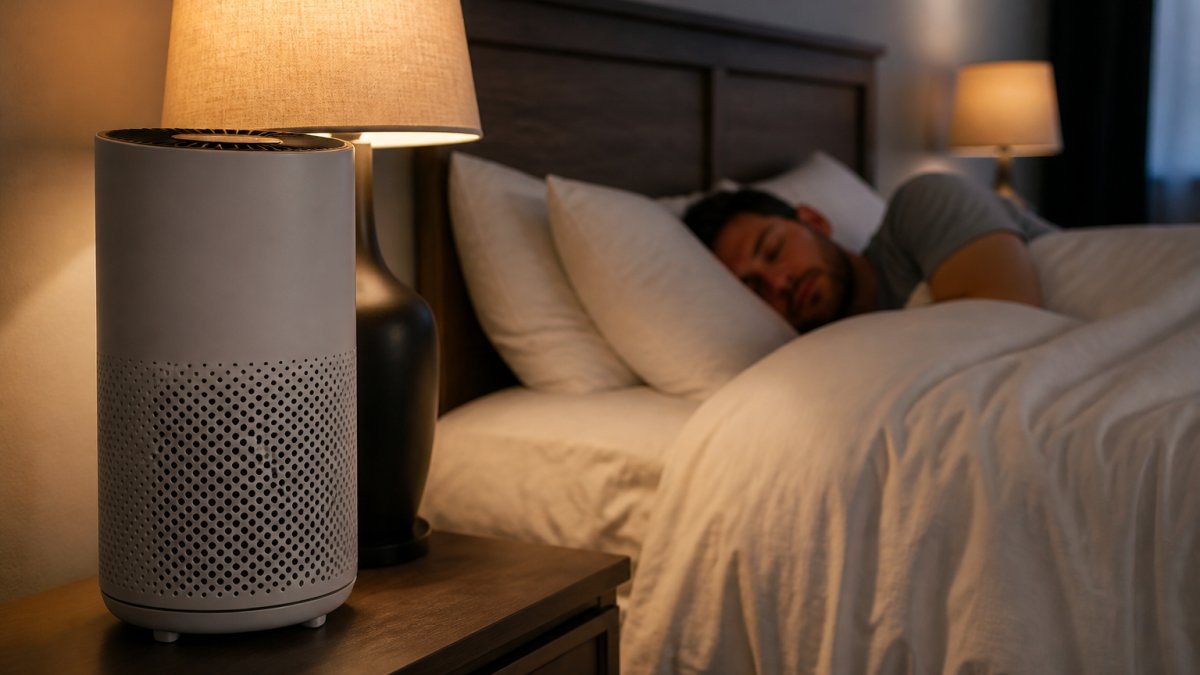
Run it continuously, or at minimum for two hours before bed and all night on low. Particle levels build up while a room sits closed, so starting the unit an hour before sleep gives it time to work.
A few habits that help:
- Keep the bedroom door closed so you are filtering one space, not the whole house
- Use the sleep mode so noise does not wake you
- Replace filters on schedule, since a clogged filter moves less air
- Vacuum and dust first, so the unit is not chasing settled particles
Filter replacement timing depends on use and local air quality. Check your unit’s indicator and your manual rather than guessing.
When Snoring or Breathing Symptoms Need Medical Evaluation
Loud snoring with pauses, gasping, or daytime exhaustion needs a doctor, not a purifier. Those are classic signs of obstructive sleep apnea, and no air filter treats it. The distinction is not a technicality, it is the difference between managing a trigger and managing a disorder.
Watch for these red flags:
- Snoring interrupted by silence, then a gasp or snort
- Witnessed pauses in breathing during sleep
- Waking with a dry mouth, sore throat, or morning headache
- Falling asleep during the day despite a full night in bed
- High blood pressure that is hard to control, or new atrial fibrillation
- A bed partner who reports you stop breathing
Any one of these is enough to justify a clinical conversation. Several together make it urgent.
The National Heart, Lung, and Blood Institute notes that obstructive sleep apnea is a serious condition linked to heart and metabolic problems when untreated. Diagnosis typically involves a sleep study, sometimes an in-lab polysomnogram, sometimes a home sleep apnea test, and treatment is directed at keeping the airway open.
Why Air Cleaning and Apnea Care Are Not Substitutes
The comparison worth making explicit is this: a purifier and apnea treatment operate on different problems.
- Air purifier: reduces airborne allergens and irritants in the room. It changes what you breathe in, not how your airway behaves.
- CPAP (continuous positive airway pressure): delivers pressurized air through a mask to splint the airway open mechanically. It treats the collapse itself.
- Oral appliances: a dentist or sleep specialist fits a mandibular advancement device that repositions the lower jaw and tongue to keep the airway patent.
- Surgery: in selected cases, procedures address anatomic obstruction, deviated septum, enlarged tonsils, or other structural issues.
- Positional therapy and weight management: for some patients, avoiding supine sleep or reducing weight meaningfully lowers event frequency.
A purifier can sit alongside any of these. It cannot replace any of them. If you have apnea and also react to dust or dander, cleaning the air may make nights more comfortable, but the apnea still needs its own treatment, and stopping CPAP because a purifier helped your congestion would be a serious mistake.
What to Do With Mild, Allergy-Linked Snoring
If your snoring is mild, worse in dusty or high-pollen conditions, and not accompanied by any red flag above, filtration is a reasonable first step alongside the bedroom habits in this guide. Track whether symptoms track with allergen exposure. If they do not, if the snoring is nightly, loud, or accompanied by daytime fatigue, stop optimizing the room and get evaluated. A sleep study answers in one night what a year of purifier shopping cannot.
Frequently Asked Questions
Can an air purifier reduce snoring?
An air purifier can reduce snoring only when the cause is airborne. If dust, pollen, pet dander, or mold spores are triggering nasal congestion, filtering them from bedroom air may ease that congestion and quiet snoring linked to it. A HEPA filter captures particles as small as 0.3 microns, which covers most common allergens. If snoring comes from anatomy, alcohol, weight, or sleep apnea, filtration will not fix it. Treat the purifier as one part of a bedroom air quality routine, not a standalone snoring remedy.
Can an air purifier help with sleep apnea?
No. Obstructive sleep apnea happens when the airway collapses or becomes blocked during sleep, and continuous positive airway pressure (CPAP) therapy remains the standard treatment. An air purifier cannot open an airway or replace CPAP. It may reduce allergen exposure that worsens nasal congestion, which can make CPAP use more comfortable for some people, but it is not a treatment for sleep apnea. If you have diagnosed or suspected sleep apnea, keep using your prescribed therapy and talk to your doctor before changing anything.
Do air purifiers help you sleep better if you have allergies?
For allergy sufferers, yes, the effect can be meaningful. Reducing airborne irritants like pollen, dust, and pet dander in the bedroom lowers overnight allergen exposure, which can ease nasal congestion and make breathing more comfortable. Better breathing tends to mean fewer sleep disruptions and more time in deep sleep. The gains depend on running the unit every night with the bedroom door closed, matching the purifier to the room size, and replacing filters on schedule so airflow stays strong.
How often should you run an air purifier in a bedroom?
Run it continuously, or at minimum for two to three hours before bed and throughout the night. Continuous operation keeps particle levels low instead of letting them build up during the day. A unit with a sleep mode runs quietly enough for overnight use. If you only run it during the day, you lose the benefit during the hours when you are breathing the air most closely. Filter replacement matters just as much: a clogged filter cuts airflow and reduces how much clean air reaches the room.
Snoring that stems from congestion is frustrating, and the air you sleep in is one variable you can control. Aero Essence LLC builds the SR100 to handle nine kinds of pollutants, from dust mites and pet dander to pollen, mold spores, and smoke, with visual confirmation that it is actively cleaning. If allergies are part of why you snore, cleaner bedroom air is a sensible place to start. Get started with Aero Essence LLC and give your bedroom air one less reason to keep you up.