
7 Pollen Blocking Window Screen Upgrades Tested Side by Side
Quick Summary
A pollen blocking window screen uses a tighter, more densely woven mesh than a standard insect screen to catch pollen grains and dust while still letting air move through. Standard insect screens stop bugs but offer limited protection against pollen, so specialty screens use higher mesh counts or layered materials. Compare claims carefully, since blocking percentages should state the particle size and test method.
- Standard insect screens stop bugs but offer limited protection against pollen grains.
- Ask manufacturers what particle size their blocking percentage covers and how it was tested.
- Mesh count and blocking percentage are different measurements; request both before comparing products.
- Tighter mesh restricts airflow, so request a measured airflow rate before buying.
- Measure the screen frame channel, not the window opening, to avoid sizing errors.
Table of Contents
- How Pollen Blocking Window Screens Work
- What Filtration Claims Really Mean and Why Test Criteria Vary
- Comparing the Best Pollen Blocking Window Screens
- Airflow, Fit and Window Compatibility
- Window Screen Filter for Pollen and Dust: Installation Steps
- Pollen-Filtering Window Screen Reviews: Ratings and Verdicts
- How to Clean Pollen-Filtering Window Screens and Plan Replacements
- Choosing Your Upgrade and Pricing Your Next Step
- Frequently Asked Questions
How Pollen Blocking Window Screens Work
A pollen blocking window screen uses a tighter, more densely woven mesh than a standard insect screen. Learn how to prevent pollen buildup on window screens The finer weave catches pollen grains and dust particles while still letting air move through the window, the core engineering trade-off in this product category.
Standard insect screens stop bugs, not airborne particles. Pollen grains are often larger than fine dust but small enough to pass through a loose mesh, so a regular screen offers limited protection. Specialty screens use higher mesh counts or layered materials to narrow the openings.
Manufacturers describe their products differently, and claims of this kind should be treated as starting points for your own evaluation rather than proven results.
What Filtration Claims Really Mean and Why Test Criteria Vary
Filtration claims are hard to compare. One manufacturer may report a percentage of pollen blocked, another may claim it blocks more particles than a standard fiberglass screen. Neither tells you the particle size, test method, or airflow conditions used.
For a fair comparison, look for three things: the particle size the claim covers, how the test was run, and whether the claim comes from the manufacturer or an independent lab. Find a method to verify whether a filtering product performs Without those details, a percentage on a product page is hard to interpret.
Comparing the Best Pollen Blocking Window Screens
Most roundups repeat manufacturer claims side by side without putting them on the same footing. The comparison below uses one consistent set of criteria so you can see where each option is strong and where documentation runs out.
| Product | Pollen capture basis | Airflow data | Durability | Fit | Total cost basis |
|---|---|---|---|---|---|
| AllergyGuard | Blocking claim; particle size and test source not published | Qualitative only | Not specified | Cut-to-size roll | Quote per window |
| RESPILON | Multi-particle claim; size not defined | Not measured | Frame-dependent | Adjustable frame | Not listed |
| Poll-Tex | >99% claim from secondary source; unverified | Not published | Not published | Not published | Not listed |
| High Density Mesh Roll | Pollen filtering; not independently verified | Not measured | Not specified | 39 x 99 in roll | Not listed |
Watch out: a high mesh count and a high blocking percentage are not the same measurement. Mesh count tells you openings per inch; a blocking percentage should tell you what share of a defined particle size was captured under a stated test method. Ask for both before comparing two products.
Pros and Cons of Each Option
- AllergyGuard: Marketed for pollen and designed to keep airflow. Cons: no published particle-size basis, airflow rate, or price.
- RESPILON: Adjustable upgrade for existing screens; covers several particle types. Cons: no measured airflow, durability spec, or price.
- Poll-Tex: Named in an allergen-protection guide with a specific blocking figure. Cons: secondary source; maker page, pricing, and installation details absent.
- High Density Mesh Roll: Clear dimensions and mesh count; roll covers about two standard screens. Cons: no verified pollen performance, airflow data, or listed price.
A practical next step: email each seller the same three questions, What particle size does your percentage refer to, was the test run by an independent lab, and what is the measured airflow or pressure drop? Sellers who answer all three give you a real basis for comparison; sellers who answer only the first are giving you marketing, not data.
Airflow, Fit and Window Compatibility
Tighter mesh restricts airflow, so a screen that blocks more particles may move less air. Manufacturers emphasizing fresh air, such as ADFORS with its Pollen Guard screen, state that air still flows through while dust and pollen are kept out. The supplied results do not include a measured airflow rate, so ask for one before buying.
Fit matters as much as mesh: a gap at the frame edge lets pollen bypass the screen entirely. Measure your window opening carefully and confirm whether the product is a custom-cut roll, an adjustable frame, or a pre-sized panel. Double-hung and casement windows often need different approaches.
Window Screen Filter for Pollen and Dust: Installation Steps
Installation difficulty depends less on the mesh than on your window type and frame condition. The sequence below covers the common routes, re-splining a fixed frame, fitting an adjustable screen, and installing a pre-sized panel, with the measurements and failure points that matter.
Measure Before You Buy
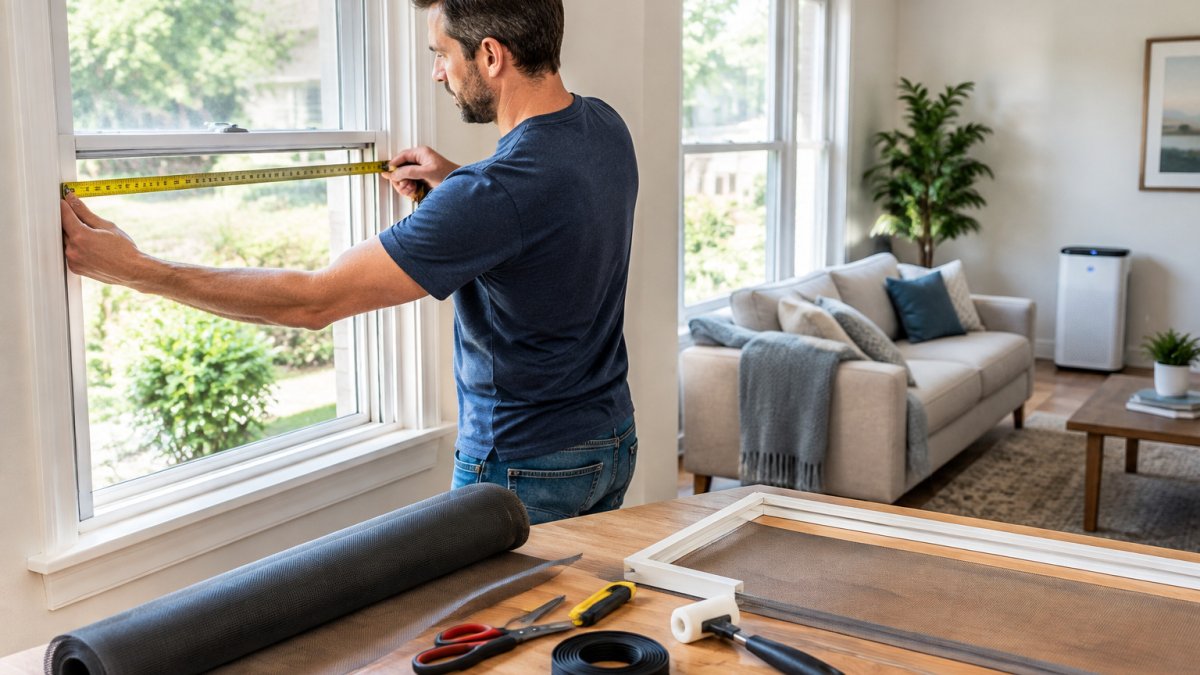
Measure the inside dimensions of the screen frame channel, not the window opening. For re-splining, record the frame’s inside height and width to the nearest 1/16 inch, then add about 1 inch of margin per side for the spline channel and trim. For an adjustable screen, measure the opening at its narrowest point and confirm the adjustable range covers it with overlap.
Watch out: measuring the window opening instead of the screen frame is the most common sizing error. Mesh cut to the opening size will be too small to seat in the spline groove, and an adjustable screen sized to the opening may not overlap the frame enough to seal.
Route 1: Re-Splining a Fixed Frame
This is the most common DIY route for replacement mesh rolls.
- Remove the screen and lay it flat on a clean work surface.
- Use a spline removal tool or stiff putty knife to lift one end of the old spline and pull it free around the perimeter.
- Remove the old mesh and clean the spline groove with a brush; grit prevents the new spline from seating.
- Lay the new mesh over the frame, aligned square, and clamp or weight one edge to hold alignment.
- Press the new spline into the groove with a roller, working from one corner around the perimeter, keeping the mesh taut but not stretched.
- Trim excess mesh with a utility knife held at a shallow angle against the spline.
- Reinstall and check for gaps at corners and along frame edges.
Expect the first screen to take 30 to 45 minutes, with subsequent screens faster. Keeping the mesh square while seating the spline is the step most people get wrong; a slack or skewed screen loses fit and tension, and a skewed weave can reduce effective airflow.
Route 2: Adjustable Screens
Adjustable screens expand to fit the opening and are held by tension or the window sash. Measure the opening at its narrowest point, set the screen to that width plus the recommended overlap, and confirm the frame sits flush against the window stop. Check that the mechanism locks and the mesh does not sag when expanded. These suit standard double-hung and sliding windows within the manufacturer’s stated range; casement and awning windows usually need a different mounting approach.
Route 3: Pre-Sized Panels
Pre-sized panels mount with clips, magnets, or hook-and-loop tape, depending on the product. Confirm the mounting method suits your frame material and that the panel can be removed for cleaning without damaging the frame finish. Panels are the fastest route but least flexible if your window dimensions fall outside standard sizes.
Window-Type Compatibility
- Double-hung and single-hung: Re-splining or adjustable screens work well; measure the sash opening and confirm the screen sits in the outer track.
- Casement and awning: These crank outward, so the screen is usually on the interior side; confirm the product is rated for interior mounting and does not interfere with the crank mechanism.
- Sliding: Adjustable screens are common; confirm the track height and that the screen does not bind when the sash moves.
- Fixed and picture windows: Pre-sized panels or re-splined fixed frames are the practical options.
Tools and Materials
A basic re-spline job needs a spline removal tool, a spline roller, replacement spline in the correct diameter for your groove, a utility knife, a tape measure, and a soft brush. Spline diameter varies by frame; measure the old spline with calipers or take a short piece to the hardware store to match it. The wrong spline diameter is a common cause of a loose screen that rattles or lets pollen bypass the edges.
Pollen-Filtering Window Screen Reviews: Ratings and Verdicts
Published reviews in this category are limited, so the ratings below reflect how well each listing documents its claims rather than measured performance.
| Product | Documented Claims | Specs Shown | Best For |
|---|---|---|---|
| AllergyGuard | Pollen and allergen reduction | Limited | Dedicated pollen replacement mesh |
| RESPILON | Several airborne particle types | Limited | Upgrading an existing screen |
| Poll-Tex | Over 99% pollen and fine particles (secondary source) | Limited | Comparing blocking figures |
| High Density Mesh Roll | Pollen filtering | Dimensions and mesh count | DIY replacement |
Verdict: The High Density Mesh Roll documents the most concrete specifications, while AllergyGuard is most clearly positioned for pollen. Before buying, request independent test data from any manufacturer.
How to Clean Pollen-Filtering Window Screens and Plan Replacements
Clean the mesh with a soft brush and a gentle stream of water, working from the inside outward so debris is not pushed into the weave. Avoid high-pressure washing, which can distort the mesh and loosen the spline. Let the screen dry fully before reinstalling.
Replacement timing depends on wear, exposure, and cleaning frequency. Compare washable and disposable filter costs Check for tears, sagging, and loose spline each season. See how often filter media should be replaced Pricing for replacement rolls was not listed in the research, so check current prices with each seller.
Choosing Your Upgrade and Pricing Your Next Step
Start by deciding whether you need full replacement mesh or an upgrade that fits your existing frame. Then compare documented claims, the airflow trade-off, and fit requirements for your windows. Ask each manufacturer for particle-size test data and current pricing before you commit.
Aero Essence LLC offers the SR100, an air purifier designed to address pollen, dust mites, pet dander, mold spores, and smoke. For current pricing or a quote on the SR100, visit the Aero Essence LLC website.
Frequently Asked Questions
Is there a window screen that keeps pollen out?
Yes, some window screens are designed specifically to block pollen, but how much they block depends on the product and how it is tested. Pollen-blocking screens use a finer mesh than standard fiberglass insect screen. Because test methods and particle-size definitions differ between brands, compare claims only when the testing basis is stated. Check the mesh specification, the manufacturer’s test documentation, and whether the screen fits your window frame properly, since gaps around the edges let pollen through regardless of mesh quality.
Do pollen screens really work?
Pollen-blocking screens can reduce the amount of pollen that enters through an open window, but they do not eliminate it. Performance depends on mesh density, frame fit, and how well the screen is maintained. Manufacturer claims vary, and these figures are not measured against a common test. Pair a screen upgrade with keeping windows closed on high-pollen days for the best results.
Does pollen come through window screens?
Yes, standard window screens let a significant amount of pollen through because their mesh is designed to stop insects, not fine particles. Pollen grains are small enough to pass through typical mesh openings, which is why homeowners with seasonal allergies often notice pollen indoors even with screens in place. Upgrading to a finer pollen-filtering mesh reduces this, and replacing the mesh on an existing frame is usually a practical way to do it.
Are pollen screens a substitute for an air purifier?
No, pollen screens and air purifiers do different jobs. A screen filters air at the window, which reduces outdoor pollen entering the home, but it does not clean air already inside or capture particles from pets, mold spores, or wildfire smoke that enter through other routes. An air purifier treats the air you breathe indoors.
