
Does Vacuuming Remove Pet Dander From Microfiber Couches?
Last Updated: November 13, 2026
Quick Summary
Vacuuming alone does not fully remove pet dander from microfiber couches, because the dense pile traps microscopic flakes at the base of the fibers. To remove it, vacuum slowly with the brush bar off, lift hair with a rubber glove, wipe only if the cleaning code allows, and run a HEPA air purifier during and after cleaning.
- Check the cleaning code tag first: W and WS allow water-based cleaners, S needs solvent only, and X is vacuum only.
- Vacuum weekly as a baseline and do the full wipe-and-brush routine every two to four weeks.
- Run a HEPA air purifier during cleaning and for at least an hour afterward to catch airborne dander.
- Skip the damp wipe on S-code and X-code couches and use a dry microfiber cloth instead.
- Visible hair returning within a day of vacuuming signals that a deeper clean is due.
Table of Contents
- Why Microfiber Couches Hold Pet Dander So Tightly
- What You’ll Need: Tools Safe for Microfiber Upholstery
- Step-by-Step: How to Remove Pet Dander From Microfiber Couches
- How to Remove Embedded Pet Hair From Microfiber
- Natural Ways to Clean Pet Dander From Upholstery
- Choosing the Best Air Purifier for Pet Dander Allergies
- How Often to Clean and How to Tell It’s Working
- Build Your Dander-Control Routine With the Right Air Purifier
- Frequently Asked Questions
Why Microfiber Couches Hold Pet Dander So Tightly
Microfiber is a magnet for pet dander, and the reason comes down to how the fabric is made.
Cat and dog owners often vacuum weekly and still watch dust settle back within a day. The fabric is only half the story.
Unlike a hardwood floor, a microfiber couch gives particles somewhere to hide. The weave traps them at the base of the pile.
Pet Hair vs. Pet Dander: What You Are Actually Removing
Pet hair and pet dander are not the same thing, and treating them as one problem is why so many cleaning routines fail.
Pet hair is the visible fur you see on the cushion. It is easy to spot and easy to pick up.
Pet dander is the microscopic skin flakes pets shed constantly. It is the protein in that dander, not the fur itself, that triggers most allergy symptoms (The Truth About Pet Allergies).
That distinction matters. If you want the full picture of what dander is and how it behaves, our guide on what pet dander is and why it causes allergies breaks it down.
So the job has two parts: remove the visible hair, then pull the invisible flakes out of the fabric.
What You’ll Need: Tools Safe for Microfiber Upholstery
Before you start, gather tools that will not damage the fabric. Microfiber scratches and pills easily, so harsh brushes and strong chemicals do more harm than good. The bigger risk, though, is moisture: many microfiber couches are labeled for solvent cleaning only, and a damp cloth on those fabrics can leave a water ring or a permanent stain.
Read the Cleaning Code First
Look under the seat cushions or on the back of the frame for a tag with a one- or two-letter cleaning code. The code tells you which liquids the fabric will tolerate, and it overrides any generic advice you read online, including the vinegar-and-water mix further down this article.
- W, water-based cleaners are safe. You can use a damp microfiber cloth, a mild dish-soap solution, or a vinegar-and-water mix.
- S, solvent-based cleaners only. Do not use water, vinegar, or foam. Use a dry-cleaning solvent labeled for upholstery, applied to a cloth rather than sprayed directly on the fabric.
- WS, either water-based or solvent-based cleaners are safe. This is the most forgiving code and the one most household routines assume.
If the tag is missing or unreadable, treat the couch as S-code until you confirm otherwise. A dry method that leaves the fabric slightly under-cleaned is far cheaper than a water ring you cannot lift.
Spot-Test Before You Touch the Couch
Pick a hidden area, the back of a cushion, the underside of a skirt, or the deck under the seat, and apply your chosen cleaner to a white cloth, not the fabric.
Watch out: testing on a visible cushion and assuming the result carries to the whole couch is how people end up with a faded patch on the one seat every guest sits in.
Tools That Are Safe on Microfiber Pile
- Vacuum with an upholstery attachment, the brush bar should be off or set to the lowest setting, because a spinning brush can fuzz the pile.
- Crevice attachment, for seams, cushion gaps, and the deck under the cushions.
- Rubber gloves or a rubber squeegee, lifts embedded hair without abrading the weave.
Keep the care tag visible while you work. If you clean the couch on a schedule, photograph the tag and store the photo with your cleaning supplies so you are not re-reading a tag tucked under a cushion every time.
Step-by-Step: How to Remove Pet Dander From Microfiber Couches
Here is the complete process, in order. Once the cushions are clean, carrying the same top-to-bottom approach to nearby carpets can help keep settled pet dander from returning to the room, a concern Mighty Clean Services addresses when discussing pet allergies.
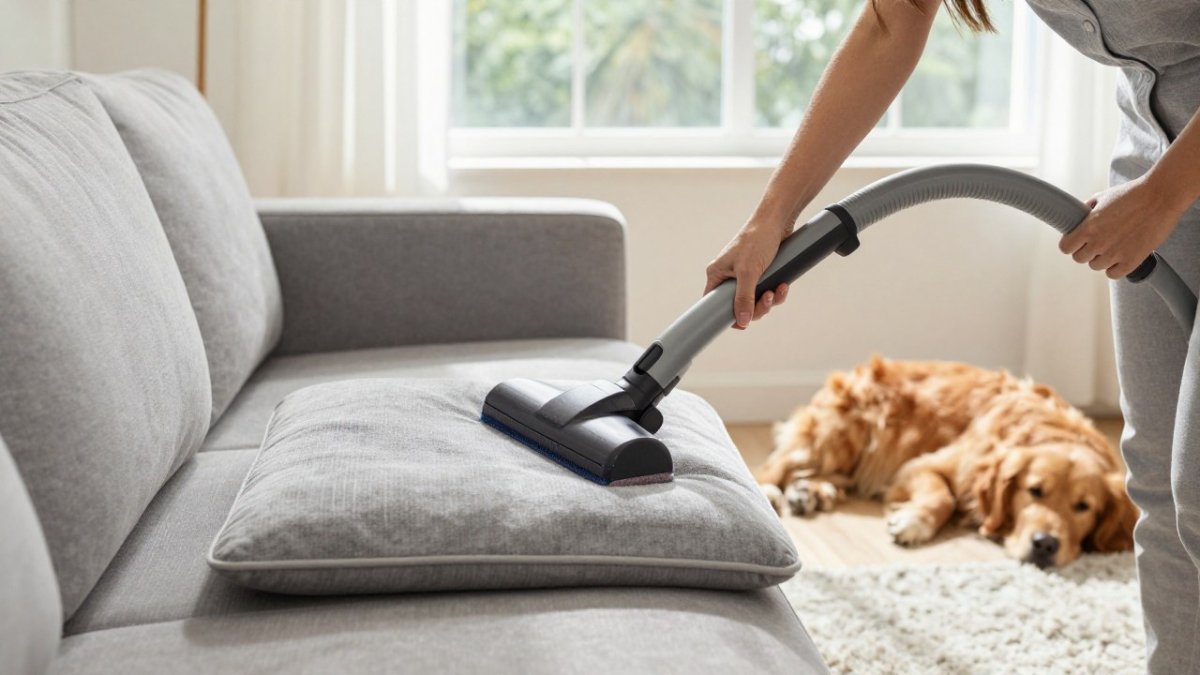
For fabric-specific tips that pair with these steps, see our guide on how to clean pet dander from furniture fabrics.
Step 1: Contain the Air Before You Disturb the Fabric
Dander is light enough to go airborne the moment you vacuum, so start by limiting how much of it resettles. Close the windows, run a HEPA air purifier in the room on a medium setting, and keep it running through the whole process and for at least an hour afterward.
A common pattern is to vacuum first and turn on the purifier later. That order lets the loosened dander settle onto the couch you just cleaned.
Step 2: Vacuum Upholstery, Cushions, and Crevice Seams
Start with a dry vacuum pass. Fit the upholstery attachment, turn off the rotating brush, and run the tool slowly across every surface in overlapping lanes.
Pull removable cushions off and vacuum both sides, then switch to the crevice tool for the seams, the gap where cushions meet the frame, and the deck underneath. Cushion seams and crevices collect the most dander because particles settle there and stay.
Step 3: Lift Loose Hair With Rubber Gloves or a Squeegee
Dampen a rubber glove or a rubber squeegee and drag it across the fabric in short strokes. The rubber grabs loose hair that a vacuum missed and pulls it into a clump you can peel off.
On an S-code couch, use a dry rubber glove rather than a damp one. The rubber still grabs hair, and you avoid introducing water the fabric cannot take.
Step 4: Wipe Only If the Cleaning Code Allows It
For W and WS codes, wipe the surface with a barely damp microfiber cloth, then follow with a soft-bristle brush working in one direction. One-direction wiping lifts residue without pushing it deeper into the weave.
For S and X codes, skip the damp wipe entirely. Use a dry microfiber cloth to lift surface residue, and reserve any liquid solvent for spot treatment on S-code fabric only.
Step 5: Dry the Fabric Completely
Let the fabric dry fully before you sit down. Moisture trapped in the pile invites odor and mildew, and on microfiber it can also leave a visible ring at the edge of the damp area.
Watch out: putting cushions back while the deck is still damp traps moisture under the foam and is a common cause of a musty smell that shows up days later.
Step 6: Confirm the Clean Worked
Before you call the job done, check three things: the rubber glove comes up clean on a second pass, the couch has no pet odor when you press your face close to the cushion, and the air purifier’s indicator or your own nose tells you the room air is not stirring up symptoms. If hair returns within a day or allergy symptoms flare when you sit down, the dander load was deeper than one pass could reach, repeat the vacuum and rubber-glove steps, and consider a second pass with the crevice tool along every seam.
How to Remove Embedded Pet Hair From Microfiber
Embedded hair needs more patience than surface hair. The strands work their way into the base of the pile, and a single vacuum pass will not reach them.
Use a stiff rubber brush or the edge of a squeegee and work in short, firm strokes against the grain. Then vacuum again with strong suction.
For a deeper walkthrough, our article on how to remove embedded pet hair from microfiber covers the tools and technique in detail.
Natural Ways to Clean Pet Dander From Upholstery
For routine cleaning, you do not need strong chemicals. A simple mix of white vinegar and water in a spray bottle handles most surface dander and helps with pet odors.
Spray lightly, wipe with a damp microfiber cloth, and dry the area right away.
Skip harsh chemicals on microfiber. For a broader list of methods, see our guide on effective ways to reduce pet dander.
Choosing the Best Air Purifier for Pet Dander Allergies
Cleaning the couch removes what has settled. It does nothing about the dander still floating in the air, and that airborne load is what keeps allergy symptoms going between cleanings.
A HEPA air purifier can help address airborne particles. A HEPA filter captures fine airborne particles, including dander, before they resettle on your microfiber upholstery.
When you are choosing the best air purifier for pet dander allergies, look at filtration, room coverage, and whether the unit gives you feedback that it is working. Our complete guide to removing pet dander from air goes deeper on placement and setup.
How Often to Clean and How to Tell It’s Working
How often you clean depends on how many pets you have and how much time they spend on the couch.
Signs it is time for a deeper clean:
- Visible hair returns within a day of vacuuming
- The couch smells like pet even after wiping
- Allergy symptoms flare when you sit down
If those signals fade and symptoms ease, your routine is working. For a full-home schedule, see our guide on effective ways to reduce pet dander.
Use this baseline schedule and these warning signs to judge whether your dander routine is keeping up.
| Item | Value | Note |
|---|---|---|
| Vacuum the couch | Weekly | Baseline for most pet households |
| Full wipe-and-brush routine | Every two to four weeks | Depends on pets and couch time |
| Visible hair returns | Within a day of vacuuming | Sign a deeper clean is due |
| Couch smells like pet | After wiping | Sign a deeper clean is due |
| Allergy symptoms | Flare when you sit down | Sign a deeper clean is due |
| Dust bunnies | Collect under and around the couch | Sign a deeper clean is due |
Build Your Dander-Control Routine With the Right Air Purifier
A clean couch and clean air work together. Vacuuming and wiping handle the fabric. Filtration handles everything that floats.
The Aero Essence LLC SR100 is an air purifier designed to address nine kinds of pollutants, including pet dander, dust mites, pollen, mold spores, and smoke.
If you are ready to compare units before you buy, our air purifier for pet dander review guide lays out what to look for.
Dander control is a routine, not a one-time chore.
Frequently Asked Questions
Can you get pet dander out of a couch?
Yes. Mechanical washing with detergent is commonly cited as a way to help reduce pet allergens on fabrics. For microfiber couches, combine vacuuming with an upholstery attachment, one-direction wiping with a damp microfiber cloth, and regular cushion-cover laundering. Dander is a fine particle that settles into the weave, so surface brushing alone leaves a residue behind. Repeat the full protocol every two weeks, and pair it with HEPA filtration to catch airborne particles the vacuum lifts.
Does vacuuming alone remove pet dander from furniture?
Not completely. Vacuuming pulls loose hair and surface dust from microfiber couches, but dander clings to fabric fibers and settles into cushion seams where a standard nozzle misses. Use a crevice attachment along seams, then follow with a damp microfiber cloth wiped in one direction. A vacuum with a HEPA filter keeps captured particles from blowing back into the room, which matters for anyone with allergy symptoms.
Are microfiber couches good for pet owners with allergies?
Microfiber has a tight weave that keeps dander and dust from penetrating as deeply as it does in loose-woven fabrics, which helps. The tradeoff is that the texture grabs loose hair and fine particles, so it needs regular vacuuming and wiping. Check the fabric care label before using water or cleaners, spot test any solution on a hidden area, and run an air purifier to manage airborne allergens between cleanings.
How often should you clean upholstery to reduce pet dander?
Vacuum microfiber couches weekly and run the full wipe-and-brush protocol every two weeks if pets sit on the furniture daily. Households with allergy sufferers or multiple pets may need weekly deep cleaning. Wash removable cushion covers according to their care label, and replace or clean air purifier filters on the manufacturer’s schedule so captured dander does not recirculate.
