
Best Air Purifier for Nighttime Asthma Symptoms: What to Check
Quick Summary
An air purifier may help reduce nighttime asthma symptoms by lowering airborne triggers like dust mites, pet dander, pollen, mold spores and smoke in your bedroom while you sleep. It does not replace prescribed asthma treatment. Choose a unit sized for your room, with a sleep mode that stays quiet and still moves meaningful air.
- A 2020 study suggests indoor air purifiers may reduce PM2.5 levels and medication burden in children with asthma.
- Match the unit’s clean air delivery rate to your bedroom’s square footage and ceiling height.
- Check the rated noise level for sleep mode and confirm it still moves meaningful air.
- Choose a unit that does not intentionally produce ozone, since the EPA advises against ozone generators.
- Replace filters on the manufacturer’s schedule and budget for recurring filter costs.
Table of Contents
- Airborne Triggers That Affect Asthma While You Sleep
- HEPA Filtration and What Particle Capture Means for Sleep
- Choosing a Bedroom Air Purifier: Room Size, Noise, and Airflow
- Best Air Purifier Options for Asthma and Pet Dander Households
- Running an Air Purifier Overnight: Filters, Maintenance, and Cost
- Start Your Bedroom Air Check and Choose Your Next Purifier
- Frequently Asked Questions
How Air Purifiers May Help Reduce Nighttime Asthma Triggers
A 2020 study suggests indoor air purifiers may reduce PM2.5 levels and medication burden in children with asthma (PubMed Central study on indoor air purifiers and children with asthma). For many people, that is the most useful starting point. Nighttime symptoms often come from airborne triggers in the bedroom, so a purifier aims to lower what you breathe while you sleep. This guide walks through what to check before you buy, since reducing nighttime asthma symptoms depends on more than the purifier itself.
Air purifiers reduce airborne triggers. They are not a guaranteed asthma treatment. To see the scientific evidence on whether a purifier helps asthma, read Does Air Purifier Help With Asthma: A Science-Backed Guide. The U.S. Environmental Protection Agency describes study findings as improvements in one or more symptoms, not as evidence that purifiers eliminate asthma (EPA Guide to Air Cleaners in the Home). Keep that distinction in mind as you read.
Airborne Triggers That Affect Asthma While You Sleep
Many people experience nighttime asthma symptoms because of particles they breathe in overnight. Dust mites, pet dander, pollen, mold spores and smoke are the triggers most often raised in purifier marketing and research. If you suspect pets are behind your nighttime symptoms, learn to recognize the signs of pet dander allergies at home.
Bedrooms with pets or closed windows can hold these particles longer. For practical steps beyond filtration, see how to reduce pet allergens indoors. Filtration works on particles in the air, so it cannot address every trigger in the home.
HEPA Filtration and What Particle Capture Means for Sleep
A HEPA filter captures very small airborne particles. To understand how CADR ratings affect how well a purifier cleans your bedroom air, see How CADR Ratings Affect Indoor Air Quality. Alen describes its asthma-focused models as using True HEPA filtration to capture 99.97% of airborne particles as small as 0.3 microns (Alen asthma air purifier guide). Manufacturer claims like this are worth checking against independent testing.
A 2021 study in Allergy, Asthma & Immunology Research reports that HEPA air purifiers can reduce indoor house-dust-mite allergen and particulate-matter levels and help control allergic asthma symptoms (Allergy, Asthma & Immunology Research HEPA study).
Choosing a Bedroom Air Purifier: Room Size, Noise, and Airflow
A bedroom purifier has to do two jobs at once: clean the air and disappear into the background while you sleep. Most buying mistakes happen when shoppers optimize for the first job and ignore the second. Use the criteria below in order, because a unit that is correctly sized but too loud will end up switched off by 2 a.m.
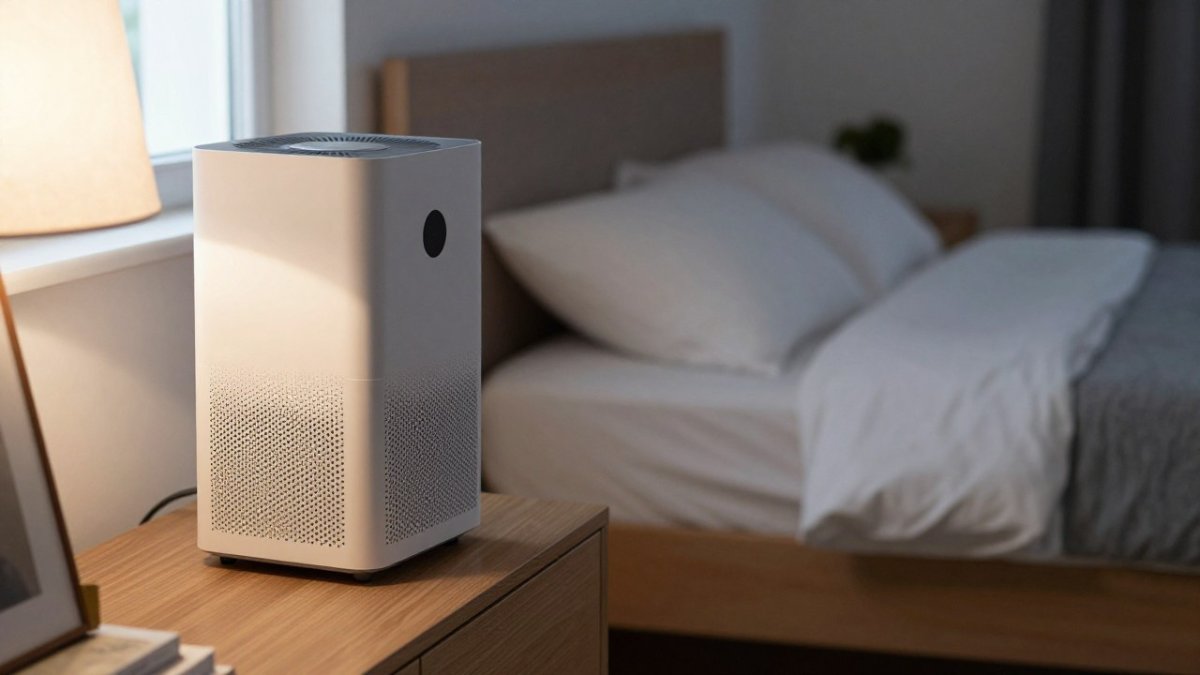
Match clean air delivery to the actual bedroom
Compare the unit’s clean air delivery rate (CADR), measured in cubic feet per minute for smoke, dust, and pollen, against your bedroom’s square footage and ceiling height. Measure the room, including ceiling height, before comparing models.
Treat sleep-mode noise as a hard requirement
Noise is the criterion most likely to determine whether the purifier actually runs all night. Manufacturers publish decibel ratings, but they are often for the lowest fan speed. Check the rated noise level for sleep mode and confirm that the mode still moves meaningful air. Some units drop to a whisper but also drop to a CADR too low to matter.
Watch out: a purifier rated quiet on its lowest setting can still produce a low-frequency hum or motor whine that bothers light sleepers more than the decibel number suggests. If possible, listen to the unit in person or check owner reports specifically about sleep-mode sound rather than overall noise.
Control light and airflow direction
Bright status displays, power LEDs, and air-quality indicator rings can disrupt sleep even when the fan is silent. Look for a display-off or dimming feature, and confirm whether the unit remembers that setting after a power interruption. Airflow direction also matters: a unit that blows directly across the pillow can feel drafty and dry, and it can disturb sleep more than the noise does. Place the unit so the outlet points along a wall or across the room rather than at the bed, and keep at least a foot or so of clearance around the intake so the unit is not starved of air.
Check certifications and safety for overnight use
For asthma and allergy households, look for any asthma and allergy friendly certification from the relevant certifying organization, and confirm the unit is listed by an accepted safety testing organization. Ozone-generating features are a poor fit for a bedroom; the EPA advises against ozone generators in occupied spaces, so choose a unit that does not intentionally produce ozone. If the unit has an ionizer, confirm it can be switched off.
Automatic mode and smart features
Automatic mode adjusts fan speed to sensor readings, which can keep the unit quiet when the air is already clean and ramp up when particles rise. That is useful overnight, but sensors vary in quality and some units are slow to react. A timer or schedule can also help: run the unit on a higher setting for an hour before bed, then drop to sleep mode. Smart features are conveniences, not substitutes for correct sizing and a genuine sleep mode.
The article’s sizing, noise and airflow criteria can be checked in a quick scan:
| Criterion | What to check | Why it matters |
|---|---|---|
| Room size | Square footage and ceiling height | Match clean air delivery to the bedroom |
| Clean air delivery rate | CADR for smoke, dust and pollen | Compare against room size |
| Sleep-mode noise | Rated level for sleep mode | Unit must run all night |
| Sleep-mode airflow | Whether it still moves meaningful air | A quiet mode with low CADR is ineffective |
| Display lights | Display-off or dimming feature | Lights can disrupt sleep |
| Airflow direction | Outlet not aimed at the pillow | Avoids drafts and dryness |
| Ozone | Unit does not intentionally produce ozone | EPA advises against ozone generators |
Best Air Purifier Options for Asthma and Pet Dander Households
Several models are marketed for asthma or allergies. Coway’s Airmega 450 is named CNET’s best overall air purifier, and CNET reports it performed impressively in its recent particle-removal test (CNET best air purifier review).
Austin Air describes its asthma purifier as using medical-grade HEPA filtration and 15 pounds of carbon (Austin Air asthma page).
Aero Essence LLC’s SR100 is designed to address nine kinds of pollutants, including dust mites, pet dander, pollen, mold spores and smoke. It also provides visual confirmation that purification is working. Pricing depends on quantity and current offers, so check our website for the current price.
Best for: Pet owners who want one unit covering several particle types.
Skip if: You need only a compact unit for a small room.
Running an Air Purifier Overnight: Filters, Maintenance, and Cost
How you run the unit overnight matters as much as which unit you buy. A correctly sized purifier on a sensible schedule will do more for bedroom air than a larger unit run intermittently or placed in a corner behind furniture.
Set up the bedroom for overnight filtration
Place the purifier where air can move freely: a few feet from the bed, with the intake and outlet unobstructed by curtains, furniture, or bedding. Keep the bedroom door closed overnight when possible so the unit is treating a defined volume of air rather than the whole house. If you keep windows open for ventilation, expect the purifier to work harder and filter life to shorten, especially on high-pollen or wildfire-smoke days. Run the unit on a higher setting for an hour before bed to knock down particles stirred up during the day, then switch to sleep mode.
Maintain filters on a realistic schedule
Filter replacement intervals vary by model and by how dirty your air is. A pre-filter, often washable or vacuumable, captures larger debris and protects the main HEPA filter, so clean it as the manufacturer directs, typically every few weeks in a bedroom with a pet. Filter life depends on use and air quality, so check the manufacturer’s replacement schedule for each filter type. Many units have a filter indicator, but treat it as a guide, a unit that runs all night in a smoky or dusty environment will need filters sooner. Keep a spare filter on hand so the unit is not out of service while you wait for a replacement.
Budget for operating and filter cost, not just purchase price
Overnight operation adds electricity use, though a typical bedroom purifier on sleep mode draws relatively little power. The larger recurring cost is usually filters. Compare the manufacturer’s stated filter replacement schedule and the price of replacement filters before you buy, and calculate a rough annual filter cost. A cheaper unit with expensive or hard-to-find filters can cost more over a few years than a pricier unit with affordable filters. Check that replacement filters are readily available and that the model is not near the end of its production run.
Troubleshoot nighttime symptoms
If symptoms persist despite a well-placed, well-maintained purifier, the purifier may not be addressing the actual trigger. Common bedroom triggers that filtration does not fully solve include dust mites in bedding and pillows, mold in humid bathrooms or on windowsills, and gases or odors from cooking, cleaning products, or attached garages. Encasing mattresses and pillows, washing bedding in hot water, controlling bedroom humidity, and ventilating the room can matter as much as filtration. A purifier is not a substitute for prescribed asthma medication or an asthma action plan; if nighttime symptoms are frequent, worsening, or waking you regularly, talk with a clinician about adjusting your treatment rather than relying on the purifier alone.
Start Your Bedroom Air Check and Choose Your Next Purifier
Start by measuring your bedroom and noting any pets, mold concerns or wildfire smoke days. Then match a unit to that room, not just to a headline score. Aero Essence LLC’s SR100 is designed to address several common household pollutants. Visit our website to see current options and get pricing.
Frequently Asked Questions
Do air purifiers help with asthma symptoms?
Air purifiers may help reduce airborne triggers such as dust, pollen, pet dander, mold spores, and smoke, which can contribute to asthma symptoms. Studies have reported associations with improvements in quality of life and some symptoms, but these findings do not show that purifiers treat or eliminate asthma. Use a purifier alongside your prescribed medication and asthma action plan, and talk with your doctor about symptoms that persist or worsen at night.
Should I run an air purifier all night in the bedroom?
Running a purifier overnight is the most practical way to keep particles in the bedroom filtered while you sleep, especially if you have pet dander or seasonal pollen. Choose a model with a quiet sleep mode, a dimmable or turn-off display, and an automatic mode that adjusts speed to air quality. Check the manufacturer’s guidance on continuous operation and filter replacement schedules before running any unit around the clock.
What should I look for in a bedroom air purifier for asthma?
Look for True HEPA filtration, which the manufacturer data cited in this research describes as capturing 99.97% of particles as small as 0.3 microns. Confirm the unit’s room coverage matches your bedroom size, check its noise level in decibels on the lowest setting, and note whether indicator lights can be dimmed. Independent testing and third-party certification provide stronger evidence than marketing claims alone.
What is the best air purifier for home use if I have asthma?
Many asthma-focused purifiers use HEPA filtration, and independent reviewers such as Wirecutter and CNET have tested several models for particle removal. Options named in the research include Coway Airmega models and Austin Air purifiers with HEPA filtration and carbon. Because prices and specifications vary by model and retailer, check current pricing and specifications directly with each manufacturer or retailer before buying.
