
How CADR Ratings Affect Indoor Air Quality
Last Updated: November 6, 2026
Quick Summary
CADR, or Clean Air Delivery Rate, measures how quickly an air purifier removes airborne particles from a room, in cubic feet per minute (CFM). Higher cadr ratings mean faster cleaning, but the number reflects short-term particle removal under test conditions, not long-term performance or gas and odor removal.
- Required CADR equals room volume in cubic feet times target air changes per hour, divided by 60.
- Smoke, dust and pollen each have a separate CADR, so match the rating to your main concern.
- Published CADR often reflects the highest fan speed, and it drops at lower speeds.
- CADR does not measure removal of gases, odors or chemical vapors.
- Replace filters on schedule, since filter loading reduces airflow and effective cleaning over time.
Table of Contents
- What CADR Measures and How It Is Tested
- How CADR Relates to Air-Cleaning Speed
- CADR Calculator: Matching a Rating to Your Room Size
- Air Purifier Room Size and CADR: Worked Examples
- Smoke CADR vs Dust CADR vs Pollen CADR
- CADR Limitations for Gases, Odors and Ultrafine Particles
- Choosing Your Next Purifier and Booking a Room-Size Check With Aero Essence
- Frequently Asked Questions
What CADR Measures and How It Is Tested
CADR, or Clean Air Delivery Rate, is one of the most useful of the cadr ratings, telling you how quickly an air purifier removes particles from the air in a room (Air Cleaners). This guide explains what the number means and how to use it when you shop.
The rating is measured in cubic feet per minute (CFM). A higher number means the purifier clears more airborne particles in a given time. Separate ratings exist for smoke, dust and pollen.
A study of an indoor air cleaner found that uneven distribution of cleaned air can create differences in CADR across a room. Those differences can reduce overall cleaning efficacy, according to Testing of an Indoor Air Cleaner for Particulate Pollutants, reported in Aerosol and Air Quality Research.
CADR is a measure of short-term, initial particle-cleaning performance. It does not guarantee that the same performance holds up over months of everyday use.
How CADR Relates to Air-Cleaning Speed
CADR describes how fast a purifier can pull particles out of the air it is cleaning.
A purifier with a higher CADR reaches cleaner air faster. That matters most when you are dealing with a sudden spike, like cooking smoke or a pet shedding in a closed room.
Speed is only part of the picture, though. Two purifiers with the same CADR will not clean the air equally well if one is placed poorly or runs on a low fan setting for most of the day.
CADR Calculator: Matching a Rating to Your Room Size
Most room-size guidance on air purifier boxes is vague: “covers up to 300 square feet” tells you nothing about ceiling height, how many air changes per hour you actually get, or whether the unit will keep up with a persistent smoke source. A more reliable method is to calculate the CADR you need from the room’s volume and a target number of air changes per hour (ACH).
Here is the formula:
Required CADR (CFM) = (Room volume in cubic feet × Target ACH) ÷ 60
Room volume is length × width × ceiling height. Target ACH depends on your goal: 2 to 3 ACH is a reasonable baseline for general dust and pollen reduction, 4 to 5 ACH is better for allergy sufferers or pet rooms, and 5 to 6 ACH or more is often recommended for wildfire smoke or other heavy particle loads. These targets are planning guidelines, not guarantees, because real-world airflow, furniture, and open doors reduce effective cleaning.
Worked example: a 12-foot by 15-foot bedroom with an 8-foot ceiling has a volume of 1,440 cubic feet. For 4 ACH, required CADR = (1,440 × 4) ÷ 60 = 96 CFM. A purifier rated at 100 CFM smoke CADR would meet that target on paper. For 6 ACH in the same room, you would need 144 CFM.
Worked example: a 20-foot by 25-foot open living area with a 9-foot ceiling has a volume of 4,500 cubic feet. At 5 ACH, required CADR = (4,500 × 5) ÷ 60 = 375 CFM. If a single unit cannot reach that rating, two smaller units placed on opposite sides of the room can approximate the same total clean-air delivery, provided they are not blocked by furniture.
A few practical adjustments matter. If the ceiling is vaulted or the room opens into a hallway, treat the connected space as one volume or accept that effective ACH will be lower. If you plan to run the purifier on low or medium most of the time, use the CADR published for that fan speed rather than the highest setting, since many manufacturers report the maximum. And if the room has a continuous particle source, such as a cat or a smoker, size toward the higher end of the ACH range.
Watch out: Dividing square footage directly into CADR, a shortcut some retailers suggest, ignores ceiling height and air-change targets and can leave you with a unit that is undersized for smoke or allergy use.
Air Purifier Room Size and CADR: Worked Examples
Consider a 200-square-foot bedroom with an 8-foot ceiling. That is about 1,600 cubic feet, so the CADR needed depends on the air-change target you choose using the formula above.
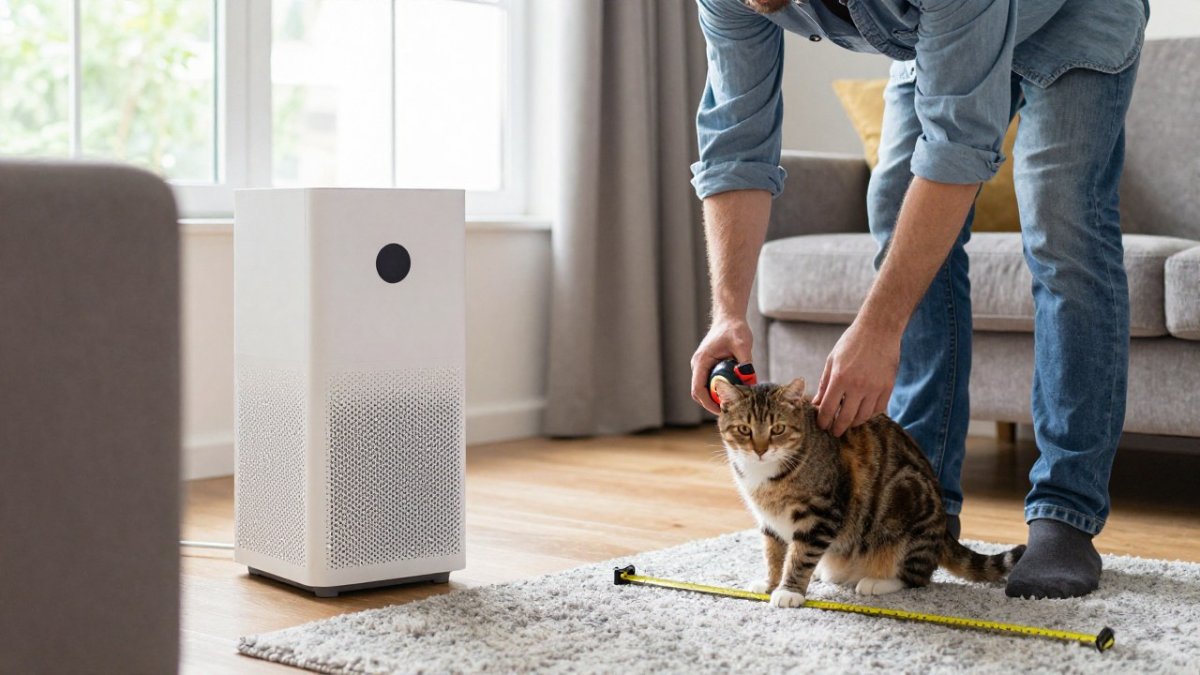
Now consider a 500-square-foot open-plan living area. Its required CADR depends on ceiling height and target ACH, and a single unit may not reach it, in which case two smaller units spaced apart can be considered.
!Homeowner with a cat measuring a living room with a tape measure beside a white air purifier on the floor
Smoke CADR vs Dust CADR vs Pollen CADR
Manufacturers often publish three separate ratings. Each one tests a different particle size.
- Smoke CADR measures the smallest particles, which matter most during wildfire season or when cooking creates haze.
- Dust CADR tests larger particles, such as household dust and pet dander.
- Pollen CADR tests the largest particles, which settle fastest and are common in spring.
If wildfire smoke is your main concern, look at the smoke rating first. If pets or dust drive your allergies, the dust rating matters more. Our guide on [How To Reduce Pollen In Home Naturally | page:4] covers habits that help alongside any purifier. When several pets add dander and fur to the mix, matching the purifier’s dust CADR to the room’s needs becomes especially important, and Bentley’s Bark offers another perspective on choosing for a multi-pet home.
CADR Limitations for Gases, Odors and Ultrafine Particles
CADR is a particle-removal metric. It is measured against smoke, dust, and pollen under standardized test conditions, and it says nothing about a purifier’s ability to remove gases, odors, or chemical vapors such as formaldehyde from new furniture, volatile organic compounds from cleaning products, or cooking fumes. A unit with an excellent smoke CADR can still leave a room smelling of paint or pet odor if it lacks a substantial activated carbon filter. When gases and odors matter, look for the weight and type of carbon media (pounds of carbon, not just “carbon filter included”) and any published removal data for specific gases.
Ultrafine particles, generally defined as particles smaller than 0.1 micrometers, are another gap. CADR testing does not report a separate ultrafine rating, and performance in that size range depends heavily on filter efficiency and airflow path. A true HEPA filter is rated to capture 99.97 percent of particles at 0.3 micrometers, which is often the most penetrating particle size for mechanical filters; smaller particles are captured with similar or higher efficiency by diffusion, but the CADR number itself does not tell you this (the EPA). Check whether the manufacturer publishes independent test data for ultrafine or nanoparticle removal, and favor units with a sealed HEPA filter and a gasketed housing that prevent bypass.
CADR also reflects a particular operating condition. Published ratings typically come from a standardized test at a specified fan speed, often the highest setting. At lower speeds, CADR drops, sometimes substantially, and noise drops with it. A purifier that is quiet enough to run continuously at medium speed may deliver only half its rated CADR in everyday use. Look for a unit that publishes CADR at multiple fan speeds or that has a credible low-speed rating if you plan to leave it on around the clock.
Real-world factors further separate the lab number from your bedroom. Filter loading as the HEPA media collects particles reduces airflow and effective CADR over time, which is why replacement intervals matter. Open doors, ventilation, and continuous sources such as pets or cooking add particles faster than a single purifier can remove them in some cases. Placement against a wall or behind furniture can short-circuit airflow and lower effective cleaning. None of these factors appear in the CADR rating, so treat it as one input among several: pair a suitable CADR with a true HEPA filter, adequate carbon for odors, a sealed airflow path, and a maintenance schedule that keeps the unit performing near its rated level.
Choosing Your Next Purifier and Booking a Room-Size Check With Aero Essence
Start with your main concern: smoke, dust, pet dander or pollen. Pick the matching CADR, then confirm the rating covers your room size. Add a margin if the room is large or you run the unit only at low speed.
| Concern | Rating to Check | Room Tip |
|---|---|---|
| Wildfire smoke | Smoke CADR | Match to full room area |
| Pet dander | Dust CADR | Add margin for pet rooms |
| Spring pollen | Pollen CADR | Keep doors and windows closed |
Our SR100 is built to handle nine kinds of pollutants, including dust mites, pet dander, pollen, mold spores and smoke. It also gives visual confirmation that it is working. The team at Aero Essence LLC can help you match a room size with the right unit.
For a room-by-room check, consider the layout, ceiling height and how the space is used. Pricing depends on the model, quantity and current availability, so visit the Aero Essence LLC website for current prices or a quote.
Frequently Asked Questions
What is a good CADR score for an air purifier?
A good CADR depends on the room. CADR is rated separately for smoke, dust and pollen, and the higher the number, the faster the unit clears particles of that type. A common approach is to choose a unit whose CADR is at least two-thirds of the room area in square feet, and to pick a higher rating for pets, wildfire smoke or allergy concerns. Check the rating for the pollutant you care most about rather than relying on a single number. Verify the specification on the current product page before buying.
Does a higher CADR always mean cleaner air?
Not necessarily. CADR measures how quickly a purifier removes particles under test conditions, not how consistently it performs in daily use or how clean the air will be in every setting. Filter condition, placement, fan speed, room layout and pollutant sources all affect results. A higher CADR helps the unit clear a room faster, but source control and regular filter replacement still matter.
Do air purifiers actually improve air quality?
They can reduce airborne particles such as dust, pollen, pet dander and smoke when sized correctly and run consistently. CADR provides a useful comparison point, but it describes particle-removal speed rather than guaranteed air quality. Gases, odors and some ultrafine particles may not be captured as effectively, so purifiers work best alongside ventilation and reducing pollution at the source.
What CADR do I need for my room?
Start with your room’s square footage, then choose a CADR for each pollutant type that is at least two-thirds of that area for general use. For example, a 300-square-foot room would call for a smoke or dust CADR of about 200 or more. Households with pets, allergies or wildfire smoke exposure may want a higher rating. Consider ceiling height and whether the unit can run on a higher fan speed when needed.
