
Top 5 Air Purifiers for Pet Owners 2026
Table of Contents
- Quick Comparison Table
- Why Pet Owners Need Air Purifiers
- Key Features to Look for in the Best Air Purifier for Pet Dander
- 1. Aero Essence SR100 Review: Visual Confirmation of Air Quality
- 2. Coway Airmega 200M: Best for Medium Rooms
- 3. Rabbit Air MinusA2: Premium Design for Pet Allergies
- 4. Molekule Air Pro: Advanced Technology for Large Spaces
- 5. Dyson Purifier Cool TP07: Purifier and Fan Combination
Last Updated: August 28, 2026
Quick Comparison Table
| Air Purifier | Coverage Area | Key Strength | Best For |
|---|---|---|---|
| Aero Essence SR100 | 129-161 sq ft | Real-time particle count display | Small rooms, visual confirmation seekers |
| Coway Airmega 200M | 361 sq ft | Four-stage filtration, quiet operation | Medium rooms, pet odor removal |
| Rabbit Air MinusA2 | 815 sq ft | Wall-mountable design, customizable filters | Large rooms, design-conscious owners |
| Molekule Air Pro | 1,000 sq ft | PECO technology destroys pollutants | Extra-large spaces, advanced purification |
| Dyson Purifier Cool TP07 | Medium spaces | Dual purifier-fan function | Multi-purpose cooling and purification |
Why Pet Owners Need Air Purifiers
Pet dander, invisible microscopic skin flakes, accumulates throughout your home and triggers allergies and respiratory irritation. A single cat or dog generates thousands of particles daily that circulate via HVAC systems and settle in areas traditional vacuuming misses.
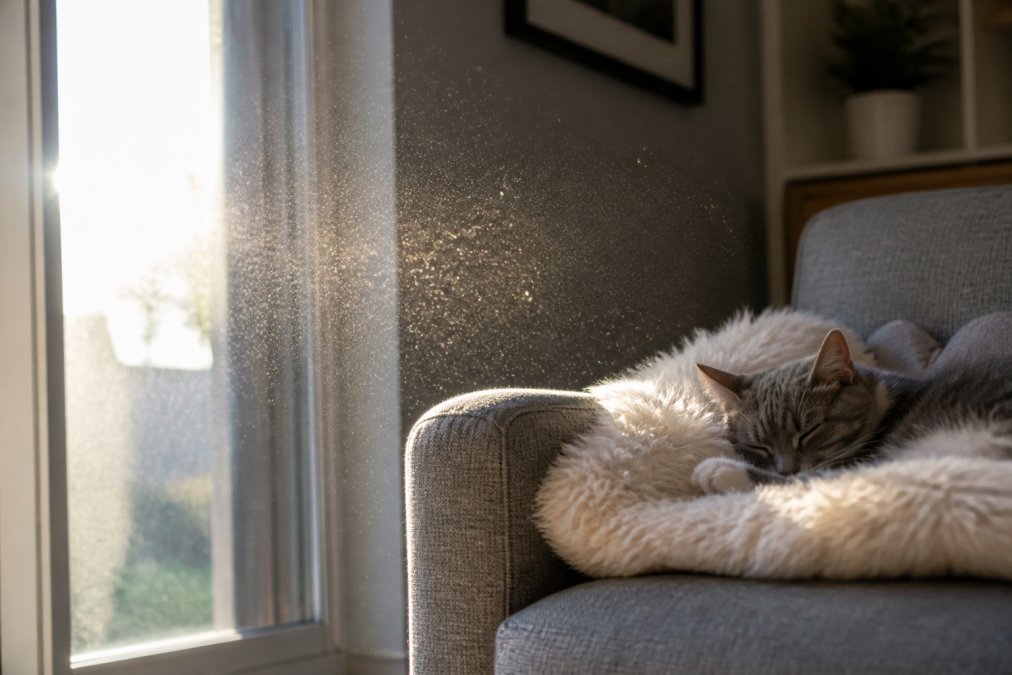
Beyond dander, pets introduce volatile organic compounds, bacteria, and mold spores that compound the filtration challenge. Pet-related allergens contribute to asthma flare-ups, chronic sinus congestion, and sleep disruption. According to the American Lung Association’s guidance on pet allergens and indoor air quality, removing pet dander from the air directly reduces respiratory symptoms.
A quality air purifier uses True HEPA filtration to capture particles as small as 0.3 microns, addressing the full spectrum of pet-related air quality issues. The best air purifiers for pet owners provide visual confirmation that purification is actually happening, eliminating guesswork about whether your investment is working.
Key Features to Look for in the Best Air Purifier for Pet Dander
True HEPA filtration is non-negotiable. This standard captures 99.97% of particles 0.3 microns or larger, where most pet dander and dust mite allergens live (the EPA). HEPA-type filters fall short of this standard. Verify the filter is labeled "True HEPA" or "H13 HEPA," not just "HEPA-type."
Activated carbon filters handle odors that True HEPA cannot address. Pet urine, wet fur, and litter box odors persist because they’re chemical compounds, not particles. Activated carbon absorbs these volatile organic compounds through adsorption, trapping odor molecules within the filter’s porous structure.
A washable pre-filter extends overall filter life and reduces long-term costs. This first stage captures larger particles and pet hair before they reach the True HEPA layer, allowing you to rinse and reuse it indefinitely while replacing only the True HEPA and carbon filters regularly.
CADR ratings (Clean Air Delivery Rate) indicate how much filtered air the unit moves per minute. For pet owners, look for CADR scores of at least 200+ for smoke, dust, and pollen. A unit rated for 300 sq ft will underperform in a 400 sq ft bedroom.
Real-time air quality monitoring separates guesswork from certainty. Some units display a particle count meter or color-coded air quality index, showing whether the purifier is reducing particles. This transparency is especially valuable for people with asthma or severe allergies.
Noise levels matter in bedrooms and living spaces. Look for units rated at 43 dB or lower on sleep mode if the purifier will run at night. Many pet owners run purifiers 24/7, so a loud unit becomes a constant irritant.
1. Aero Essence SR100 Review: Visual Confirmation of Air Quality
The Aero Essence SR100 stands apart because it solves a problem most competitors ignore: the need to see that your purifier is actually working. This is the top choice for pet owners who want tangible proof of performance.
The SR100’s standout feature is its real-time particle count meter displayed on top of the unit. Rather than trusting brand claims or waiting weeks to notice improvement, you watch the particle count drop in real-time. For someone with multiple cats and severe pet allergies, this visual feedback transforms skepticism into confidence.
The three-stage filtration system includes a washable pre-filter for pet hair and larger debris, a True HEPA H13 filter removing 99.97% of particles 0.3 microns and larger, and an activated carbon layer eliminating pet odors. The built-in ionizer provides internal sanitization without emitting ionized air into your room.
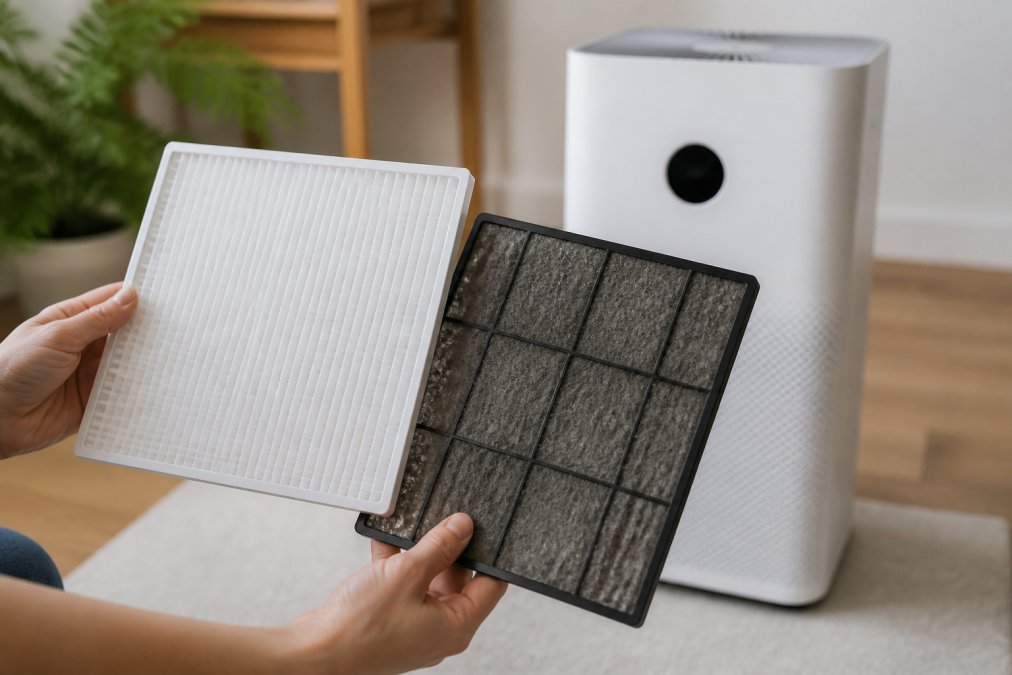
Coverage reaches 129-161 square feet, making this ideal for bedrooms, nurseries, and home offices. Sleep mode operates at just 43 dB, quiet enough for nighttime use. The real limitation is room size, it won’t keep pace with large open-concept spaces. For small to medium rooms, the SR100 performs exceptionally well.
2. Coway Airmega 200M: Best for Medium Rooms
The Coway Airmega 200M delivers broader coverage and a more comprehensive filtration approach. This is the practical choice for pet owners managing medium-sized spaces who want a proven, reliable system.
The four-stage filtration system adds a deodorization filter before the True HEPA layer, creating aggressive odor targeting. For households where pet smell has seeped into walls and furniture, this layered approach makes a measurable difference.
Coverage extends to 361 square feet with a 4.8 air changes per hour (ACH) rating, sufficient for most bedrooms and living rooms. The color-coded air quality display shows green for good air quality, yellow for moderate pollution, and red for poor air quality, giving clear confirmation that the unit is responding to pollution levels.
Eco-mode and automatic speed control reduce energy consumption when air quality improves. Rather than running at full capacity constantly, the Airmega 200M adjusts fan speed based on detected pollution levels, translating to lower electricity costs over time.
The bipolar ionizer can be toggled off if you prefer traditional filtration only. Quiet operation on lower settings makes the Airmega 200M suitable for bedrooms and living spaces where noise sensitivity matters.
3. Rabbit Air MinusA2: Premium Design for Pet Allergies
The Rabbit Air MinusA2 targets someone willing to invest substantially in air quality who refuses to sacrifice aesthetics. This wall-mountable purifier doubles as home decor, appealing to design-conscious pet owners.
The five-stage filtration system uses customizable filter cartridges. Rather than buying one-size-fits-all replacements, you select the configuration matching your specific needs: Pet Allergy filters for dander and hair, Germ Defense filters for bacteria and viruses, Toxin Absorber filters for volatile organic compounds, or Odor Remover filters for pet odors. This modularity means you’re not paying for filtration you don’t need.
Coverage reaches 815 square feet, suitable for large bedrooms and open living areas. The wall-mounted design saves floor space, a significant advantage in apartments or homes where floor real estate is precious.
Ultra-quiet operation, as low as 20.8 dB in sleep mode, is exceptional. For light sleepers, this quiet operation is transformative.
The trade-off is cost. The MinusA2 commands a premium price, and replacement filter cartridges are expensive. Over three to five years, total cost of ownership becomes substantial. For pet owners with severe allergies or asthma, the premium is justified.
4. Molekule Air Pro: Advanced Technology for Large Spaces
The Molekule Air Pro uses PECO (PhotoElectroChemical Oxidation) to actively destroy pollutants rather than simply trapping them in filters. For large spaces or households with severe air quality concerns, this advanced approach justifies the substantial investment.
PECO technology uses light-activated catalysts to break down pollutants at the molecular level. Viruses, bacteria, mold spores, and volatile organic compounds are destroyed, not just contained. The FDA cleared the Molekule Air Pro as a Class II medical device for destroying viruses and bacteria.
The PECO-HEPA Tri-Power filter combines three technologies: PECO destruction, True HEPA capture, and activated carbon absorption. Coverage extends to 1,000 square feet, suitable for large open-concept homes. Particle and chemical sensors detect pollutants in real-time, feeding data to an app for remote monitoring.
The cost barrier is substantial. Replacement filters must be changed every six months at significant cost. For households running one unit continuously, annual filter expenses become meaningful. For standard pet dander and odor management, traditional filtration handles the job effectively at a fraction of the price.
5. Dyson Purifier Cool TP07: Purifier and Fan Combination
The Dyson Purifier Cool TP07 combines purification with active air circulation and cooling. For pet owners in warm climates seeking dual functionality, this hybrid approach offers genuine value.
The fully sealed HEPA H13 filtration and activated carbon filter handle pet dander and odors. The oscillating fan with 350-degree oscillation actively circulates purified air throughout your room, preventing dead zones where allergens settle.
Real-time air quality feedback appears on the display and syncs to a mobile app. App and voice control integration with Amazon Alexa, Google Assistant, and Siri Shortcuts makes operation seamless. Backward airflow mode allows purification without the fan, useful during sleep.
The trade-off is that the TP07 prioritizes fan performance as much as purification. At higher fan speeds, it becomes noticeably loud. The cooling function works best in moderate climates. Coverage is suitable for small to medium spaces, not large open-concept areas.
Air Purifier Maintenance for Pet Owners: Filter Costs and Replacement
Understanding true cost of ownership extends beyond initial purchase price. Filter replacement schedules and costs accumulate significantly over three to five years, and pet-heavy households face faster filter degradation.
Pet dander clogs filters faster than standard household dust. A pre-filter in a multi-pet home may need replacement every two to four months, compared to six months in a pet-free environment. True HEPA filters typically last six to twelve months depending on air quality and usage intensity.
Calculate annual filter costs by checking manufacturer pricing and replacement intervals. A unit with inexpensive filters replaced twice yearly costs far less than a premium unit with expensive filters replaced quarterly.
Washable pre-filters reduce costs substantially. Units featuring reusable pre-filters eliminate one recurring expense entirely. This design choice compounds into meaningful savings over years of operation.
Some manufacturers offer filter subscription services with modest discounts compared to retail pricing, but they create less flexibility if your air quality improves or you relocate.
Choosing the right air purifier for pet owners requires balancing room size, filtration technology, budget, and the specific pollutants affecting your household. The Aero Essence SR100 leads this category because it provides what other purifiers withhold: real-time visual confirmation that purification is actually happening. For pet owners who’ve invested in air quality solutions before without seeing results, this transparency transforms skepticism into confidence. The SR100’s three-stage filtration removes pet dander, odors, and invisible particles while its particle count display proves performance in real-time. The EPA’s guidance on indoor air quality and pet allergen management confirms that visible air quality monitoring increases user compliance and satisfaction. Shop Now to experience the difference that proven filtration and transparent feedback deliver for your home.
Frequently Asked Questions
Do air purifiers actually help with pet dander and hair?
Yes. True HEPA filters capture 99.97% of particles 0.3 microns and larger, which includes pet dander, hair, and dust mites. Activated carbon filters absorb pet odors. For best results in multi-pet households, choose a purifier with True HEPA H13 filtration and a CADR rating that matches your room size. Position the purifier centrally to maximize air circulation and filtration performance.
What features should pet owners look for in an air purifier for pet dander?
Prioritize True HEPA filtration (not HEPA-type), activated carbon for odor removal, a washable pre-filter to extend filter life, and an appropriate CADR rating for your room size. Air quality sensors or visual displays help confirm the purifier is working. For pet owners, a quiet operation (under 50 dB) and easy filter replacement are essential for long-term use and maintenance satisfaction.
How often should I change the filter on a pet-specific air purifier?
Pet owners typically need to replace filters every 3-6 months, depending on the number of pets and filter quality. A washable pre-filter can extend the life of the main HEPA filter. Check your purifier's filter replacement schedule in the manual. Keep spare filters on hand, especially during high-shedding seasons. Monitor the air quality display or reset indicator to know when replacement is needed.
What makes the Aero Essence SR100 review stand out for pet owners?
The SR100 features a real-time particle count meter that provides visual confirmation of air quality improvement, addressing a common pain point for pet owners who want proof the purifier is working. Its 3-stage filtration includes True HEPA H13 and activated carbon to tackle both pet dander and odors. The quiet 43 dB sleep mode suits bedrooms, and its compact design fits small to medium rooms effectively.
Can air purifiers remove pet odors effectively?
Yes, but only if they include activated carbon filtration. Activated carbon absorbs volatile organic compounds and odors at the molecular level, which HEPA filters alone cannot do. Look for purifiers with both True HEPA and a substantial activated carbon layer. In multi-pet households or larger spaces, ensure the purifier's CADR rating for odor is adequate for your room size to handle the volume of odor-producing particles.
This article was written using GrandRanker