
Do Air Purifiers Help With Allergies: What Science Shows
Table of Contents
- How Air Purifiers Work for Allergies
- HEPA Filter Effectiveness for Allergens
- Types of Allergens Removed by Air Purifiers
- Do Air Purifiers Remove Mold Spores
- How to Reduce Indoor Allergens Beyond Filtration
- Real-World Limitations and What Clinical Evidence Shows
- Conclusion
- Frequently Asked Questions
Last Updated: September 4, 2026
Ask whether do air purifiers actually help with allergies and you will get a confident “yes” from every manufacturer and a skeptical shrug from many owners who bought one, ran it for a week, and saw no change. The truth sits between those extremes. Air purifiers are effective tools for reducing airborne allergens, but they work within strict physical limits that most marketing glosses over. At Aero Essence LLC, we design purification systems for homes dealing with pet dander, pollen, and wildfire smoke, and we have learned that the difference between a purifier that helps and one that collects dust comes down to filtration type, room size, and placement.
A good air purifier is a mechanical device that pulls room air through a filter stack to trap particulate matter before recirculating cleaner air. The core technology is straightforward, yet most buyers skip the specifications that actually determine whether the unit will reduce their respiratory symptoms. Below, we will explain the filtration science, the real-world limitations, and the maintenance costs you need to budget for before you buy.
How Air Purifiers Work for Allergies
An air purifier reduces indoor allergens by continuously circulating room air through a filter that captures airborne particles such as dust, pollen, and dander. The unit’s fan pulls contaminated air in through an intake, passes it through the filter media, and pushes cleaned air back into the room. This cycle repeats until particle concentrations drop to a level that is less likely to trigger symptoms.
The filtration process explained
Most effective purifiers use a multi-stage system. A pre-filter catches larger particles like pet fur and lint, which protects the main filter and extends its life. The primary HEPA filter then captures finer particles, while an activated carbon layer absorbs gases and odors. Understanding this sequence matters because a purifier with a weak pre-filter will clog its HEPA layer faster, increasing your filter replacement costs.
Why placement and room size matter
Air purifier placement determines how much of the air in your living space actually passes through the filter. A unit rated for 200 square feet placed in a corner of a 600 square foot open-plan room will only clean the air immediately around it. You need the unit’s clean air delivery rate (CADR) to match your room’s square footage, and you should position the intake away from walls and furniture to allow proper air circulation.
The most common mistake is buying a purifier sized for a bedroom and placing it in a living room. The unit runs constantly, the filter loads quickly, and the owner concludes that [air purifiers](/removing-mold-spores-from-home-air/) do not work. Match the CADR to your room size first, then evaluate performance.
HEPA Filter Effectiveness for Allergens
HEPA filter effectiveness for allergens is well established: a true HEPA filter captures at least 99.97% of particles at 0.3 microns, which covers the size range of most common allergens (the EPA). This filtration efficiency is why HEPA is the standard recommendation from allergy specialists for reducing airborne triggers.
What HEPA filters capture
Pollen grains range from 10 to 100 microns, dust mite debris sits around 10 microns, and pet dander flakes fall between 2.5 and 10 microns. Mold spores typically measure 3 to 100 microns. All of these are far larger than the 0.3 micron test standard, meaning a genuine HEPA filter traps them with near-total efficiency. The particles that escape HEPA filtration are the ultrafine ones below 0.1 microns, which are less relevant to allergy sufferers and more relevant to smoke and chemical concerns.
CADR and ACH: Understanding real performance
Two specifications tell you whether a purifier will actually clean your room: CADR and air changes per hour (ACH). CADR measures the volume of clean air a purifier delivers in cubic feet per minute, and it is certified by the Association of Home Appliance Manufacturers for units sold in the United States. ACH refers to how many times the purifier cycles the entire room’s air volume in an hour.
For allergy relief, you want a purifier that achieves at least four air changes per hour, meaning it processes the full room volume every 15 minutes. A common mismatch is buying a unit with a high CADR rating but placing it in a room too large for that rating, which drops the effective ACH below useful levels.
Types of Allergens Removed by Air Purifiers
Air purifiers remove the allergens that float in the air, and that distinction matters more than most guides admit. A unit with a true HEPA filter will capture pollen, dust mite debris, pet dander, and mold spores while they are airborne, along with smoke particles and other particulate matter down to 0.3 microns.
Pollen, dust mites, and pet dander
Pollen enters from open windows and on clothing, and it stays airborne for hours, which makes it highly responsive to filtration. Dust mites themselves are too heavy to float, but their fecal particles and shed exoskeletons become airborne when you disturb bedding or carpet, and those fragments are what trigger allergic rhinitis. Pet dander is light and sticky, so it circulates in the air and also settles on surfaces, meaning a purifier reduces your exposure but does not eliminate the source.
Mold spores and volatile organic compounds
Mold spores travel through the air and can be captured by a HEPA filter, which is relevant for damp basements and bathrooms. Volatile organic compounds (VOCs) from paints, cleaning products, and new furniture are gases, not particles, so a HEPA filter alone will not remove them. You need an activated carbon layer for VOC absorption, and that layer saturates over time and must be replaced.
Do Air Purifiers Remove Mold Spores
Yes, air purifiers remove mold spores from the air, but they do not solve an active mold problem. A HEPA filter captures airborne mold spores as they circulate, which reduces your inhalation exposure and can help prevent spores from spreading to other rooms. For someone with asthma or mold sensitivity, this reduction in airborne spore concentration can ease respiratory symptoms.
The limitation is that mold grows on surfaces, and a purifier has no effect on the colony itself. If you have visible mold growth in your basement or behind drywall, you must address the moisture source and remediate the infestation before filtration becomes useful. Running a purifier alongside an active mold problem is like trying to mop a floor while the ceiling leaks.
Use an air purifier with a HEPA filter to manage airborne mold spores in damp spaces, but only after you have fixed the underlying moisture problem. Filtration manages symptoms; it does not cure the source.
How to Reduce Indoor Allergens Beyond Filtration
The most effective way to reduce indoor allergens combines air purification with source control, and this is where many allergy sufferers go wrong. Air purifiers only capture particles that pass through their intake, and a significant portion of allergens never become airborne in the first place, or they settle out of the air before the purifier can trap them.
The settling problem: why airborne allergens don’t stay airborne
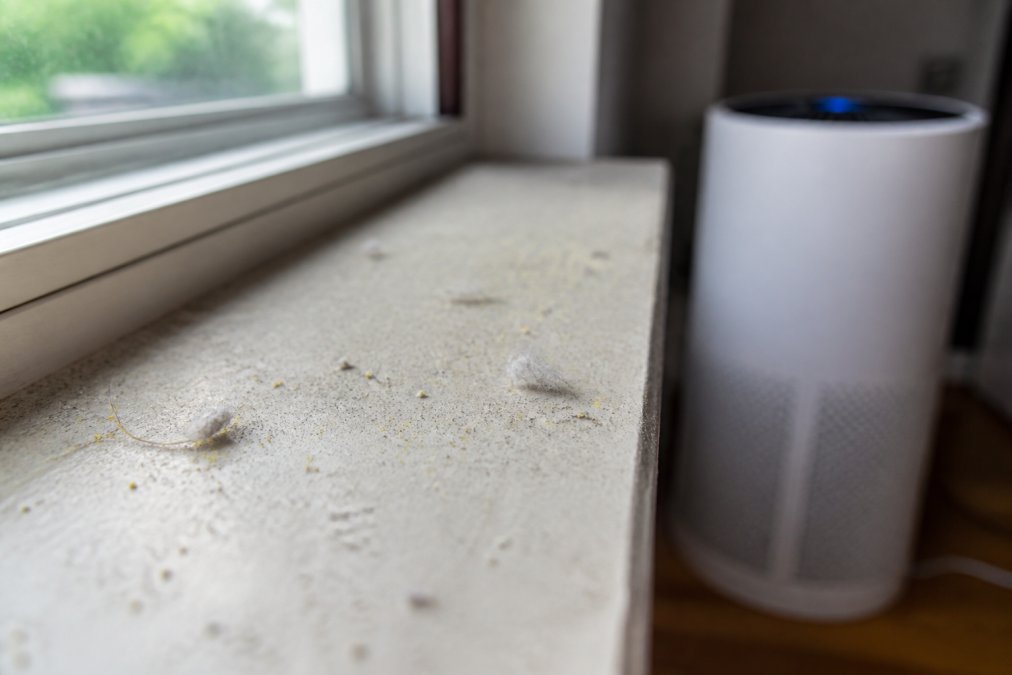
Particles have weight, and gravity pulls them down. Dust mite fecal pellets (roughly 10 microns) and pet dander clusters settle to surfaces within 15 to 30 minutes of being disturbed, depending on air currents and humidity. Larger pollen grains (10-100 microns) settle even faster. Once settled on a carpet, bedding, upholstered furniture, or windowsill, these allergens are no longer airborne and cannot be captured by a purifier.
This is the critical limitation competitors often gloss over: a purifier running in a bedroom with wall-to-wall carpet, a pet sleeping on the bed, and unwashed sheets will only capture the small fraction of allergens that remain suspended in the air. The majority of your allergen exposure comes from the settled reservoir on surfaces.
A practical approach to reduce indoor allergens includes:
- Wash bedding weekly in hot water (at least 130°F) to kill dust mites and remove their fecal debris.
- Use allergen-proof mattress and pillow covers (rated for particles down to 0.3 microns) to create a physical barrier between you and the settled allergen layer.
- Vacuum with a HEPA-equipped vacuum at least twice weekly, especially in high-traffic areas and bedrooms. Standard vacuums recirculate fine particles back into the room; HEPA vacuums trap them.
- Reduce carpet and upholstered furniture where allergens accumulate. Hard flooring and wipeable surfaces are easier to keep clean.
- Keep pets out of the bedroom if you have pet allergies. Pet dander settles heavily on sleeping surfaces, and a purifier cannot remove it from your pillow while you sleep.
- Dust surfaces with a damp cloth rather than dry dusting, which kicks particles back into the air.
When combined with a properly sized purifier, these measures reduce both the airborne and settled allergen load, which produces more noticeable symptom relief than filtration alone.
Filter maintenance and the true cost of ownership
Filter replacement is the recurring cost most buyers never budget for, and it determines whether your purifier continues to work effectively. Understanding the maintenance schedule and cost is essential to making a realistic long-term decision.
Pre-filter maintenance: Most purifiers include a washable or replaceable pre-filter that catches larger particles like pet fur, lint, and dust. This layer protects the HEPA filter underneath and extends its life. Depending on pet ownership and dust levels in your home, you should clean or replace the pre-filter every 2 to 4 weeks. A washable pre-filter costs nothing to maintain but requires regular attention; a disposable pre-filter typically costs $15 to $40 per replacement.
HEPA filter replacement: The main HEPA filter is where most of the cost accumulates. A genuine HEPA filter typically needs replacement every 6 to 12 months, depending on how many hours per day you run the unit and how dusty your home is. Homes with pets, smokers, or high outdoor pollen counts may need replacement every 6 months. HEPA filter replacements range from $40 to $150 per filter, depending on the purifier model and where you buy them.
Activated carbon layer: If your purifier includes an activated carbon filter for odor and gas absorption, this layer saturates faster than HEPA and may need replacement every 3 to 6 months if you live near smoke, use strong cleaning products, or have pets. Carbon filter replacements typically cost $20 to $80.
Annual maintenance cost example: A household running a purifier 8 hours daily in a dusty environment might spend:
- Pre-filter replacements (6 per year): $90
- HEPA filter (2 per year): $200
- Carbon filter (2 per year): $80
- Total annual cost: $370
This recurring expense often exceeds the initial purchase price of budget purifiers within 2 to 3 years. Before buying a unit, confirm that replacement filters are readily available and check their cost. Some purifier models have expensive proprietary filters with limited availability, which can make long-term ownership impractical.
Running a purifier with a clogged filter reduces air flow, drops the effective CADR, and can allow previously captured particles to shed back into the room. A clogged HEPA filter also forces the motor to work harder, increasing electricity consumption and shortening the unit’s lifespan. Staying on top of filter replacement is not optional, it is the difference between a working purifier and an expensive dust collector.
Real-World Limitations and What Clinical Evidence Shows
Clinical evidence supports air purifier use as part of an allergy management plan, but the research consistently shows that filtration works best alongside environmental controls. Studies on allergic rhinitis have measured reductions in nasal congestion and symptom scores when HEPA purifiers run in bedrooms, yet the same research notes that improvements are modest for people with dust mite allergies, because the major exposure happens in bed, where the purifier cannot remove allergens from your pillow.
What the evidence does not support is the expectation that a purifier will eliminate symptoms entirely. Air purifiers are an environmental control measure, not a medical treatment. If you have asthma or moderate to severe allergies, the guidance from organizations like the American Academy of Allergy, Asthma & Immunology is to combine filtration with medication, source reduction, and, where appropriate, allergy immunotherapy.
The Environmental Protection Agency’s indoor air quality guidance similarly frames air cleaners as one component of a broader strategy that includes ventilation and source control. For most households, the realistic outcome of running a properly sized purifier is a measurable reduction in airborne particle counts, which translates to fewer symptom flare-ups, not a cure.
Conclusion
Choosing an air purifier for allergies means accepting what the technology can and cannot do. A properly sized unit with a true HEPA filter will reduce airborne pollen, dander, and mold spores, and that reduction can ease your symptoms. It will not fix a mold problem, remove settled dust, or replace medication, and the filters will cost you money every year.
For households that want a unit that visibly confirms it is working, the SR100 from Aero Essence LLC targets nine types of pollutants, including dust mites, pet dander, pollen, mold spores, and smoke, with visual confirmation that purification is actively happening. Shop Now with Aero Essence LLC and take the first step toward measurably cleaner indoor air.
Frequently Asked Questions
Do air purifiers actually help reduce allergy symptoms?
Air purifiers can help reduce airborne allergens like pollen, dust mites, and pet dander when equipped with HEPA filters. However, they work best as part of a broader allergy management strategy. Many allergens settle on surfaces within minutes, so air purifiers alone won’t eliminate all triggers. They’re most effective in smaller, enclosed spaces with proper placement and regular filter maintenance. Clinical evidence shows they can reduce respiratory symptoms when used consistently alongside other environmental controls.
How often should you change air purifier filters for allergy relief?
Filter replacement frequency depends on air quality, usage, and the purifier’s specifications. In homes with pets or high pollen exposure, filters may need replacement every 3-6 months. Standard household use typically requires annual replacement. Check your purifier’s manual for exact recommendations. Frequent filter changes ensure optimal HEPA filter effectiveness for allergens and maintain clean air delivery rates. Clogged filters reduce performance and can actually recirculate captured particles, making regular maintenance critical for allergy relief.
Can air purifiers help with pet dander allergies?
Yes, HEPA filters can capture pet dander particles as small as 0.3 microns, making them effective at removing airborne dander. However, pet dander settles quickly on furniture, bedding, and floors, so an air purifier works best when combined with frequent vacuuming, washing pet bedding, and keeping pets out of bedrooms. Placement matters, position the purifier in the room where you spend the most time. For households with multiple pets or severe allergies, a high-performance unit with strong airflow and adequate room coverage yields better results than smaller models.
Do air purifiers remove mold spores?
HEPA filters can capture airborne mold spores, but they address only part of the mold problem. Mold grows on surfaces with moisture and humidity, so an air purifier alone won’t prevent mold growth. To manage mold effectively, control humidity levels below 50%, fix water leaks promptly, and improve ventilation. An air purifier helps reduce spores already in the air, but if you have visible mold or persistent moisture issues, consult a mold specialist. Air purifiers work best as a preventive tool alongside proper moisture control, not as a substitute for addressing the root cause.
This article was written using GrandRanker