
Air Purifier vs Mold Remediation: Cost & Effectiveness
Table of Contents
- Air Purifier vs Mold Remediation: Quick Comparison
- Understanding Mold Spores and Indoor Air Quality
- Signs of Mold Infestation in Home
- Air Purifier Costs and Limitations for Mold
- Professional Mold Removal Cost Breakdown
- When to Choose Air Purification vs Professional Remediation
- Making Your Decision: ROI and Long-Term Value
- Frequently Asked Questions
Last Updated: September 1, 2026
Air Purifier vs Mold Remediation: Quick Comparison
When mold becomes a problem in your home, you face a fundamental choice: invest in air purification to manage airborne spores, or hire professionals to eliminate the source. Air purifiers capture mold spores already floating in your indoor air, while professional mold remediation removes the visible mold growth and moisture sources that generate those spores in the first place.
An air purifier can be part of your strategy, but it’s not a replacement for addressing mold at its source when structural damage or active growth exists.
Professional mold removal typically ranges from $1,223 to $3,753 depending on the extent of contamination and affected square footage, while quality air purifiers vary significantly depending on filtration technology and coverage area (the CDC). The real question is whether you’re dealing with a containable airborne problem or a structural one that requires professional intervention.
| Solution | Primary Cost | Coverage | Best For |
|---|---|---|---|
| Air Purifier (HEPA-based) | Initial purchase + filter replacement | Single room to 2,800 sq ft | Ongoing spore reduction in clean spaces |
| Professional Mold Remediation | $1,223-$3,753 average | Entire affected area | Active mold growth, structural concerns |
| Air Purifier (Advanced filtration) | Higher initial investment | Large open spaces | Sensitive individuals, post-remediation maintenance |
Understanding Mold Spores and Indoor Air Quality
Mold reproduces by releasing microscopic spores into the air. These invisible spores travel through your home continuously, and when mold colonies grow on surfaces like basement walls, bathroom tiles, or HVAC systems, they become a persistent source of airborne contaminants.
Air purifiers with HEPA filtration can trap mold spores as they float through the air. HEPA filters capture particles as small as 0.3 microns, which includes most mold spores (the EPA). However, capturing spores already airborne doesn’t stop new spores from being produced by the mold source. If you have active mold growth on a basement wall, a purifier running in your bedroom manages the problem downstream, not at the source.
This explains why many homeowners feel disappointed with air purifier results when they have actual mold infestations. The purifier works as designed, but the source keeps generating new spores faster than the purifier can capture them. You’re treating a symptom while the underlying problem grows.
Check your HVAC system for mold growth. Many mold problems spread through ductwork because the system’s moisture and temperature create perfect conditions for colonies. A professional inspection can identify hidden mold that air purifiers alone won’t address.
Signs of Mold Infestation in Home
Visible mold is the most obvious sign, but many problems start hidden inside walls, under flooring, or in crawl spaces before becoming visible. The most common visible signs appear in bathrooms, basements, and around windows: black or dark green spots on grout, caulk, or tile indicate active mold colonies. Discoloration on drywall or wood framing suggests moisture penetration.
Beyond visible signs, a persistent musty odor is often the first clue that microbial growth is present. Respiratory symptoms that worsen indoors, particularly in specific areas, suggest elevated spore levels. Allergic reactions that improve when you leave the house and worsen when you return suggest your indoor environment contains mold spores. Visible condensation on windows indicates humidity levels that support mold growth.
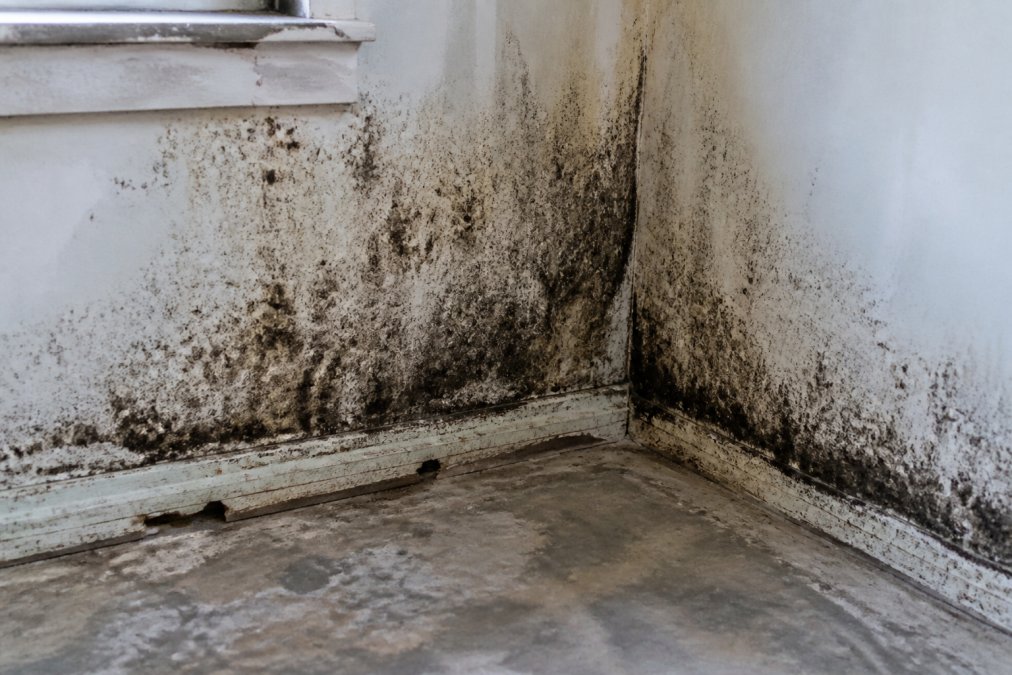
Basements are the most common site because they’re below grade and prone to moisture infiltration. Bathrooms rank second due to constant humidity from showers. Attics can develop mold if roof leaks go unaddressed. HVAC systems harbor mold when condensation builds up in ducts.
If you find mold covering an area larger than 10 square feet, professional remediation is necessary ([the EPA](https://www.epa.gov/mold/mold-cleanup-your-home)). Attempting DIY removal on large infestations risks spreading spores throughout your home and failing to address the moisture source that caused it.
Air Purifier Costs and Limitations for Mold
Air purifiers designed for mold spore capture use HEPA filtration as their primary mechanism. Medical-grade HEPA filters trap 99.97% of particles down to 0.3 microns, which catches most mold spores. Some advanced models add activated carbon for odor elimination and additional filtration layers.
Quality HEPA-based units start around $300 and scale upward depending on coverage area and filtration sophistication. Larger units covering 2,800 square feet run significantly higher. Filter replacement typically occurs every 6-12 months, with replacement filters costing $50-$200 per set. Annual electricity costs generally fall between $50-$150 for continuous operation.
The critical limitation of air purifiers is their inability to address mold sources. A purifier sitting in your bedroom captures spores drifting in from the basement, but it doesn’t stop the basement mold from producing those spores. If the source remains active, you’re in a perpetual cycle of spore generation and capture.
Coverage area presents another practical limitation. A single air purifier covers a defined space, typically one room or an open-concept area. Whole-home mold problems require multiple units, which multiplies your cost investment. Air purifiers also require consistent maintenance; filters clog over time, reducing effectiveness.
Advanced air purification technologies like PECO (Photoelectrochemical oxidation) break down pollutants at a molecular level rather than simply trapping particles. However, PECO units carry premium pricing and still don’t address the source mold growth.
Air purifiers excel at maintaining clean air in spaces where mold sources have been eliminated. They’re less effective as standalone solutions when active mold growth continues in your home.
Professional Mold Removal Cost Breakdown
Professional mold remediation follows a structured protocol: assessment, containment, removal, and prevention. The initial assessment and inspection typically costs $300-$700 and includes identifying visible mold, checking for hidden growth using moisture detection equipment, and determining the extent of contamination.
Containment and removal represent the bulk of remediation costs. Professionals isolate affected areas to prevent spore spread during removal, seal doorways, run negative pressure equipment, and use specialized air filtration. For localized problems (under 100 square feet), costs typically range from $500-$1,500. Larger infestations covering 500-1,000 square feet run $2,000-$4,000 or more.
Professional remediation averages $10-$25 per square foot depending on severity, accessibility, and whether structural materials need replacement. Moisture remediation adds another cost layer, as professionals identify and repair the water source causing mold growth, whether that’s fixing a roof leak, improving basement drainage, or addressing HVAC condensation. This prevention work costs $500-$2,000 depending on the underlying issue.
Documentation and post-remediation testing add $200-$500. Professionals provide reports confirming remediation completion and may conduct air quality testing to verify spore levels have returned to normal.
Professional remediation is essential for homeowners with visible mold growth, structural concerns, health symptoms worsening indoors, or moisture problems they can’t identify or fix themselves.
When to Choose Air Purification vs Professional Remediation
The decision depends on what problem you’re actually solving. If you have visible mold growth on surfaces, active moisture intrusion, or symptoms that worsen in specific rooms, professional remediation is necessary. Air purification alone won’t resolve these situations.
Air purification makes sense after professional remediation is complete, to maintain air quality and capture residual spores; in homes where mold risk is high due to climate or building characteristics, as ongoing prevention; or when mold spores are present but no active mold growth exists.
The timeline matters. Professional remediation takes days to weeks depending on severity. After remediation is complete and the space has been cleaned, air purifiers become valuable for maintaining the improvement.
Consider the cost-effectiveness of each approach. If you invest $500-$1,000 in an air purifier but the underlying mold source costs $3,000 to fix, you’ve delayed the real solution while spending money on symptom management. Conversely, if you’ve already paid for professional remediation, a $600-$1,200 air purifier is a reasonable investment to prevent recurrence.
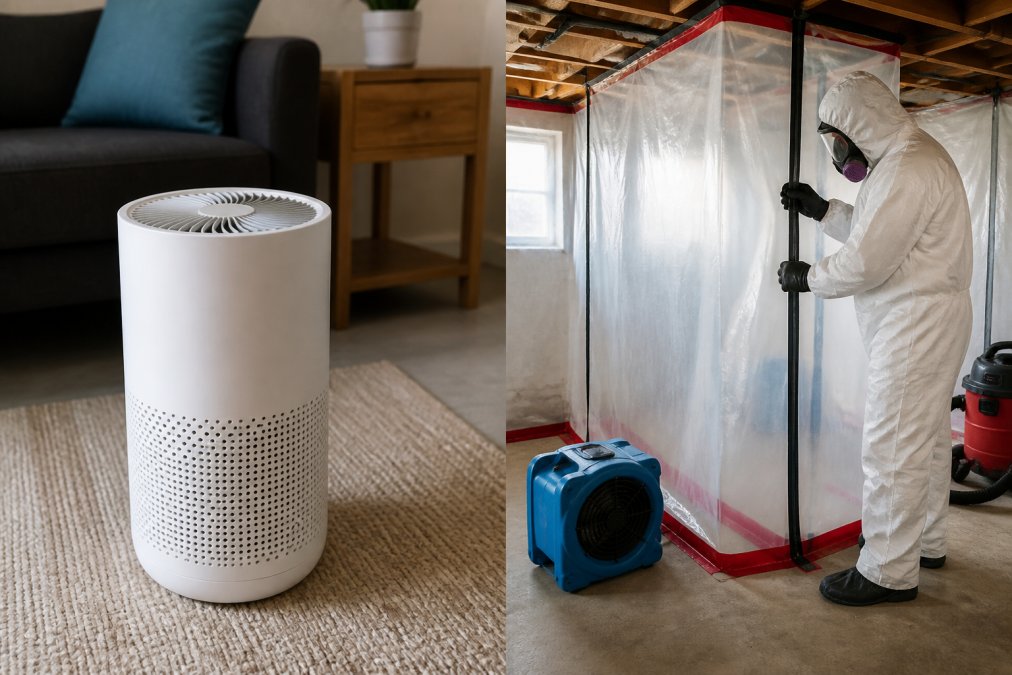
The presence of health symptoms shifts the equation. If household members have asthma, COPD, or documented mold sensitivity, professional remediation becomes the priority because it eliminates the source triggering symptoms.
Making Your Decision: ROI and Long-Term Value
Return on investment differs significantly between these approaches. Professional remediation costs more upfront but solves the problem permanently, assuming moisture sources are addressed. An air purifier costs less initially but requires ongoing filter replacement and electricity, with no guarantee it resolves the underlying issue.
A $700 air purifier with $100 annual filter costs and $100 electricity costs reaches $1,500 over five years. If your mold problem remains unaddressed during that period, you’ve spent $1,500 managing symptoms while structural damage worsens. When you finally hire professionals, remediation costs may be significantly higher.
Professional remediation’s value becomes clearer when you factor in property impact. Unaddressed mold reduces home value and creates liability if you sell. Documented professional remediation protects your property value and provides evidence of proper maintenance.
The decision framework is straightforward: if you have visible mold, structural concerns, or health symptoms worsening indoors, professional remediation is necessary. If you’re managing residual spore levels after remediation or preventing mold in a moisture-prone space, air purification adds value.
Aero Essence LLC’s SR100 air purifier is designed to handle nine distinct types of pollutants, including mold spores, as part of a comprehensive indoor air quality strategy. For homeowners who’ve already addressed mold sources professionally, this kind of purifier provides ongoing assurance that your air remains clean.
The long-term value equation favors addressing the root cause first, then using air purification for maintenance. Invest in professional remediation if mold is present, then deploy air purification to prevent recurrence and manage spore levels.
If you’re dealing with visible mold or experiencing symptoms that worsen indoors, professional remediation should be your first step. Once the mold source is eliminated and moisture is controlled, air purification becomes a valuable maintenance tool. At Aero Essence LLC, the SR100 handles mold spores alongside eight other pollutant types, giving you comprehensive protection for your home’s air quality. Shop Now to explore how the SR100 fits your indoor air management strategy.
Frequently Asked Questions
Q: Does an air purifier really help with mold?
A: Air purifiers with HEPA filtration capture airborne mold spores, reducing the concentration of spores in your breathing space. However, they address only spores suspended in the air, not mold growing on surfaces or the moisture conditions that cause mold to spread. For active mold colonies or visible growth, an air purifier alone is insufficient. It works best as a supplementary tool alongside moisture control or professional remediation.
Q: How expensive is professional mold removal cost on average?
A: Professional mold remediation typically ranges from $1,223 to $3,753, or $10 to $25 per square foot, depending on the extent of infestation, affected area size, and whether hidden mold exists. Costs increase significantly if structural materials require removal or if HVAC systems need cleaning. Obtain multiple professional quotes to understand your specific situation, as pricing varies by location and severity.
Q: Can an air purifier prevent mold growth on surfaces?
A: No. Air purifiers remove spores from the air but cannot prevent mold from growing on surfaces. Mold growth requires moisture, organic material, and warmth. To prevent surface mold, control humidity levels below 50%, ensure proper ventilation, fix water leaks, and maintain adequate airflow. An air purifier complements these efforts by reducing airborne spore concentration, but it does not address the root causes of mold formation.
Q: What are the best air purifiers for mold spores?
A: The best air purifiers for mold spores feature medical-grade HEPA filtration that captures 99.9% of particles as small as 0.3 microns. Look for units with activated carbon filters to eliminate musty odors and PECO technology that actively destroys pollutants rather than just trapping them. Ensure the purifier’s coverage area matches your space size, and verify long filter life to minimize replacement costs. Brands offering visual confirmation of operation help confirm the unit is actively working.
This article was written using GrandRanker