
Air Purifier Maintenance Tips to Extend Lifespan
Table of Contents
- Why Air Purifier Maintenance Directly Impacts Lifespan
- Air Purifier Filter Replacement Frequency: When to Swap Each Filter Type
- How to Clean Air Purifier Pre-Filter: Step-by-Step
- Best Practices for Air Purifier Placement
- Sensor Calibration and Smart Feature Reset Procedures
- OEM vs. Third-Party Filters: Cost and Performance Trade-Offs
- Maintenance Schedules for Homes With Pets, Allergies, and Wildfire Smoke
- Frequently Asked Questions
Last Updated: September 29, 2026
Why Sr100 Air Purifier Maintenance Directly Impacts Lifespan
Sr100 Air purifier maintenance is the most reliable way to extend a unit’s working life, and skipping it is the fastest way to shorten it. As filter media loads with captured particles, the fan motor pushes harder to move the same volume of air, raising energy consumption, lowering the clean air delivery rate, and wearing down the motor.
Air Purifier Filter Replacement Frequency: When to Swap Each Filter Type
Air purifier filter replacement frequency depends on the filter type, the pollution load in your home, and daily runtime. There’s no universal calendar, but there are reliable ranges.
HEPA and Activated Carbon Filter Timelines
HEPA filters capture fine particulate matter; activated carbon handles odors, gases, and volatile organic compounds. Both degrade with use, not time, a filter in a box doesn’t wear out, but one running 24/7 in a home with three cats does.
A practical way to think about replacement:
| Filter Type | Typical Replacement Window | Replace Sooner If |
|---|---|---|
| Pre-filter | Clean monthly, replace when frayed | Heavy pet hair or dust |
| HEPA | 6-12 months | Smoke events, allergies, continuous use |
| Activated carbon | 3-6 months | Odors return quickly, cooking fumes |
| Washable filters | Rinse monthly per manual | Visible discoloration persists |
The Runtime Math Most Guides Skip
Manufacturer replacement windows assume a duty cycle of 8 to 12 hours a day at moderate fan speed. Run your unit 24/7 and you consume filter life roughly twice as fast, divide the stated window by your actual daily runtime divided by the assumed runtime. Example: a HEPA filter rated for 12 months at 10 hours a day, run 24 hours a day, lands closer to 5 months.
Pressure Drop: The Real Signal a Filter Is Spent
Filter media doesn’t fail all at once. As it loads, resistance to airflow rises, what engineers call pressure drop, forcing the fan motor to work harder to move the same cubic feet per minute (CFM). A saturated filter shows up as:
- A noticeably louder fan at the same speed setting
- Reduced airflow from the exhaust vent (hold a tissue near it, weak flutter means restricted flow)
- The unit running on high more often to hit the same air quality reading
- Higher electricity draw for the same cleaning result
How to Read Your Unit’s Own Signals
Most modern purifiers give you at least one built-in indicator. Learn which yours uses:
- Filter life percentage: counts down based on runtime, not actual loading, treat it as a ceiling, not a floor.
- Airflow sensor or fan-speed auto-adjust: if the unit keeps ramping up, the filter is restricting flow.
- Odor breakthrough on carbon: when cooking smells or pet odors linger longer than they used to, the carbon stage is exhausted even if the HEPA stage is fine.
- Visible discoloration: hold the filter up to a light. Uniform gray is normal; dark, matted patches mean localized loading and uneven airflow.
Running a purifier with a saturated HEPA filter doesn’t just stop cleaning the air. It forces the fan motor to work against airflow obstruction, which can overheat the motor and permanently reduce unit lifespan.
Staggered Replacement Saves Money Without Sacrificing Performance
HEPA and carbon stages rarely die on the same day. Carbon usually exhausts first in homes that cook often or sit near traffic; HEPA first in pet or wildfire-smoke households. With separate cartridges, replace each on its own schedule; combined HEPA-plus-carbon cartridges lock you to the shorter lifespan.
A Quick Decision Checklist
Before ordering a replacement, run through this:
- How many hours a day does the unit actually run?
- Has anything changed, new pet, wildfire season, remodeling, new smoker?
- Is the fan louder or the exhaust weaker than when the filter was new?
- Has the unit’s filter indicator triggered, or is it close?
- Does the filter look uniformly loaded, or are there dark patches?
If two or more answers point to a loaded filter, replace it. If none do, you can push the window, but recheck monthly.
How to Clean Air Purifier Pre-Filter: Step-by-Step
Learning how to clean air purifier pre-filter is the highest-return maintenance task you can do: the pre-filter catches hair, lint, and large dust before they reach the HEPA media, directly extending HEPA filter life.
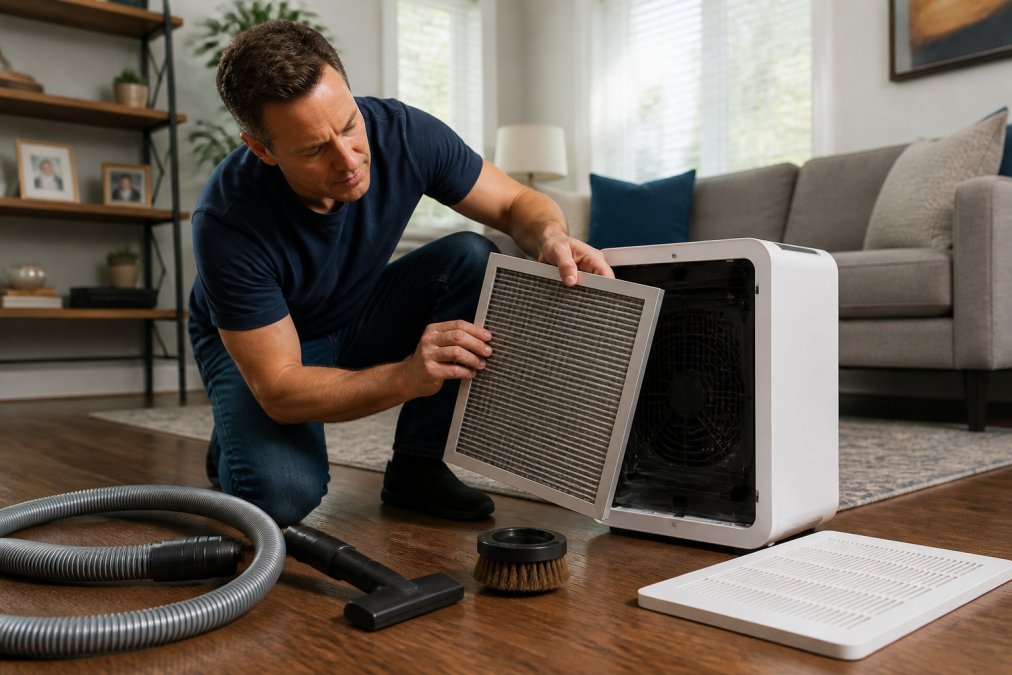
Here’s the process:
- Unplug the unit and remove the front grille or filter housing cover.
- Slide out the pre-filter. Most are a thin mesh layer wrapped around the main filter.
- Vacuum both sides using a brush attachment on low suction. Work along the mesh, not against it.
- For washable filters, rinse under lukewarm water until the runoff clears. Never use soap unless the manual allows it.
- Let the filter dry completely, at least 12 hours, before reinstalling. A damp filter invites mold growth.
- Wipe the intake vents and interior of the filter housing with a dry microfiber cloth.
- Reassemble, plug in, and reset the filter indicator if your unit tracks pre-filter service.
Best Practices for Air Purifier Placement
Best practices for air purifier placement come down to airflow. A purifier needs unobstructed air on all sides to hit its rated air exchange rate; push it into a corner behind a sofa and you’ve throttled it before it starts working. Placement rules that hold up in real homes:
- Keep at least 15 centimeters of clearance on every side, including the top.
- Never block intake vents with curtains, furniture, or shelving.
- Position the unit where people actually breathe: bedrooms and main living areas beat hallways.
- For open-concept spaces, place the purifier centrally rather than against a far wall.
- Keep it off the floor if you have pets that shed heavily, or vacuum around it more often.
If you’re coming from a unit you could never verify was working, look for visual confirmation of purification performance. Being able to see the SR100 respond to changing air conditions tells you placement is correct without a separate air quality monitor.
Sensor Calibration and Smart Feature Reset Procedures
Sensor calibration keeps a smart purifier honest. Particulate sensors drift as dust accumulates on the lens, causing the unit to under-report pollution and run at lower fan speeds than it should.
Reset and calibration steps:
- Power down and unplug the unit.
- Locate the sensor cover, usually a small panel on the side or rear.
- Remove the cover and wipe the sensor lens with a dry cotton swab. Never use water or solvents.
- Let the sensor air out for a few minutes before replacing the cover.
- Plug in, then hold the reset button (or follow the manual’s reset indicator sequence) until the display clears.
- Run the unit on auto for an hour and confirm it responds to a known source, such as cooking.
OEM vs. Third-Party Filters: Cost and Performance Trade-Offs
OEM versus third-party filters is where most owners try to save money and accidentally cost themselves more. The trade-off isn’t just price but filter efficiency, fit, and how hard the fan motor works. OEM filters are built to the unit’s exact airflow specifications; third-party options vary widely, and some use thinner media that restricts airflow or lets fine particulate matter pass through.
The Fit-and-Seal Problem, Explained
A HEPA filter only works if air is forced through the media. If the frame doesn’t seat flush against the housing gasket, air takes the path of least resistance, around the filter, not through it. This bypass leakage is invisible because the unit still sounds like it’s working.
Signs of bypass leakage:
- The exhaust airflow feels strong even when the filter is visibly loaded
- Dust accumulates on the downstream side of the filter housing
- The unit’s air quality readings improve more slowly than expected after a filter change
- The replacement filter slides in loosely or requires force to seat
Cost-Per-Day Math, Not Sticker Price
The right comparison isn’t “$40 filter vs. $20 filter” but cost per day of actual filtration. A filter costing twice as much but lasting twice as long costs the same per day, and if it fits better, it delivers more clean air per dollar.
Run the math like this:
- Divide filter price by the replacement window in days.
- Adjust the window for your actual runtime (see the replacement-frequency section above).
- Compare the adjusted cost-per-day across options.
What the Warranty Actually Says
A common myth is that any third-party filter voids the warranty. Under the Magnuson-Moss Warranty Act, a manufacturer generally cannot void a warranty solely because you used a third-party part, but they can deny a specific claim if they show that part caused the damage. Translation for owners:
- Using a third-party filter does not, by itself, void your warranty.
- If the motor fails and the manufacturer can show the off-spec filter restricted airflow and overheated it, they can deny that claim.
- Keeping receipts and documenting filter changes helps you argue your side if a claim comes up.
A Decision Framework That Holds Up
- If the unit is under warranty: use OEM filters. Off-spec filters can complicate motor claims even if they don’t automatically void coverage.
- If you’re cost-focused and the unit is older: a third-party filter with a verified HEPA rating (look for H13 or H14 classification) and a snug, gasketed seal is a reasonable bet.
- If anyone in the home has asthma or COPD: don’t gamble on unverified filter media. The performance difference is the whole point of owning the machine.
- If the unit uses a combined HEPA-carbon cartridge: third-party options are harder to verify because both stages have to perform. OEM is the lower-risk choice.
How to Vet a Third-Party Filter Before You Buy
- Confirm the HEPA class, H13 or H14, not “HEPA-like” or “HEPA-type.”
- Check for a gasket or foam seal around the frame.
- Read reviews specifically mentioning fit, not just air quality.
- Verify the seller’s return policy in case the filter doesn’t seat properly.
- Weigh the filter, a suspiciously light filter usually means less media.
For current SR100 filter options and pricing, check the Aero Essence LLC store directly rather than relying on third-party listings.
Maintenance Schedules for Homes With Pets, Allergies, and Wildfire Smoke
The maintenance schedule that protects your unit is the one matched to your environment. A monthly pre-filter clean is the floor, not the ceiling, for pet owners and smoke-exposed homes.
One more consideration most guides skip: filter disposal. Spent HEPA and carbon filters can’t be recycled in most curbside programs because they’re composite materials. Bag them before disposal to contain captured particulate matter, and check whether your local waste authority accepts them separately.
Frequently Asked Questions
What is the average lifespan of an air purifier?
Most air purifiers last 5 to 10 years with consistent air purifier maintenance. The fan motor and housing typically outlast the filters by years, so the biggest factor in unit lifespan is whether you keep filters changed and vents clear. Running a unit 24/7 is fine for the motor, but it does accelerate filter saturation. Clean the pre-filter monthly, replace HEPA and carbon filters on schedule, and vacuum intake vents to get the longest service life from your unit.
How often should I vacuum my air purifier filter?
Vacuum the pre-filter every 2 to 4 weeks, or weekly in homes with pets or heavy dust. Use a brush attachment on low suction to avoid tearing the filter media. For HEPA filters, vacuuming only removes surface dust and does not restore filter efficiency, so treat it as a stopgap between replacements rather than a substitute. If your unit has a washable pre-filter, rinse it under cool water and let it dry completely before reinstalling to prevent mold growth inside the filter housing.
Does cleaning an air purifier filter actually extend its life?
Cleaning extends the life of pre-filters and washable filters, but not true HEPA media. Pre-filters capture large particulate matter like hair and dust, and keeping them clear protects the HEPA layer from premature filter saturation. HEPA filters rely on dense fiber structure to trap fine particles, and once that structure clogs, airflow restriction and performance degradation set in. Vacuuming a HEPA filter can even damage the fibers. Replace HEPA filters on schedule for reliable air quality.
Is it okay to run an Aero Essence SR100 air purifier 24/7?
Yes, running an air purifier continuously is safe and often recommended for allergy and asthma sufferers. Continuous operation keeps the air exchange rate steady and prevents airborne contaminants from building up between cycles. The trade-offs are higher energy consumption and faster filter replacement frequency. Many units draw less power than a standard light bulb on low settings. If you want to reduce wear, run it on high during peak pollen or wildfire smoke and switch to low or auto mode overnight.