
How Moisture Meters Detect Wall Mold: A Practical Guide
Quick Summary
Moisture meters measure how wet a wall material is, not whether mold is present. They read electrical resistance or electromagnetic response, and a high reading shows where moisture conditions exist that need a closer look.
- Compare readings against a dry baseline taken on the same material in the same room.
- Pin-type meters read at probe depth, while pinless meters scan wide areas without leaving holes.
- Set the meter to the correct material mode before testing drywall, wood or masonry.
- Confirm any high reading with a second pass and a reading a few inches to either side.
- A dry reading does not rule out past water damage or dormant mold.
Table of Contents
- What a Moisture Meter Actually Measures in a Wall
- Does a Moisture Meter Detect Mold?
- Pin-Type Versus Pinless Meters for Drywall, Wood, and Masonry
- A Step-by-Step Method for Testing Walls
- Reading Moisture Meter Results: Baselines, Elevated Readings and Misleading Signals
- How to Detect Moisture Behind Drywall and Trace Its Source
- Booking a Professional Mold Assessment Next
- Frequently Asked Questions
What a Moisture Meter Actually Measures in a Wall
Here is the short answer: a moisture meter measures moisture content in building materials, not mold. It tells you how wet a drywall panel, wood stud or masonry surface is, and that reading can point you toward a problem worth investigating.
Most meters work in one of two ways. Pin-type meters push two small probes into the material and measure electrical resistance between them. Wet material conducts electricity better than dry material, so a higher moisture level produces a lower resistance reading.
The reading is relative. A number on the screen means little until you compare it with a dry area of the same material in the same room. That comparison is the foundation of every useful wall test.
Does a Moisture Meter Detect Mold?
No, a moisture meter does not detect mold. To learn how to recognize signs of hidden mold in walls, see signs of hidden mold in walls.
A moisture meter reading shows you where moisture conditions exist. It does not confirm that mold is present, and it does not tell you how much mold is there.
This distinction matters because a wet wall does not always have mold, and a dry-reading wall can still have a history of growth. Mold can stay dormant after a water-damaged wall dries.
Watch out: treating a high reading as proof of mold leads to unnecessary alarm. Treating a low reading as proof of safety leads to missed problems. Use the reading to decide where to look next.
Pin-Type Versus Pinless Meters for Drywall, Wood, and Masonry
Each meter type has a place, and the right choice depends on the surface.
- Pin-type meters give a more precise reading at the depth of the probe. They work well on wood framing and can reach behind a surface, but they leave small holes.
- Pinless meters scan a wide area without damaging the wall. They read only to a shallow depth, roughly three-quarters of an inch according to one product guide, so they show surface and near-surface conditions.
For drywall, a pinless meter is often a convenient first tool. For wood trim, subfloors or structural framing, a pin-type meter can give more useful numbers. Masonry such as concrete or brick often needs a meter with a setting made for that material, because density and mineral content change the reading.
Check your meter’s manual for the material setting you should use. Using the wrong setting is one of the most common reasons readings look wrong.
A Step-by-Step Method for Testing Walls
A repeatable procedure is what separates a useful wall test from a random sweep. The goal is not to find one dramatic number; it is to build a comparable record of readings across the same material so you can see a pattern.
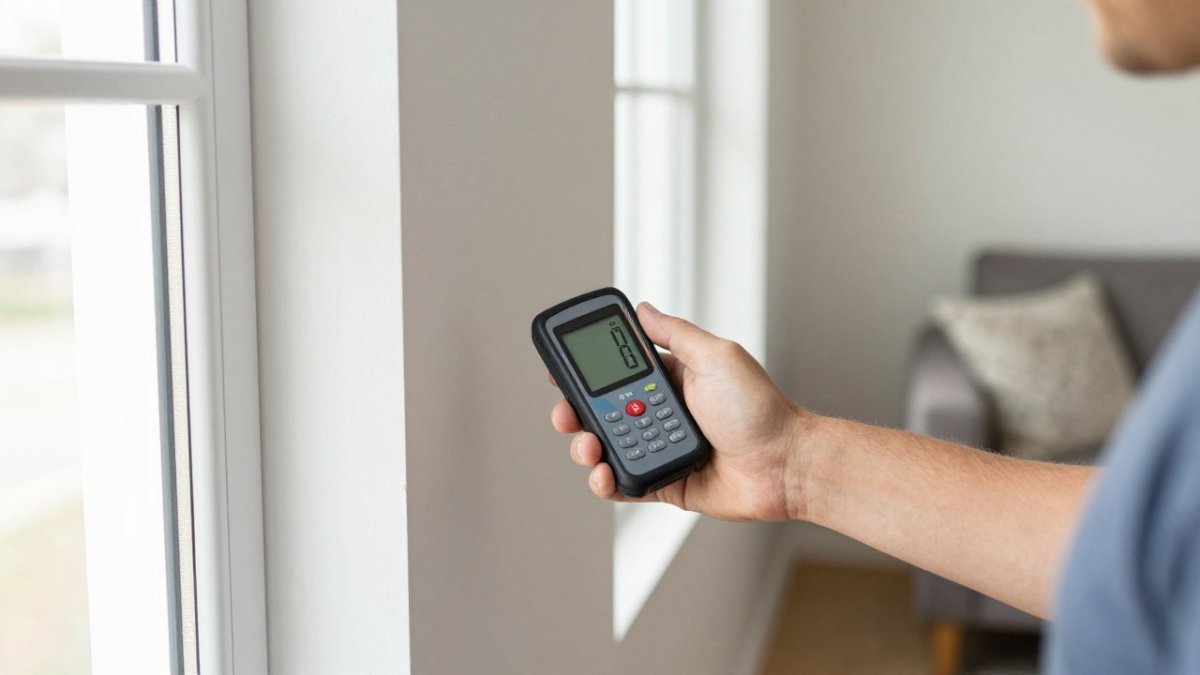
- Set the meter to the correct material mode. Drywall, wood, and masonry read on different scales, and most meters have separate settings for each. Using the drywall setting on a wood stud, or the wood setting on concrete, produces numbers that cannot be compared to anything. Check the manual before the first reading and do not change modes mid-scan.
- Establish a dry reference on the same material. Pick an area of the same material in the same room that is far from plumbing, windows, and exterior walls, and take three readings there. Average them and write the number down as your baseline. A dry reference from a different material is not a valid comparison, because a reading that is high for drywall can be normal for wood.
- Scan the suspect wall in a consistent grid. Move the meter in even horizontal rows about 6 to 12 inches apart, keeping the same pressure and angle against the surface. Pinless meters are sensitive to how flat the sensor sits against the wall, so rocking the meter or pressing harder in one spot changes the reading. Mark the grid on a sketch or photo of the wall so every number has a location.
- Log every reading, not just the high ones. Record the location, the number, the meter mode, and the date for each spot. A cluster of moderately elevated readings is usually more meaningful than a single spike, and the log is what lets you see the cluster. Photograph the wall with a ruler or tape measure in frame so the locations are unambiguous later.
- Test the likely moisture paths first. Check below windows, around plumbing penetrations, under roof edges, at the base of exterior walls, and anywhere you have seen staining, bubbling paint, or soft drywall. These are the places where water most often enters a wall assembly.
- Confirm any high reading with a second pass. Re-test the same spot and the area around it. If the reading holds, take a pin-type reading at the same location if the meter allows it, because a pin reading at probe depth is less affected by surface finishes than a pinless scan.
- Compare the pattern, not the single number. Look at how readings change as you move away from a suspected source. A reading that drops steadily as you move away from a pipe or window points to that feature; a broad area of elevated readings suggests a larger moisture source or a wall that has been wet for a while.
Watch out: testing a wall right after cleaning, painting, or running a humidifier can produce readings that reflect surface conditions rather than moisture inside the assembly. Wait for the surface to dry and the room to return to normal humidity before you scan.
Keep the meter’s contact surface clean between readings. Dust, joint compound residue, and fresh paint can all change how a pinless sensor couples to the wall, and a dirty sensor is one of the most common reasons two readings from the same spot disagree.
Reading Moisture Meter Results: Baselines, Elevated Readings and Misleading Signals
A reading only means something when it is set against a baseline taken on the same material with the same meter mode. Your dry reference point is that baseline.
Several factors can push a reading away from the true moisture content, and understanding why helps you decide whether to trust a number:
- Metal studs, fasteners, wiring, and pipes. Pinless meters send an electromagnetic field into the wall and measure how the material responds. Metal responds strongly, so a scan that passes over a steel stud, a nail plate, or a copper pipe can read high even when the drywall itself is dry. If a high reading lines up with a stud or a fixture, move the meter a few inches to either side and re-test.
- Foil-backed materials and radiant barriers. Foil-faced insulation and radiant barrier sheathing reflect the meter’s signal, which can produce readings that do not correspond to moisture in the drywall or framing. Pin-type meters are less affected because they measure at the probe tips, but they still read the material the probes touch.
- Surface finishes and paint. A thick layer of paint, texture, or joint compound changes how a pinless sensor couples to the wall. Fresh paint can read differently from cured paint, and a heavily textured wall can give inconsistent readings from spot to spot. Wipe the surface and let it dry before scanning.
- Salts and mineral content. Masonry and concrete that have been wet and dried can leave salts behind that affect conductivity. A pin-type meter on masonry may read elevated even after the wall has dried, which is one reason masonry readings are best interpreted as a trend over time rather than a single number.
- Material and mode mismatch. A number that is high for drywall may be normal for wood, and a masonry reading on a wood setting is meaningless. Always confirm the meter mode matches the material before comparing readings.
Watch out: a single dramatic reading is less informative than a consistent pattern across several spots.
A dry reading does not rule out past moisture damage or existing mold. Investigating these subtle indicators remains the most reliable way to spot hidden mold growth before the underlying issue compromises the structural integrity of your home.
Several factors can push a reading away from the true moisture content, so here is what to check before trusting a number.
| Factor | Why it skews the reading | What to do |
|---|---|---|
| Metal studs, fasteners, pipes | Metal responds strongly to pinless scans | Move meter a few inches and re-test |
| Foil-backed materials | Foil reflects the meter’s signal | Use pin-type readings where possible |
| Paint or joint compound | Changes how sensor couples to wall | Wipe surface and let it dry |
| Salts in masonry | Residue affects conductivity | Read masonry as a trend over time |
| Material and mode mismatch | Wrong scale makes numbers incomparable | Confirm meter mode matches material |
How to Detect Moisture Behind Drywall and Trace Its Source
Moisture behind drywall often comes from a leak that is still active or has recently stopped. To keep humidity low while the wall dries, see dehumidifier settings for mold prevention.
Then move outward in steps. Once you have traced the source, learn how to prevent mold growth in homes by controlling that moisture.
Note the timing too. Moisture that comes and goes with rain or with running water points to an intermittent leak. Moisture that stays constant suggests a continuous source. Either pattern gives you a clue for the repair.
If you are changing the drywall to find the source, prevent mold from growing on the newly exposed framing. Dry the area fully, and use a dehumidifier to keep humidity low while the wall dries.
Booking a Professional Mold Assessment Next
Consider calling a mold remediation professional if you find high readings you cannot trace, if you see visible growth larger than a small area, or if anyone in the home has ongoing respiratory symptoms. A professional can take air and surface samples and identify the moisture source you could not find.
Before the visit, keep your readings log, photos and any notes about when water problems occurred. For practical steps on dealing with spores in the air while the problem is addressed, read removing mold spores from home air.
While you wait for an assessment, you can reduce airborne spores in the room. Our SR100 air purifier is designed to address mold spores along with dust mites, pet dander, pollen and smoke, and it provides visual confirmation that it is working.
Last Updated: November 16, 2026
Frequently Asked Questions
Does a moisture meter detect mold?
No. A moisture meter measures moisture content in building materials, not mold, spores or living colonies. A reading alone does not establish that mold is present. An elevated reading is a signal to investigate further, which can include a visual inspection for staining, odor, and the moisture source, and possibly a professional assessment.
How do moisture meters help identify possible mold in walls?
Moisture meters help by finding damp areas that may support mold growth. Mold typically needs moisture to develop, so locating wet drywall, wood or masonry points you toward where to look. Pinless meters scan the surface for relative readings, while pin-type meters measure moisture content at set depths. Compare suspect spots with dry reference areas in the same room to judge whether a reading is unusual.
Can a moisture meter detect moisture behind drywall?
A pinless meter can often indicate moisture behind drywall by reading to roughly three-quarters of an inch, though readings depend on the material and wall construction. Pin-type meters can probe drywall more deeply but leave small holes. Neither method shows the source of the water. Mapping readings across the wall and comparing them to dry areas helps narrow down where a leak or condensation problem may be.
When should you call a mold or water-damage professional?
Call a professional if you find persistent elevated readings that do not dry out, visible mold growth over a meaningful area, musty odors without a visible cause, or water damage from a leak you cannot locate. Anyone with asthma, COPD or other respiratory conditions should consider professional help sooner. A qualified assessor can sample for mold and identify the moisture source, which a handheld meter cannot do on its own.
