
Best Dehumidifier Settings for Mold Prevention at Home
Last Updated: November 9, 2026
Quick Summary
For mold prevention, set your dehumidifier settings to hold indoor humidity at 45% to 50% relative humidity. Mold can begin to spread around 60%, so staying below 50% keeps spores from settling and growing. Use a separate hygrometer in damp corners, since the unit’s display can read differently from the room.
- Keep indoor relative humidity below 50% to help prevent mold and mildew.
- Mold can start to spread at around 60% relative humidity.
- Basements and rooms with cold outside walls need a lower target, around 40% to 45%.
- Run the unit all day during humid weather, and keep emptying the bucket or using a continuous drain.
- Use an air purifier like the SR100 alongside the dehumidifier to handle mold spores already in the air.
Table of Contents
- Why Humidity Level Decides Whether Mold Grows
- Setting Your Dehumidifier to the Right Humidity Target
- Adjusting Settings for Basements, Cold Walls and Climate
- Matching Dehumidifier Capacity to Room Size
- How Long to Run a Dehumidifier for Mold Control
- Using an Air Purifier Alongside Your Dehumidifier for Mold Spores
- Setting Up a Monthly Check to Keep Mold Away
- Frequently Asked Questions
Mold needs moisture to grow, and the air in your home is the easiest place to control it. Getting the dehumidifier settings right is one of the most practical steps you can take to prevent mold at home. Aero Essence LLC has put together this guide to help you set your machine correctly, match it to your space, and keep indoor air healthy year-round.
Why Humidity Level Decides Whether Mold Grows
Mold spores are always present in the air, both indoors and out. What decides whether they settle and grow is the moisture in the room. Consumer Reports says a dehumidifier should be able to bring indoor humidity below 50% to help prevent dust mites and mildew (Consumer Reports dehumidifier assessment, which cites the below-50% target).
Industry guidance from early 2026 suggests keeping indoor relative humidity between 35% and 50%, since mold can begin to spread at around 60% relative humidity (Quartz News summary of Consumer Reports dehumidifier testing).
- Below 50%: the range most guides recommend for prevention
- 50% to 60%: a warning zone where mold can start to form
- Above 60%: mold growth becomes much more likely
Watch out: a reading taken in the middle of the room can look fine while damp corners stay wet. Check humidity in the places mold tends to appear, not just in the center of the room.
Setting Your Dehumidifier to the Right Humidity Target
A good starting point is a target of around 45% to 50% relative humidity. Some 2026 expert guides recommend this range for basement moisture control, noting that mold can thrive where humidity goes above 55% (Yahoo Lifestyle guide to dehumidifier settings).
To set your unit:
- Find the humidistat or target setting on your dehumidifier.
- Set it to 45% to 50% for most rooms.
- Let the unit run for a full day before you judge the result.
- Compare the room’s reading against your target and adjust in 5% steps if needed.
A separate hygrometer is useful, since the number on the unit’s display can drift from the actual room reading.
Adjusting Settings for Basements, Cold Walls and Climate
Basements and rooms with cold outside walls need extra care. Cold surfaces can collect condensation even when the room’s overall humidity looks acceptable. Relative humidity depends on temperature, so air near a cold exterior wall can hold more moisture relative to its capacity and shed it onto the surface. Some 2026 guidance recommends lowering the setting to the 40% to 45% range in rooms with cold outside walls to account for this risk (Yake Climate guide to mold prevention settings). For a full walkthrough of keeping mold out of a finished basement, see how to prevent mold in finished basements.
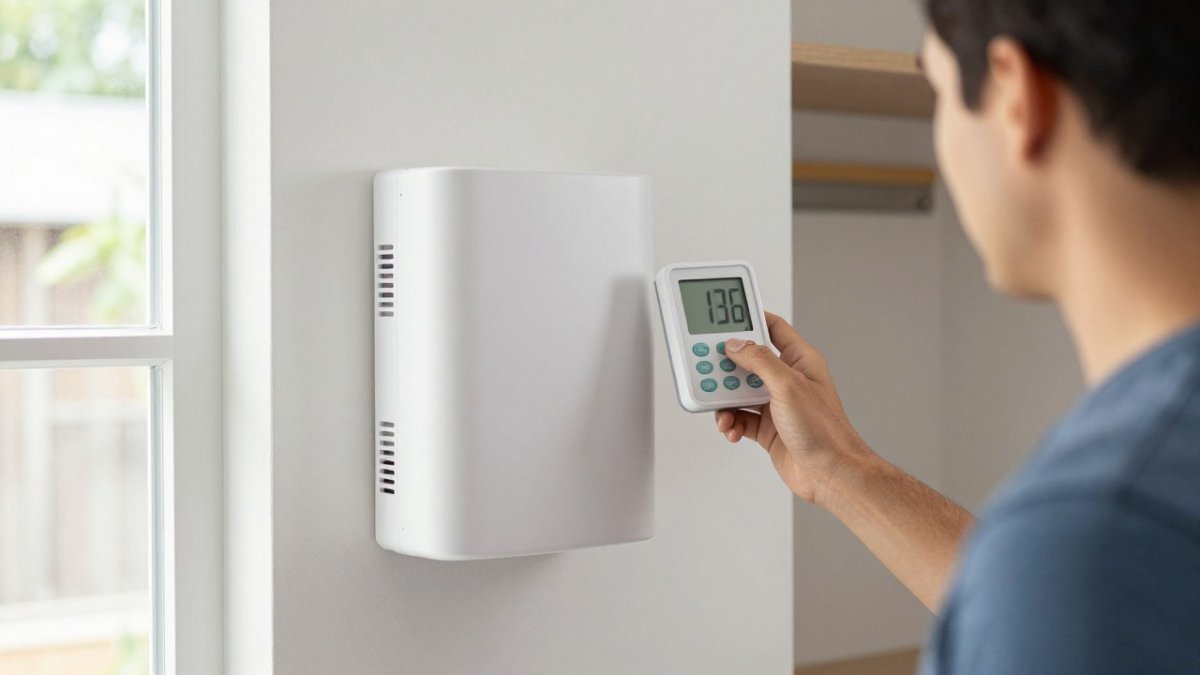
Climate matters too, and this is where most generic guides stop short. A 50% target is not a universal number, it is a starting point that has to be adjusted for how much moisture your local air carries and how often your home exchanges indoor air with outdoor air. In humid summers, your dehumidifier may run most of the day; in dry winters, the same unit may barely run, and the room may even become too dry. Adjust your target with the seasons instead of setting it once and forgetting it.
- Basements: aim for the lower end, around 40% to 50%
- Rooms with cold outside walls: aim for 40% to 45%
- Humid climates: expect longer run times and check the drain or bucket often; a unit that runs continuously needs a continuous drain or it will shut off on a full bucket and leave the room damp
- Dry climates: raise the target if the air feels harsh or static builds up, since over-drying wastes energy and can crack wood trim
- Shoulder seasons: recheck the hygrometer when outdoor temperatures swing, because the same setting can produce different indoor readings as the walls warm and cool
A common mistake is treating a finished basement the same as an unfinished one. Hidden spaces behind finished walls can hold moisture that the room’s main sensor never detects, so a finished basement often needs the lower end of the range and a separate check behind access panels. If you suspect mold is already behind the wall, learn the warning signs of hidden mold in walls before relying on humidity control alone. Watch out: a dehumidifier’s built-in humidistat reads the air at the unit’s intake, not at the cold wall or the corner where mold actually starts, so trust a separate hygrometer placed in the damp spot over the number on the display.
Matching Dehumidifier Capacity to Room Size
A unit that is too small will run constantly and still fall short of your target. A unit that is too large for a small room can short-cycle, switching on and off so quickly that it never pulls moisture out of the air long enough to matter, and leave pockets of damp air behind. Capacity is listed in pints of moisture removed per day.
Dehumidifiers are commonly sized by pint rating against square footage and the dampness of the space, not by square footage alone. The mechanism is simple: a unit removes a fixed number of pints per day at a given temperature and humidity, so a space that generates more moisture than the unit can pull out will never reach the set point no matter where you set the dial.
Use this as a rough guide for choosing a size:
| Space | Typical Need | What to Check |
|---|---|---|
| Small bathroom or closet | Smaller unit | Avoid oversizing for tight spaces; short-cycling wastes energy |
| Medium bedroom or room | Mid-size unit | Confirm the pint rating and the square footage it is rated for |
| Large basement or open living area | 50-pint unit | Check that the unit covers the full floor area, not just the room it sits in |
| Damp basement with a known water source | Larger unit or multiple units | Fix the water source first; capacity alone will not keep up |
Room size is only part of the picture. A damp basement with a leaking foundation needs more capacity than a dry room with the same square footage. Fix the source of water first, then size the unit. An undersized unit that runs all day to chase a target it cannot reach will cost more in electricity than a correctly sized unit that cycles on and off, because the compressor never gets to rest. Watch out: a unit rated for a large space will not help if the moisture is coming from a crawl space or a wall cavity the unit’s intake cannot reach, the setting becomes irrelevant when the air the unit samples is not the air that is wet.
How Long to Run a Dehumidifier for Mold Control
Run time depends on how damp the space is. Most units should run continuously in a basement or a room that stays above your target. Once the humidity holds steady at your set point, the unit will cycle on and off, which is normal.
Some practical rules:
- Run it all day during humid weather or after a leak.
- Keep it running until the room stays at or below your target for several days.
- Do not turn it off just because the room feels dry.
- Empty the bucket or use a continuous drain, or the unit may shut off and leave moisture behind.
Using an Air Purifier Alongside Your Dehumidifier for Mold Spores
A dehumidifier controls the moisture that lets mold grow. It does not remove the spores already floating in the air. An air purifier handles that job. Aero Essence LLC offers the SR100, a high-performance air purifier designed to tackle nine distinct types of pollutants, including mold spores, pet dander, pollen, dust mites and smoke.
Use the two together:
- Set the dehumidifier to keep humidity at 45% to 50%.
- Place the SR100 in the room where spores are most likely to build up.
- Keep the air purifier running while the dehumidifier does its job.
The SR100 provides visual confirmation of its purification performance. Do not expect it to fix a damp room on its own. Control the moisture first, then clean the air.
Setting Up a Monthly Check to Keep Mold Away
Mold prevention works best as a routine. Set a monthly check so small problems do not become big ones.
- Read the hygrometer and confirm the room stays at or below 50%.
- Empty the bucket or check the drain line.
- Clean or replace the dehumidifier filter as the manual directs.
- Look for musty smells, damp spots or discoloration along walls and corners.
- Check the air conditioning vents for dust or spotting, and clean them if needed. If you find mold in the vents, this guide to cleaning mold from air conditioning vents walks you through the process.
Writing the date and humidity reading in a notebook can help you spot patterns over a few months and decide when to adjust your target.
Keeping mold away comes down to controlling moisture, sizing your equipment, and cleaning the air you breathe. Aero Essence LLC designs the SR100 to handle the airborne spores that a dehumidifier cannot remove, so you can protect your home from both sides. Shop the SR100 at Aeroessenceair.com to see how it fits into your mold prevention plan.
Frequently Asked Questions
What is the ideal humidity level to prevent mold growth?
Keep indoor relative humidity between 30% and 50%. Keeping indoor humidity below 50% is a widely used target for limiting mildew and mold, which can begin to proliferate at higher relative humidity levels. Use a hygrometer to confirm the reading in each room you care about, since a single thermostat-mounted sensor often misses damp corners.
Should I run my dehumidifier at 40% or 50% for mold prevention?
For most rooms, 45% to 50% is a practical setting that keeps mold from establishing. A setting of 45% to 50% is a practical range for basement moisture control. If a room has cold outside walls, lower the setting to 40% to 45% to account for condensation on those surfaces. Lower settings use more energy, so choose the highest setting that keeps the room dry and check for condensation or musty odor to confirm it is working.
Does a dehumidifier kill existing mold spores?
No. A dehumidifier removes moisture, which stops mold from growing and spreading, but it does not kill spores already present or remove visible growth. Existing mold has to be cleaned or removed from affected surfaces. Once the moisture is controlled, an air purifier can capture airborne spores that remain in the air, which helps with respiratory comfort during cleanup and afterward.
Can a dehumidifier alone stop a mold infestation?
Usually not on its own. A dehumidifier controls the moisture that mold needs, but it cannot fix a source such as a roof leak, plumbing problem, or water intrusion through a foundation wall. Find and repair the water source first, clean the mold, dry the materials, and then use the dehumidifier to hold humidity below 50% so the problem does not return.
