
Air Purifier for Chemical Sensitivities: 2026 Buyer’s Guide
Table of Contents
- What to Look for in an Air Purifier for Chemical Sensitivities
- Best Air Purifier for VOC Removal: Activated Carbon and Medical-Grade Filtration
- Why Ozone and Ionizers Are Harmful for Multiple Chemical Sensitivity
- How to Test Air Purifier for Ozone Emissions
- Top Air Purifier Models for Chemical Sensitivities Without Ozone
- Aero Essence SR100: Visual Confirmation of Nine-Pollutant Removal
- Austin Air HealthMate: Medical-Grade Carbon for Severe Sensitivities
- AirDoctor AD3500: Sealed Filtration for VOC and Ozone-Free Operation
- Coway Airmega Mighty2: Affordable HEPA and Carbon for Smaller Spaces
- Rabbit Air A3: Customizable Five-Stage Filtration for Sensitivities
- TEQOYA: Ultra-Silent Ozone-Free Air Purification
- Key Filtration Technologies That Matter
- Maintenance, Filter Replacement, and Long-Term Cost Considerations
- Frequently Asked Questions
Last Updated: September 17, 2026
What to Look for in an Air Purifier for Chemical Sensitivities
Choosing an air purifier chemical sensitivities requires understanding what filtration actually removes from your air. The best air purifier for chemical sensitivities must handle volatile organic compounds, formaldehyde, and synthetic fragrances. This guide breaks down the critical specifications that separate effective units from those that merely circulate air.
Most people focus on HEPA filtration alone and miss the bigger picture. HEPA captures particulate matter like dust and pollen, but not gaseous pollutants. If you’re sensitive to chemicals, you need activated carbon. The weight and quality of that carbon determines whether your purifier absorbs odors and VOCs or just moves them around your room.
The second critical factor is seal integrity. A purifier with gaps or bypass routes, where air flows around the filter instead of through it, defeats the entire purpose. Medical-grade filtration means nothing if unfiltered air leaks past the filter cartridge. Look for units with sealed filter chambers and gasket-sealed designs.
Finally, verify the purifier operates without ozone or ionizers. These technologies generate secondary pollutants that trigger severe reactions in people with chemical sensitivities. An ozone-free design isn’t a luxury, it’s mandatory for your safety.
Best Air Purifier for VOC Removal: Activated Carbon and Medical-Grade Filtration
Activated carbon removes volatile organic compounds and odors through adsorption. The thickness, surface area, and quality determine how many molecules it can trap before saturation.
Medical-grade filtration combines HEPA with substantial activated carbon layers. Look for units with 10+ pounds of activated carbon. The Austin Air HealthMate uses 15 pounds of medical-grade activated carbon, meaning the filter lasts longer and removes more chemical pollutants before needing replacement.
The porous structure of activated carbon creates massive surface area. When VOC molecules encounter this surface, they stick to it. Once saturated, it stops working. Thicker carbon means more binding sites and longer filter life.
Some purifiers use multiple carbon stages. A pre-filter removes larger particles, allowing the main carbon filter to focus on gases and odors, extending filter life and improving efficiency.
Check the filter replacement schedule before buying. A purifier with exceptional carbon capacity means nothing if replacement filters cost $200 and need changing every 3 months. Calculate annual filter costs upfront, they often exceed the purchase price over time.
Why Ozone and Ionizers Are Harmful for Multiple Chemical Sensitivity
Ozone is a secondary pollutant. Some purifiers intentionally generate ozone, claiming it sanitizes air. For people with multiple chemical sensitivity, ozone is a trigger. Even low levels cause respiratory inflammation, chest tightness, and chemical reactions.
Ionizers charge particles so they stick to surfaces, but produce ozone and new chemical compounds when ions interact with VOCs. For someone with MCS, this is counterproductive.
The EPA and respiratory health organizations recommend avoiding both technologies. Look for purifiers explicitly labeled ozone-free and ionizer-free. Verify in product specifications or contact the manufacturer directly.
Some manufacturers use deceptive marketing, calling ionizers “negative ion generators” or claiming “safe levels” of ozone. There is no safe level for someone with chemical sensitivities. Skip any product using ionization or ozone generation.
How to Test Air Purifier for Ozone Emissions
Before purchasing, verify that a purifier operates without generating ozone. Manufacturer claims alone aren’t enough.
Third-party testing by independent labs provides the most reliable verification. Look for units with published test results showing zero ozone emissions under operating conditions.
Request the Certificate of Compliance from the manufacturer showing ozone test results. Reputable manufacturers provide this freely. If a company won’t share testing data, that’s a red flag.
Real-world testing requires an ozone meter ($100-$300). Run the purifier for 30 minutes in a sealed room, then measure. Any ozone increase means the unit is generating it.
Never assume a purifier is ozone-free based on marketing language alone. The term “ionizer-free” doesn’t guarantee zero ozone, the purifier could use other technologies that generate ozone as a byproduct. Always request third-party test results or use an ozone meter to verify.
::: Eliminating hidden ozone sources remains essential for maintaining indoor air quality, particularly when common household items like non-toxic home candles can inadvertently introduce their own chemical complexities into your breathing space.
Top Air Purifier Models for Chemical Sensitivities Without Ozone
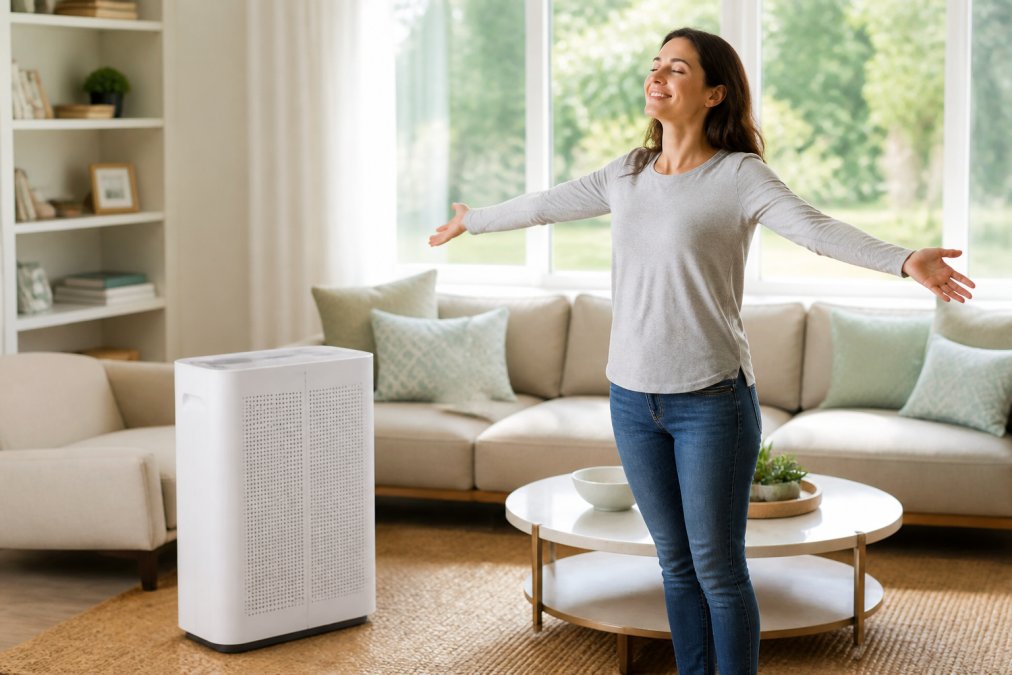
Aero Essence SR100: Visual Confirmation of Nine-Pollutant Removal
The Aero Essence SR100 tackles nine distinct types of pollutants while providing visual confirmation of purification. You see the system actively removing dust mites, pet dander, pollen, mold spores, and smoke.
The SR100 design addresses a core frustration: most purifiers run silently while you wonder if they’re working. Visual feedback gives you confidence that triggers are being removed.
The purifier targets invisible particles that trigger reactions: pet dander, dust mites, mold spores, and smoke from cooking or wildfires. The SR100 handles this full spectrum.
Austin Air HealthMate: Medical-Grade Carbon for Severe Sensitivities
The Austin Air HealthMate is engineered for severe chemical sensitivities. Its 15 pounds of medical-grade activated carbon is the heaviest in this category, directly impacting filter life and VOC removal.
Steel construction prevents off-gassing from plastic housing. The HealthMate’s metal design eliminates that risk. The filter is CARB-certified and verified to operate without ozone.
The trade-off is size and noise. If you have severe MCS or live in a high-pollution area, the performance justifies the footprint.
Replacement filters are expensive but extended filter life offsets some cost, you replace filters less frequently than with lighter-carbon units.
AirDoctor AD3500: Sealed Filtration for VOC and Ozone-Free Operation
The AirDoctor AD3500 uses UltraHEPA filtration with a dedicated VOC filter. The sealed filtration system ensures no air bypasses the filters, critical for chemical sensitivities.
Auto-sensing technology adjusts fan speed based on real-time air quality, ramping up when pollutants increase and reducing noise when air is clean.
The ozone-free design is verified through third-party testing with published compliance documentation.
Filter costs are higher than budget models but lower than medical-grade units, making this practical for moderate to severe sensitivities.
Coway Airmega Mighty2: Affordable HEPA and Carbon for Smaller Spaces
The Coway Airmega Mighty2 combines HEPA and activated carbon in a compact design with real-time air quality feedback.
Best for bedrooms, home offices, or smaller spaces. Carbon capacity is smaller than medical-grade units, so replacement is more frequent, but it’s effective for targeted room purification.
Ozone-free operation is verified. Compact size fits shelves or desks with reasonable noise levels.
Budget-conscious households managing mild to moderate chemical sensitivities in single rooms. Ideal for bedrooms where you spend 8 hours sleeping and want controlled air quality without major expense.
Rabbit Air A3: Customizable Five-Stage Filtration for Sensitivities
The Rabbit Air A3 offers customizable filters for specific sensitivities. Choose pet odor, formaldehyde, or other filters based on your triggers, avoiding unnecessary filtration.
Five-stage filtration includes pre-filter, HEPA, activated carbon, and two specialized stages. Wall-mountable design saves space. Extremely quiet operation matters if you’re noise-sensitive.
Premium pricing is justified by customization and quiet operation for those needing fine-tuned control.
TEQOYA: Ultra-Silent Ozone-Free Air Purification
TEQOYA specializes in silent operation without ozone generation. If noise sensitivity is part of your profile, these purifiers operate at whisper levels while maintaining effective filtration.
Energy efficiency reduces operating costs. Minimalist design appeals to those avoiding bulky appliances.
Availability is limited in some regions. Research local availability before committing.
Key Filtration Technologies That Matter
HEPA filtration captures particulates down to 0.3 microns, including dust, pollen, pet dander, and mold spores (the EPA). HEPA is the baseline for any air purifier chemical sensitivities.
Activated carbon removes gaseous pollutants and odors. Weight and quality determine effectiveness. Zeolite and potassium permanganate enhance VOC removal. Some purifiers layer multiple carbon types for different compounds.
Electrostatic precipitation uses electrical charges to capture particles. It’s less effective than HEPA but useful as a pre-filter. Some people report reactions to electrical fields, so verify this doesn’t trigger you.
Ultraviolet germicidal irradiation (UVGI) kills bacteria and viruses but doesn’t remove chemical pollutants.
Maintenance, Filter Replacement, and Long-Term Cost Considerations
Filter replacement is where the real cost lives. A $300 purifier with $80 filters replaced every 3 months costs $1,000+ annually. A $600 purifier with $150 filters replaced annually costs $750 total. Calculate 5-year cost, not just purchase price.
The cheapest purifier isn’t the best value if filters cost $200 and need replacing every 3 months. A mid-range unit with affordable, readily available filters often delivers lower total cost of ownership over 5 years.
Frequently Asked Questions
Are there air purifiers that do not emit ozone?
Yes. Many air purifiers operate ozone-free by design, particularly those using sealed HEPA and activated carbon filtration without ionizer technology. Look for units explicitly labeled ‘ozone-free’ and CARB-certified. The Aero Essence SR100, Austin Air HealthMate, and AirDoctor AD3500 are all verified ozone-free models. Check the manufacturer’s specifications and third-party testing reports to confirm ozone emissions are zero before purchase.
What is the best air purifier for destroying volatile organic compounds and formaldehyde?
The best units for VOC removal combine substantial activated carbon weight with sealed filtration. The Austin Air HealthMate features 15 pounds of medical-grade activated carbon specifically engineered for chemical sensitivity management. The AirDoctor AD3500 includes a dedicated activated carbon filter alongside UltraHEPA technology. For formaldehyde and other VOCs, carbon adsorption capacity directly determines effectiveness, so units with higher carbon weights and potassium permanganate-enhanced filters perform better.
How do I know if my air purifier is actually removing pollutants like pet dander and mold spores?
Look for purifiers with real-time air quality sensors and visual feedback systems. The Aero Essence SR100 provides visual confirmation of active purification, showing you the device is working. Independent CADR ratings (Clean Air Delivery Rate) and HEPA certification verify particle removal performance. Request third-party testing data from manufacturers, and monitor your symptoms, reduced allergy flare-ups, fewer respiratory triggers, and less dust accumulation on surfaces are practical indicators of effectiveness.
Will an air purifier solve mold and chemical sensitivity issues, or do I need other solutions?
Air purifiers remove airborne mold spores and volatile organic compounds but cannot address moisture sources or existing mold colonies. For chemical sensitivities, a quality ozone-free purifier with medical-grade filtration significantly reduces environmental triggers, but you may still need to identify and eliminate source chemicals (off-gassing furniture, synthetic fragrances, cleaning products). Use air purification as part of a broader indoor air quality strategy alongside humidity control and source reduction.