
10 Tips for Living With Dog Allergies
Table of Contents
- Tip 1: Create a Pet-Free Zone in Your Bedroom
- Tip 2: How to Reduce Dog Dander in House With Grooming and Bathing
- Tip 3: Choose the Best Air Purifier for Pet Dander Allergies
- Tip 4: Managing Indoor Air Quality With Pets Through Filtration
- Tip 5: Clean and Vacuum Strategically to Remove Dander
- Tip 6: Use Allergen-Resistant Bedding and Covers
- Tip 7: Support Your Dog’s Diet and Skin Health
- Tip 8: Medical Options and Allergy Testing for Dog Allergies
- Frequently Asked Questions
Last Updated: September 10, 2026
Tip 1: Create a Pet-Free Zone in Your Bedroom
The single most effective change for anyone managing dog allergies is making the bedroom a closed door to your dog. You spend six to eight hours there every night, which means it is the room where you inhale the most airborne allergens. Closing that door cuts your exposure by roughly a third of your day.
Dander is the real culprit, not the fur you can see. These are microscopic protein particles shed from skin, saliva, and urine, and they stay suspended in the air for hours before settling into soft furnishings. At Aero Essence LLC, we build products around exactly this problem, so we pay close attention to how allergens behave indoors.
Keep the door shut at all times, not just at night. If your dog sleeps in your room now, expect a rough first week of whining. It passes.
Washing bedding once is not enough. Dander re-accumulates within days, so plan on weekly hot-water washes of sheets, pillowcases, and blankets. Skipping this step undoes most of the benefit of the pet-free zone.
Tip 2: How to Reduce Dog Dander in House With Grooming and Bathing
Learning how to reduce dog dander in house starts with the dog itself. Regular brushing outdoors removes loose hair and the dander clinging to it before it ever reaches your carpet. A deShedding tool that reaches the undercoat, like the Furminator, pulls far more material than a standard brush.
Bathing helps, but frequency matters. Most veterinarians suggest a bath every one to four weeks depending on coat type and skin condition, using a dog-specific shampoo (vcahospitals.com). Overbathing strips natural oils and can make shedding worse.
Between baths, waterless grooming foam such as Earthbath’s Hypo-Allergenic formula or Burt’s Bees hypoallergenic wipes handle daily maintenance. Wipe paws and coat after outdoor time, since pollen and dander ride in on fur.
Tip 3: Choose the Best Air Purifier for Pet Dander Allergies
The best air purifier for pet dander allergies uses a sealed HEPA filter, sized correctly for the room, with enough clean air delivery rate to cycle the air several times per hour. Anything less is a fan with a filter-shaped decoration.
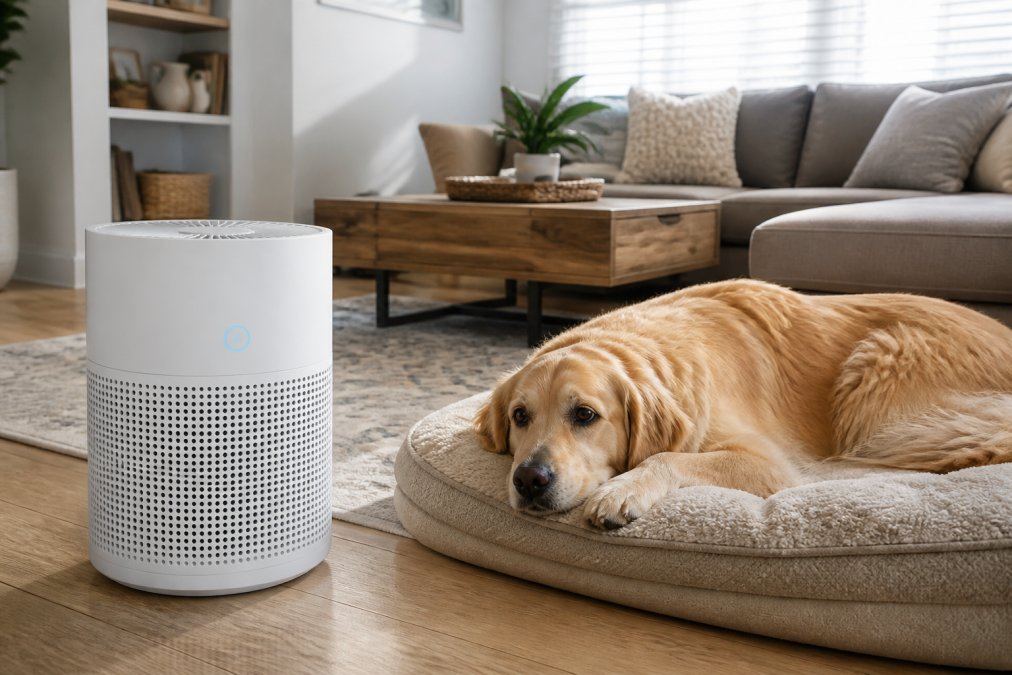
What to Look for in a Purifier for Dog Allergies
Start with true HEPA filtration, which captures particles at 0.3 microns. Dander particles vary in size, and HEPA catches the range that matters. Then check the seal: a purifier that leaks air around the filter instead of through it re-releases what it just captured.
The SR100 from Aero Essence LLC handles nine distinct pollutant types, including pet dander, dust mites, pollen, mold spores, and smoke. That breadth matters because most homes with dogs also deal with at least two or three of those at once.
One feature worth prioritizing: visual confirmation that the unit is working. The SR100 shows purification performance in real time, so you are not guessing whether the filter is doing its job.
| Feature | Why It Matters | What to Avoid |
|---|---|---|
| True HEPA filter | Captures dander at 0.3 microns | “HEPA-like” marketing claims |
| Sealed system | Keeps captured allergens inside | Units with loose filter housings |
| Room-size rating | Undersized units underperform | Buying one unit for a whole floor |
| Filter replacement cost | Drives yearly ownership cost | Cheap units with costly filters |
Check the filter replacement schedule before you buy, not after. Replacement filters are where budget purifiers quietly become expensive, and a clogged filter moves less air than a new one by a wide margin.
Tip 4: Managing Indoor Air Quality With Pets Through Filtration
Managing indoor air quality with pets is not a one-device job. Whole-home filtration through your HVAC system catches what a portable purifier misses in hallways, closets, and rooms you rarely enter.
Swap your HVAC filter for a high-efficiency option rated MERV 11 or higher. Filtrete’s Allergen Reduction filters carry a MERV 12 rating and capture microscopic allergens circulating through your vents. Change them on schedule; a loaded filter restricts airflow and strains the system.
Run your portable purifier in the rooms where you and your dog spend the most time. Bedrooms and living rooms top the list. According to the EPA’s guidance on indoor air quality, indoor pollutant levels can run several times higher than outdoor levels, which is why filtration inside the home matters so much.
Tip 5: Clean and Vacuum Strategically to Remove Dander
Vacuuming removes settled dander, but only if your vacuum keeps it captured. A standard vacuum without a sealed system blows fine particles back into the air through its exhaust, which is why allergy sufferers often feel worse after cleaning.
Use a vacuum with a sealed HEPA system, like the Bissell Pet Hair Eraser Turbo, and go over carpets and upholstery slowly. Speed defeats the purpose; the suction needs contact time. A common pattern is to make two slow passes in overlapping strips rather than one fast pass, because the first pass loosens embedded dander and the second actually lifts it.
Which Cleaners Actually Neutralize Dander
Here is where most guides go quiet. Dander allergens are proteins, and the cleaning products that help are the ones that break those proteins down or lift them off surfaces, not the ones that just smell clean. A few practical rules:
- Enzymatic cleaners are formulated to break down protein-based soils (the same category of product used for pet accidents). They are the closest thing to a dander-neutralizing cleaner for hard surfaces and washable fabrics. Look for ‘enzymatic’ on the label rather than ‘pet odor eliminator.’
- Plain soap and water or a mild surfactant physically lifts dander proteins off hard surfaces so a damp cloth can carry them away. This is unglamorous but effective.
- Disinfecting sprays and air fresheners may kill germs and mask odor, but they do not remove dander protein. A room can smell fresh and still be loaded with allergen.
- Dry dusting and sweeping just redistribute dander into the air. Use a damp microfiber cloth on hard surfaces and a damp mop on floors.
The Order of Operations
- Vacuum carpets and upholstery with a sealed HEPA unit.
- Damp-wipe hard surfaces and damp-mop floors.
- Wash or wipe down soft furnishings you cannot launder.
- Run your air purifier last to clear what cleaning kicked into the air.
The order of operations matters. Vacuum and dust first, then run your air purifier. Cleaning kicks particles into the air, and the purifier clears what your vacuum could not hold. And remember: a product that only masks odor is not removing the allergen that triggers your symptoms.
Tip 6: Use Allergen-Resistant Bedding and Covers
Allergen-resistant bedding creates a physical barrier between you and the dander that settles into pillows and mattresses. Zippered covers are the key detail; a loose-fitting cover lets allergens pass around the edges.
AllerEase’s Cotton Allergy Protection Pillow Protector uses a zippered closure and breathable cotton that blocks dander and dust mites without the crinkly plastic feel. Cover the mattress too, not just the pillows, since mattresses hold years of accumulated allergen.
Wash these covers weekly in hot water along with your sheets. The cover protects the pillow; the wash removes what landed on the surface.
Tip 7: Support Your Dog’s Diet and Skin Health
Diet affects how much your dog sheds. A dog eating a complete, balanced diet with adequate omega-3 fatty acids tends to have healthier skin and a fuller coat, which means less dry, flaky skin dropping into your home.
Look for dog foods that list a named animal protein first and include omega-3 sources like fish oil or flaxseed. Some owners add a veterinary-recommended fish oil supplement, but ask your vet before adding anything to your dog’s diet.
The connection is straightforward: dry, irritated skin sheds more. If your dog scratches constantly, that is a signal to talk to your veterinarian about both skin health and whether an underlying allergy is driving the shedding.
Tip 8: Medical Options and Allergy Testing for Dog Allergies
Medical treatment deserves a place alongside home management, not as a last resort. If your symptoms include persistent sneezing, wheezing, or skin irritation despite a clean home, see an allergist or your primary care physician.
Clinical diagnosis starts with allergy testing, which identifies whether you are sensitized to dog dander specifically or to several allergens at once. Knowing the difference changes your treatment plan. Someone who reacts to dog dander plus dust mites and pollen may get most of their relief from environmental control alone, while someone with a strong dog-specific sensitization may need medical support to stay comfortable.
Options range from over-the-counter antihistamines for mild symptoms to prescription nasal sprays, and for long-term relief, immunotherapy shots or sublingual tablets that gradually reduce your sensitivity. The American College of Allergy, Asthma & Immunology outlines how immunotherapy works and who tends to benefit most. Immunotherapy is typically a multi-year commitment, so it is worth discussing the timeline and expectations with your allergist before starting.
The Question Most Guides Avoid
Nearly every article on this topic ends with a tidy list of treatments and skips the part that keeps people up at night: what happens if management is not enough? The honest answer is that rehoming is not the only path, and it should never be a decision made from panic in the middle of a bad allergy week.
A few things worth knowing before you consider giving up your dog:
- Management takes time to work. Environmental changes, cleaning routines, and medication often need several weeks of consistency before you feel a real difference. Judging the whole approach after three days is not a fair test.
- Severity varies widely. Many people with dog allergies live comfortably with dogs for years using a combination of environmental control, medication, and consistent cleaning. Others have asthma or severe reactions where the calculus is genuinely different, and that is a conversation for a doctor, not a forum.
- The emotional cost is real. Giving up a family dog carries a documented psychological weight, grief, guilt, and strain on relationships, that is rarely acknowledged in clinical write-ups. If you are weighing this decision, it is reasonable to treat your mental health as part of the equation, not a footnote to it.
- There are middle paths. Restricting the dog to certain rooms, shifting sleeping arrangements, and delegating grooming and vacuuming to a non-allergic household member can reduce exposure enough to make living together workable.
Do not make a permanent decision during a temporary flare. Talk to your physician about the full range of medical options first, and give a consistent management routine a fair trial before concluding that you and your dog cannot share a home.
Frequently Asked Questions
Can you build up immunity to dog allergies?
Allergy shots (immunotherapy) can reduce sensitivity over time for some people, but natural exposure alone does not reliably build immunity. A 2020 study in the Journal of Allergy and Clinical Immunology found that immunotherapy can decrease symptoms by 60-80% for certain individuals. However, results vary, and it requires consistent treatment over 3-5 years. For immediate relief, environmental control like HEPA filtration and pet-free zones remains essential.
How often should you bathe a dog to reduce allergens?
Bathing your dog once or twice weekly with a hypoallergenic shampoo can reduce dander by up to 80%, according to veterinary dermatologists. More frequent baths may dry out your dog’s skin, which can increase shedding. Between baths, use pet wipes or waterless grooming foam to remove dander from the coat. Always follow with a thorough brushing outdoors to capture loose hair before it spreads indoors.
Do air purifiers actually help with dog allergies?
Yes, air purifiers with HEPA filters capture 99.97% of particles as small as 0.3 microns, including pet dander and saliva proteins. A 2021 study in Allergy found that consistent HEPA filtration reduced airborne dog allergens by 50-75% in tested homes. For best results, run the purifier continuously in the room where you spend the most time and replace filters as recommended. Visual confirmation models help you know it’s working.
What are the best hypoallergenic cleaning practices for pet owners?
Use a HEPA-sealed vacuum at least twice weekly on carpets and upholstery. Damp-mop hard floors instead of sweeping to trap dander. Wash bedding and pet beds in hot water (130°F) weekly. Choose fragrance-free, enzyme-based cleaners that break down protein allergens. Avoid dry dusting, which just spreads particles. For managing indoor air quality with pets, combine cleaning with a purifier and regular HVAC filter changes.
How can I create an allergy-free zone in my bedroom?
Designate your bedroom as a pet-free zone and keep the door closed. Use allergen-resistant zippered covers on pillows and mattresses. Run a HEPA air purifier 24/7 in the bedroom. Remove carpets or use washable rugs, and clean bedding weekly in hot water. This strategy reduces nighttime allergen exposure by 70-90%, giving your body a recovery period each day.
Living with dog allergies and a dog is a daily balancing act, and the right equipment makes that balance far easier to hold. Aero Essence LLC built the SR100 to remove pet dander, dust mites, pollen, mold spores, and smoke while showing you, in real time, that it is working. If you are tired of guessing whether your air is actually clean, get started with Aero Essence LLC and give your home air you can see the difference in.