
Quiet Air Purifier for Baby Nursery: 2026 Top Picks
Table of Contents
- Why a Quiet Air Purifier Matters for Your Baby’s Nursery
- 2026 Comparison: Top Quiet Air Purifiers for Baby Nurseries
- Aero Essence SR100: Best for Visual Confirmation and Multi-Pollutant Removal
- Rabbit Air A3: Best Premium Option with Child Lock
- Coway Airmega 100: Best Compact Unit for Small Nurseries
- Clorox Medium Room Air Purifier: Best Budget-Friendly Choice
- Smart Air Blast Mini: Best for High CADR Without Smart Features
- Alen BreatheSmart 45i: Best for Customization and Warranty
- Air Purifier Noise Levels for Sleep: Decibels That Won’t Wake Your Baby
- Safe Air Purifier Placement in Baby Room: Where to Put It for Best Airflow
- Maintenance Tips for Nursery Air Purifiers: Filters, Costs, and Schedules
- Ozone, EMF, and Safety: What Parents Need to Know
- Conclusion: Choosing the Right Quiet Air Purifier for Your Nursery
- Frequently Asked Questions
Last Updated: September 16, 2026
Why a Quiet Air Purifier Matters for Your Baby’s Nursery
A quiet air purifier runs under 30 dB on its lowest setting, cleaning nursery air overnight without disturbing infant sleep. This guide from Aero Essence LLC covers how to choose one, where to place it, and what parents overlook.
Babies breathe faster than adults and sleep most of the day, so their lungs take in more of whatever floats in the room. That makes a quiet air purifier for baby nursery with quiet operation 2026 a baseline purchase. The catch: a unit loud enough to wake a light sleeper gets switched off, and a purifier that’s off cleans nothing. Below: six models, the decibel thresholds that matter, and the safety questions most guides skip.
The best air purifier for a nursery is the one that stays running all night. Noise, not raw filtration power, is the deciding spec for most families.
2026 Comparison: Top Quiet Air Purifiers for Baby Nurseries
Every unit below uses HEPA filtration, and several add activated carbon for odors and VOCs. What matters: noise floor, room coverage, safety hardware, and annual filter cost.
| Model | Noise Floor | Best For | Filter Style | Standout Feature |
|---|---|---|---|---|
| Aero Essence SR100 | Sleep-friendly | Multi-pollutant removal | HEPA + carbon | Visual confirmation |
| Rabbit Air A3 | Very low | Premium safety features | HEPA + carbon | Child lock |
| Coway Airmega 100 | Low | Small nurseries | True HEPA | Compact footprint |
| Clorox Medium Room | Low | Tight budgets | True HEPA | Simple controls |
| Smart Air Blast Mini | Moderate | Large rooms | HEPA | High CADR |
| Alen BreatheSmart 45i | Very low | Customization | HEPA + carbon | Long filter life |
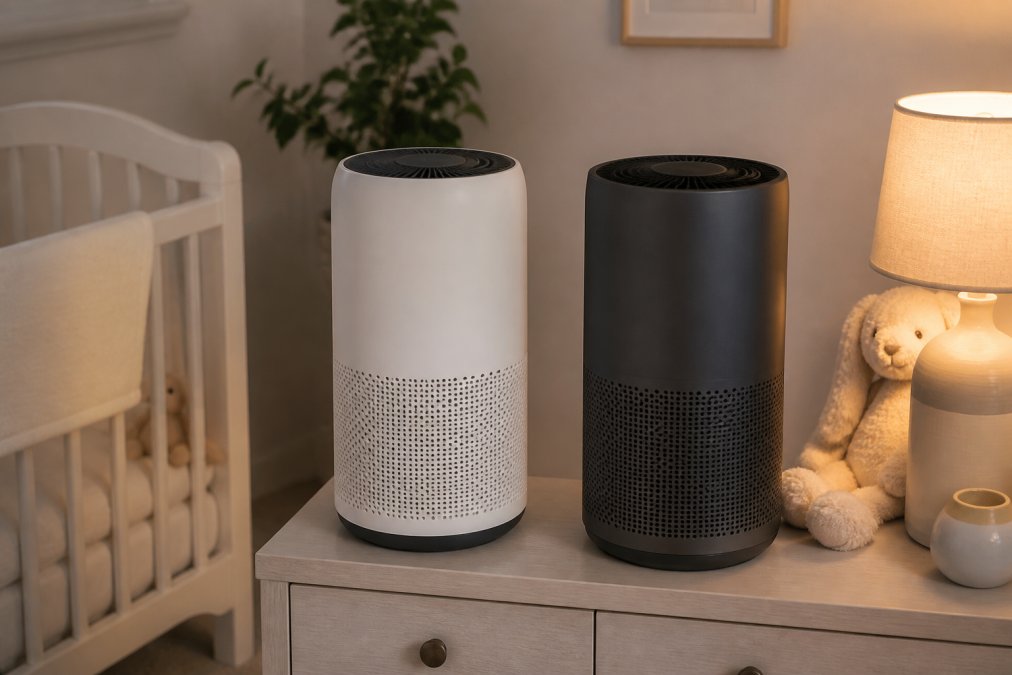
Aero Essence SR100: Best for Visual Confirmation and Multi-Pollutant Removal
The SR100 targets nine pollutant types, including dust mites, pet dander, pollen, mold spores, and smoke.
Rabbit Air A3: Best Premium Option with Child Lock
If safety hardware is your priority, the A3 is the one to beat.
Coway Airmega 100: Best Compact Unit for Small Nurseries
Small rooms don’t need a large machine.
Clorox Medium Room Air Purifier: Best Budget-Friendly Choice
Entry-level pricing, True HEPA filtration, and whisper-quiet operation on low settings.
Smart Air Blast Mini: Best for High CADR Without Smart Features
This is the pick for parents who want air exchange rate over app connectivity.
Alen BreatheSmart 45i: Best for Customization and Warranty
Alen’s 45i pairs whisper-quiet sleep operation with a laser air quality sensor and long filter life.
Air Purifier Noise Levels for Sleep: Decibels That Won’t Wake Your Baby
Run your purifier at its intended overnight speed for a full night before the baby’s first night in the nursery. You’ll hear the ramp-up cycles that spec sheets never mention.
Safe Air Purifier Placement in Baby Room: Where to Put It for Best Airflow
A few placement rules that prevent problems:
- Keep the unit off the floor if possible; a low table or dresser reduces dust intake and keeps cords out of reach.
- Leave at least a foot of clearance on all sides so the pre-filter can pull air freely.
- Never place it behind furniture, curtains, or a crib bumper, which starves the intake and cuts effective room coverage.
- Route the power cord behind furniture and secure any slack with cord clips. Cord safety is the most common oversight in nursery setups.
Maintenance Tips for Nursery Air Purifiers: Filters, Costs, and Schedules
Filter replacement is where the real cost of ownership lives, and most buyers never calculate it before purchase.
Replacement cadence
- Pre-filter: rinse or vacuum every two to four weeks.
Building a three-year cost-of-ownership estimate
You need four numbers:
- Unit price, the sticker cost.
- Annual filter cost, filter price × replacements per year. A $60 HEPA filter replaced twice a year costs $120 annually; a $30 filter replaced once costs $30.
- Annual electricity cost, watts ÷ 1,000 × hours per day × 365 × your local rate. A 20-watt unit running 24/7 at a typical residential rate lands in the low tens of dollars per year; a 60-watt unit costs roughly three times that.
- Three-year total, unit price + (annual filter cost × 3) + (annual electricity cost × 3).
Before you buy, look up the filter part number and check its price and availability. A cheap unit with expensive, hard-to-find filters is the most common regret in this category.
Energy efficiency
An ENERGY STAR certified unit running continuously draws very little, but not zero.
Maintenance habits that protect quiet operation
Skipping pre-filter cleaning is the single most common maintenance mistake. It’s also the one that most directly undermines the quiet operation you paid for.
Air purifier vs. humidifier: do you need both?
They solve different problems.
Ozone, EMF, and Safety: What Parents Need to Know
Most buying guides treat safety as a checklist item.
Ozone: the invisible byproduct
- Ionizers and electrostatic precipitators charge particles so they stick to plates. Some designs generate ozone as a byproduct.
- UV-C lamps can produce ozone if they emit at wavelengths below roughly 240 nm.
- “Ozone generators” are marketed as air purifiers but are not appropriate for occupied spaces at any concentration.
How to verify a unit is ozone-free
- Look for a CARB executive order number on the box, the manual, or the manufacturer’s site.
- Cross-check the number against CARB’s publicly posted list of certified air cleaning devices.
- Treat “ozone-free” as a marketing claim unless it’s backed by a certification number you can look up.
CARB certified air cleaning devices list
If a product advertises “activated oxygen,” “super oxygen,” or “energized oxygen,” that is ozone under another name. Skip it for a nursery.
EMF: a proportionate answer
A few concrete steps:
- Place the unit across the room from the crib rather than beside it. Three feet is a reasonable minimum; more is better.
- Choose a unit with a cord long enough to reach an outlet without an extension cord draped near the sleep area.
- If EMF is a specific concern for you, prioritize models with a lower measured draw and a simple motor rather than units packed with sensors and wireless radios.
Other safety hardware worth checking
- Child lock: prevents a toddler from changing fan speed or switching the unit off.
- Tip-over stability: a purifier on a dresser should not be easy to pull down.
- Cord management: route cords behind furniture and secure slack with clips so nothing loops within reach of the crib.
- No sharp edges or small removable parts that could become a choking hazard.
Integration with nursery monitors and white noise
Most standalone purifiers don’t communicate with baby monitors.
Conclusion: Choosing the Right Quiet Air Purifier for Your Nursery
The hard part isn’t finding a purifier that filters well.
Frequently Asked Questions
Do babies really need an air purifier in their nursery?
A quiet air purifier can help reduce airborne allergens like dust mites, pet dander, and pollen that may irritate a baby’s developing respiratory system. If your home has pets, you live in an area with wildfire smoke, or your baby has asthma or allergies, a purifier with HEPA filtration is worth considering. It won’t replace medical advice, but it can be part of a cleaner sleep environment.
What decibel level is considered quiet for a nursery air purifier?
For sleep, aim for a unit that runs at or below 30 decibels on its lowest setting. That’s roughly the sound of a whisper. Many models advertise ‘whisper-quiet’ operation, but check the actual decibel rating for the sleep mode. A purifier that jumps to 50 decibels on high may be fine for daytime, but you’ll want a low setting for overnight use.
Should an air purifier run all night in a baby’s room?
Yes, running a quiet air purifier overnight is safe and often recommended, as long as it has a sleep mode and child-safe design. Continuous operation helps maintain air circulation and keeps particulate matter low while your baby sleeps. Just ensure the cord is secured and the unit is placed away from the crib to avoid any hazard.
Are ozone-generating air purifiers safe for infants?
No. Ozone can irritate lungs and worsen respiratory conditions, especially in infants. Choose an ozone-free purifier that uses HEPA and activated carbon filtration. Look for CARB certified models, which meet California’s strict ozone emission standards. Avoid any unit that advertises ‘ionization’ or ‘UV-C’ as its primary cleaning method without third-party ozone testing.
Where is the best place to position an air purifier in a nursery?
Place the purifier at least 3 feet away from the crib, on a stable surface or floor, with clear space around the intake and exhaust. Avoid corners and behind furniture, which block airflow. For safe air purifier placement in a baby room, keep it near the center of the room if possible, and secure the cord behind furniture so your baby can’t reach it.
Choosing a nursery purifier comes down to a trade-off most product pages won’t state plainly: filtration power, silence, and low running costs rarely all peak in the same unit. Aero Essence LLC built the SR100 to close that gap, combining multi-pollutant removal across nine categories with visual confirmation that the unit is working, so you’re not guessing whether the air in your baby’s room is actually cleaner. Explore the SR100 and see the difference for yourself.