
Portable Air Purifier for Travel: Worth It in 2026?
Table of Contents
- Do Portable Air Purifiers Actually Work for Travel?
- HEPA Filter Effectiveness in Portable Units
- Best Travel Air Purifier for Hotel Rooms: What to Look For
- How to Improve Indoor Air Quality While Traveling
- Real-World Performance in High-Traffic Environments
- Total Cost of Ownership: Filter Replacement and Maintenance
- Portable Air Purifiers for Specific Health Needs
- The Verdict: When a Portable Air Purifier Is Worth the Investment
- Frequently Asked Questions
Last Updated: September 25, 2026
Do Portable Air Purifiers Actually Work for Travel?
Portable air purifiers have become increasingly common in hotel rooms, rental apartments, and transit lounges. But do they actually deliver measurable results, or are they just another gadget that promises more than it delivers?
The short answer: it depends on what you’re trying to achieve and which device you choose. Whether a portable air purifier for travel worth it comes down to matching the device to your needs, it can work effectively in small, enclosed spaces like hotel rooms and car interiors. However, effectiveness varies dramatically based on the unit’s CADR (Clean Air Delivery Rate), filtration type, and how well it matches your specific environment.
What matters most isn’t the brand name or price tag, it’s whether the device’s airflow capacity matches your room size and whether it actually targets the pollutants you’re exposed to.
The real question isn’t whether portable air purifiers work. It’s whether a portable air purifier for travel is worth the investment for your specific situation. That requires understanding how these devices function, what they can and cannot remove, and whether the benefits justify the cost and maintenance involved.
Most travelers buy a portable unit, run it for a week, then stop using it because they don’t see visible results. The key is matching the device’s CADR to your room size, a unit rated for 150 square feet won’t noticeably improve air quality in a 400-square-foot suite.
HEPA Filter Effectiveness in Portable Units
True HEPA filters capture 99.97% of particles 0.3 microns or larger (the EPA). In portable units, this means dust, pollen, pet dander, mold spores, and smoke particles are trapped effectively, but only if the airflow passes through the filter.
The catch: portable units have limited airflow compared to whole-home systems. A device pulling air through a HEPA filter at 30 cubic feet per minute (CFM) will clean that air effectively, but it won’t refresh an entire hotel room’s air quickly. The filter itself works as advertised. The real limitation is volume and speed.
Many portable units use multi-stage filtration: a pre-filter for larger particles, activated carbon for odors and volatile organic compounds, and HEPA for fine particulates. This layered approach extends filter life and improves overall performance. However, activated carbon filters saturate faster than HEPA filters and require more frequent replacement.
When evaluating HEPA effectiveness in portable units, focus on two metrics: the CADR rating and the clean air exchange rate. A device with a CADR of 100 will refresh a 150-square-foot room’s air roughly every 15 minutes. The same device in a 400-square-foot space will take 40 minutes per air exchange, meaning you’ll notice less dramatic improvements.
Portable units marketed as “HEPA-type” or “HEPA-like” do NOT meet true HEPA standards. Look for “True HEPA” or “Certified HEPA” on the product specifications. The difference in filtration efficiency is substantial.
Best Travel Air Purifier for Hotel Rooms: What to Look For
CADR and Cubic Feet Per Minute
CADR measures how many cubic feet of air a purifier cleans per minute for specific pollutants: smoke, dust, and pollen. A higher CADR means faster air cleaning. For hotel rooms, a CADR of 75 or higher handles most standard rooms effectively.
Cubic feet per minute (CFM) is related but different, it measures total airflow, not cleaned air. A device might have high CFM but lower CADR if the filtration isn’t efficient. Always prioritize CADR over raw CFM when comparing portable units.
For a typical hotel room (roughly 250-300 square feet), aim for a CADR of at least 75. Larger suites require higher CADR values. A portable air purifier for travel should complete at least 4-5 air exchanges per hour in your room, that’s the standard for noticeable air quality improvement.
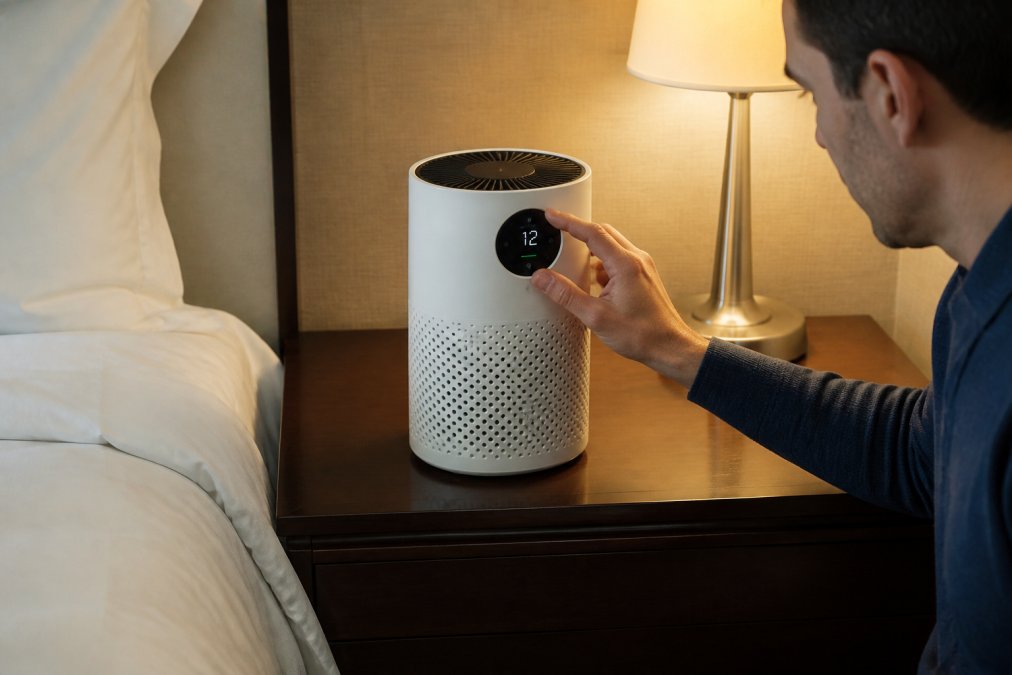
Noise Levels and Sleep Mode
Noise matters more in travel than at home. You’re trying to sleep in an unfamiliar room, and a purifier running at 60+ decibels will keep you awake.
Most portable units have multiple fan speeds. The lowest setting produces 25-35 decibels (quiet background noise). High settings can reach 60-70 decibels, comparable to a vacuum cleaner. Sleep mode, when available, reduces noise to near-silent levels while maintaining some air cleaning capability.
A common mistake is buying a high-CADR unit without checking the noise profile. A device that cleans air effectively at full speed but sounds like an airplane engine defeats the purpose of improving your sleep environment.
Look for units with dedicated sleep modes that automatically reduce fan speed while maintaining air circulation. Some models include air quality sensors that adjust speed automatically based on detected pollution levels, a useful feature if you want the device working harder during the day and quieter at night.
Power Source and Battery Life
Portable air purifiers use three power options: AC wall outlets, USB charging, or rechargeable batteries.
AC-powered units offer consistent performance but require access to an outlet. USB-powered devices work with laptop chargers and power banks, making them genuinely portable. Battery-powered units provide true cordless operation but sacrifice performance and runtime.
For travel, USB-powered units offer the best balance. They run continuously as long as you have power, and most modern hotel rooms have USB outlets or allow you to use your phone charger. Battery-powered units typically run 4-8 hours per charge, adequate for a single night but requiring daily recharging.
Battery life decreases over time. After one year of regular use, expect 20-30% less runtime than the original specifications. This matters if you’re traveling frequently and relying on battery operation. Managing these power constraints becomes part of a broader strategy for maintaining hygiene and comfort alongside other travel essentials like a portable bidet.
How to Improve Indoor Air Quality While Traveling
Beyond running a portable air purifier for travel, several low-cost tactics improve air quality in hotel rooms.
Open windows when weather permits. Even 5-10 minutes of fresh air exchange reduces indoor pollutants significantly. In high-pollen seasons, this may not be ideal, but in urban areas with moderate outdoor pollution, window ventilation works remarkably well.
Request a room away from the elevator, ice machine, and hallway. These areas accumulate dust and odors. Corner rooms and upper floors typically have better air quality than interior rooms or ground floors near common areas.
Use the bathroom exhaust fan. Running it for 15-20 minutes after showering removes humidity and odors, reducing mold spore concentration. This costs nothing and provides measurable benefit.
Avoid rooms with visible dust on surfaces or stale odors. Air quality problems in hotels often reflect poor housekeeping. A room that looks clean typically has better baseline air quality than one that doesn’t.
If you’re traveling with a portable unit, run it for at least 30 minutes before sleeping. This gives it time to remove accumulated particles from the room’s air.
The most effective approach combines a portable unit with basic environmental management, opening windows when possible, requesting better rooms, and running the device before bedtime. No single tactic solves all air quality issues, but the combination addresses most travel scenarios.
Real-World Performance in High-Traffic Environments
Airport lounges, train stations, and hotel lobbies present unique challenges. These spaces have high foot traffic, constant air recirculation from HVAC systems, and elevated levels of ultrafine particles and pathogens.
A portable air purifier for travel works in these environments, but with limitations. In a crowded lounge, a personal unit cleans air in a 2-3 foot radius around the device, not the entire space. If you’re sitting next to the purifier, you’ll benefit. If you’re 10 feet away, the benefit diminishes significantly.
For high-traffic transit environments, personal filtration devices (worn near the face) provide better protection than tabletop units.
Total Cost of Ownership: Filter Replacement and Maintenance
Purchasing price is only part of the equation. Filter replacement and maintenance determine long-term cost.
Portable Air Purifiers for Specific Health Needs
Effectiveness depends partly on what you’re trying to remove.
For allergies: HEPA filtration removes pollen and dust mites effectively. A portable unit helps most in enclosed spaces where you sleep. Running it for 1-2 hours before bedtime reduces airborne allergens and can improve sleep quality. Effectiveness increases if you also control dust sources, using allergen-proof pillow covers, washing clothes after travel, and vacuuming your suitcase.
The Verdict: When a Portable Air Purifier Is Worth the Investment
You travel frequently (more than once monthly) and spend multiple nights in hotels or rentals. One-time travelers may not justify the purchase cost.
Frequently Asked Questions
Do portable air purifiers actually work in hotel rooms?
Yes, portable air purifiers with True HEPA filters can reduce airborne contaminants in hotel rooms, but effectiveness depends on room size, CADR rating, and how long the unit runs. A purifier with a CADR of 50+ cubic feet per minute will noticeably improve air quality in a standard hotel room within 2-3 hours of continuous operation. For best results, keep doors and windows closed and run the unit for at least 4-6 hours daily.
What makes HEPA filter effectiveness in portable units different from larger home purifiers?
Portable units use the same True HEPA filtration standard as larger purifiers, capturing 99.97% of particles 0.3 micrometers or larger. The difference lies in airflow capacity and room coverage. A portable purifier handles smaller spaces (under 200 square feet) efficiently, but struggles in open-concept rooms. Pair a portable unit with a confined space, like a bedroom or hotel room, to maximize HEPA effectiveness.
Which portable air purifier works best for pet allergies and wildfire smoke?
Look for units with multi-stage filtration including a pre-filter, True HEPA layer, and activated carbon. Activated carbon specifically targets volatile organic compounds and smoke odors, while HEPA captures pet dander and ultrafine particles from wildfire smoke. Models with air quality sensors let you see real-time improvements in particulate matter levels, providing confirmation that the unit is actively reducing allergens.
How often do I need to replace filters, and what’s the real cost?
Most portable air purifier filters last 3-6 months depending on usage and air quality. Monthly operation in a hotel room extends filter life; daily use in a smoky environment shortens it. Replacement filters typically cost $20-$50 per set. Calculate annual maintenance by multiplying filter cost by replacement frequency (roughly 2-4 filters per year). Factor this into your total cost of ownership before deciding if a portable unit fits your budget.