Portable Air Cleaner Picks: 6 Top Models for 2026
Table of Contents
- Quick Comparison: 6 Portable Air Cleaners Worth Buying
- How We Evaluated These Portable Air Cleaners
- 1. Aero Essence SR100: Best for Pet Dander and Mold Spores
- 2. Coway Airmega Mighty2: Best All-Around Value
- 3. Pure Enrichment PureZone Mini: Best Cordless Travel Option
- 4. Smart Air QT3: Best Quiet Desk Purifier
- 5. VEIL Personal Air Filter: Best for Frequent Flyers
- 6. Dyson Purifier Cool: Best Fan and Purifier Combo
- Portable Air Purifier Maintenance: What You Actually Need to Do
- Understanding CADR and HEPA Efficiency Before You Buy
- Placement and Coverage: Getting the Most From Your Unit
- Frequently Asked Questions
Last Updated: September 12, 2026
Quick Comparison: 6 Portable Air Cleaners Worth Buying
A portable air cleaner is a freestanding filtration device that removes airborne contaminants from a single room without permanent installation. This guide from Aero Essence LLC cuts through the spec sheets to models that genuinely perform.
| Model | Starting Price | Best For | Coverage |
|---|---|---|---|
| Aero Essence SR100 | See site for pricing | Pet dander, mold spores | Full room |
| Coway Airmega Mighty2 | $129.99 | All-around value | Small to medium |
| Pure Enrichment PureZone Mini | $59.99 | Travel and desks | Personal |
| Smart Air QT3 | $129.00 | Quiet desk use | Personal |
| VEIL Personal Air Filter | $89.00 | Frequent flyers | Personal |
| Dyson Purifier Cool | $499.99 | Fan plus purification | Whole room |
The picks below cover common use cases.
How We Evaluated These Portable Air Cleaners
Every model here earns its place on filtration type, real-world noise, and honest coverage claims. We weighted CADR, filter cost over time, and odor handling, a cleaner that can’t neutralize smoke or pet odors loses points fast, no matter how quiet it runs.
Ignore “room size” marketing numbers on their own. Check the CADR figure against your actual square footage, then confirm the filter replacement cycle cost before buying. A cheap unit with expensive filters costs more over three years.
1. Aero Essence SR100: Best for Pet Dander and Mold Spores
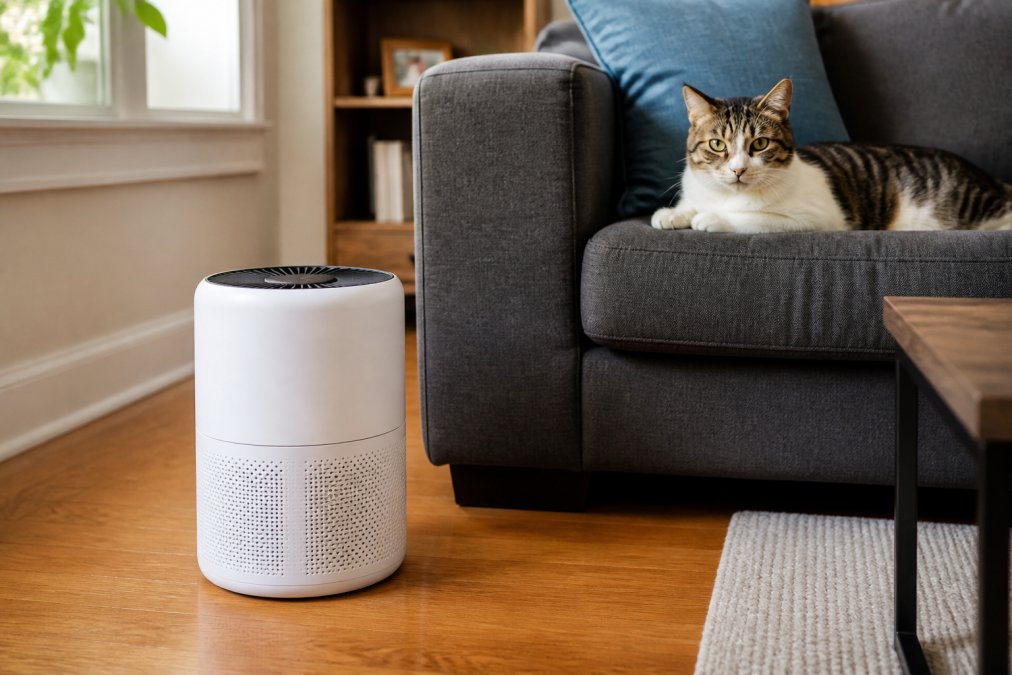
The Aero Essence SR100 is our top pick because it targets nine pollutant types, including the ones that matter most to allergy sufferers: pet dander, mold spores, pollen, dust mites, and smoke. What sets it apart is visual confirmation: the SR100 shows you it’s actively pulling invisible particles from your air, rather than leaving you guessing whether it’s working.
Pros:
- Handles nine pollutant types in one unit
- Visual confirmation of purification performance
- Targets invisible particles directly
Cons:
- Pricing varies by configuration, so check the site for current figures
2. Coway Airmega Mighty2: Best All-Around Value
3. Pure Enrichment PureZone Mini: Best Cordless Travel Option
The PureZone Mini is a true portable air cleaner in the literal sense: cordless, rechargeable, and light enough to toss in a bag. At $59.99, it’s the cheapest way to get HEPA filtration into a car, hotel room, or small office.
The limitation is coverage. This is a personal-space device, not a whole-room unit. Expect it to clean the air immediately around you, not an open-plan living area.
Pros:
- Highly portable and battery-operated
- True HEPA filter for dust and odors
- Three-speed fan settings
Cons:
- Limited coverage area
4. Smart Air QT3: Best Quiet Desk Purifier
If noise is your dealbreaker, the Smart Air QT3 at $129.00 is the quietest option here. It’s USB-powered and built for a desktop, with HEPA-grade filtration and an ultra-quiet motor that won’t intrude on calls.
Desk purifiers solve a different problem than room purifiers: the QT3 cleans your immediate breathing zone, often enough in a shared office with recycled air.
Pros:
- Very quiet operation
- Simple, lightweight design
- USB-powered convenience
Cons:
- Not suitable for whole-room cleaning
5. VEIL Personal Air Filter: Best for Frequent Flyers
The VEIL Personal Air Filter at $89.00 is a niche device, and it owns that niche. Built for travel, it uses high-efficiency particulate filtration in a lightweight form factor with easy-to-replace cartridges.
This isn’t the unit for your living room. It’s for the person who spends hours in airports and airplanes and wants personal air protection they can carry.
Pros:
- Optimized for travel
- Lightweight and portable
- Easy filter cartridge replacement
Cons:
- Niche use case
6. Dyson Purifier Cool: Best Fan and Purifier Combo
The Dyson Purifier Cool is the premium option at $499.99, and it earns the price by doing two jobs. It combines HEPA H13 filtration with Air Multiplier technology to circulate purified air across a whole room, plus an LCD screen for live pollutant reporting and app or voice control.
Where it falls short is value: you’re paying a premium for the dual-function design and reporting features. If you only need purification, cheaper units do the core job well.
Pros:
- Dual-function fan and purifier
- HEPA H13 filtration
- Advanced live pollutant reporting
Cons:
- Expensive compared to standard purifiers
Portable Air Purifier Maintenance: What You Actually Need to Do
Maintenance is where most owners quietly waste money. A portable air purifier only performs as well as its filters allow, and the replacement cycle depends on your environment, not the calendar alone.
The practical routine
- Vacuum or rinse the pre-filter every two to four weeks to protect the main filter
- Check the HEPA filter monthly for discoloration, odor, or visible loading
- Replace the activated carbon layer when odors stop disappearing, carbon saturates before HEPA clogs
- Log replacement dates so you do not run a saturated filter unnoticed
- Match filter type to your pollutant: HEPA for particles, carbon for VOCs and smoke odor
What filters actually cost over three years
Filter cost is the hidden line item in every purifier purchase: a unit that looks cheap up front can cost more than a premium model once you factor in replacements.
- Washable pre-filters, no replacement cost, but they must be dried fully before reuse or they grow odor
- HEPA cartridges, the main recurring cost; replacement frequency depends on run hours and local particulate levels
- Activated carbon, often sold as a separate layer or combined with HEPA; saturates faster than HEPA and is the first thing to fail in a smoke- or pet-heavy home
- Proprietary cartridges, some brands lock you into their filter supply, which raises long-run cost and limits third-party options
A purifier’s three-year filter cost often approaches or exceeds the purchase price. Before buying, look up the replacement filter price and interval, then multiply, that number, not the sticker price, is what you’re committing to.
Running a clogged HEPA filter does not just stop cleaning. It forces the motor to work harder, raising energy consumption and shortening the unit’s life. Replace on schedule, not when it visibly fails.
Filter disposal and environmental impact
This is the part most buying guides leave out, and it matters if you care about what your purifier leaves behind.
- HEPA media is not recyclable in most curbside programs. The filter is a composite of fiber media, glue, and often a plastic or metal frame. Check your local program before assuming it can go in the recycling bin.
- Activated carbon is typically landfilled. Spent carbon can be regenerated industrially, but residential-scale regeneration is not practical, so most carbon ends up in the trash.
- Washable and reusable pre-filters reduce waste by extending the life of the disposable layers behind them. This is the single easiest way to cut a purifier’s waste stream.
- Longer filter life is a sustainability feature. A unit with a larger filter media area and a lower recommended replacement frequency generates less waste over its life than a small unit you replace every few months.
- Some manufacturers run take-back or recycling programs for spent cartridges. It is worth checking before you buy if disposal is a priority for you.
The greenest purifier is not the one with the lowest price, it is the one with the longest filter life, a washable pre-filter, and a manufacturer that takes cartridges back. Factor disposal into the purchase decision, not just the operating cost.
When to replace versus when to clean
Not every filter is disposable. Pre-filters and some carbon pre-layers can be vacuumed or rinsed and reused. True HEPA media cannot, washing it damages the fiber structure and creates gaps that let particles through. Treat washable-HEPA claims with skepticism unless the media is specifically engineered for it. When in doubt, replace rather than rinse.
Understanding CADR and HEPA Efficiency Before You Buy
Two specs decide whether a portable air cleaner actually fits your room: CADR and filter efficiency. Get these right and you avoid the most common buying mistake, a unit either too small to keep up or too large to justify the price.
CADR (Clean Air Delivery Rate), explained properly
CADR measures how much filtered air a purifier delivers, expressed in cubic feet per minute (CFM). It is not a measure of how clean your room is, but of how fast the unit moves cleaned air, a higher CADR means faster cleaning for a given room size.
The number that matters is not the headline CADR but the CADR for the pollutant you actually care about. Under the AHAM certification program, a unit is tested and reported with three separate CADR figures:
- Smoke CADR, the finest particles, the hardest to capture, and the best proxy for wildfire smoke and ultrafine particulate
- Dust CADR, the middle range, relevant for general household dust and dust mites
- Pollen CADR, the largest particles, the easiest to capture, and the least useful number for most buyers
A unit can post a strong pollen CADR and a weak smoke CADR. If you are buying for wildfire season or allergies to fine particulate, read the smoke number, not the average.
The sizing rule that actually works
A widely used rule of thumb: a purifier’s smoke CADR should be at least two-thirds of the room’s square footage, assuming standard 8-foot ceilings. That means:
- A 150 sq ft bedroom needs roughly 100 CFM of smoke CADR
- A 300 sq ft living room needs roughly 200 CFM
- A 500 sq ft open-concept space needs roughly 330 CFM, or two smaller units
If you are between two sizes, size up: a unit running at lower speed to hit the same CADR is quieter and cheaper to operate than a smaller unit running flat out. This is also why two mid-size units often beat one large unit in an open floor plan, better air distribution and redundancy if one needs filter service.
Ignore “room size” marketing numbers on their own. Check the smoke CADR figure against your actual square footage, then confirm the filter replacement cycle cost before buying. A cheap unit with expensive filters costs more over three years.
What HEPA efficiency actually means
HEPA filter efficiency describes how well the filter captures fine particulate matter. True HEPA captures the vast majority of particles at the most penetrating particle size, roughly 0.3 microns, where filters are least effective. Larger and smaller particles are captured more easily, which is why HEPA is the standard for allergen and smoke reduction.
Watch for these labels:
- True HEPA / HEPA H13, meets the recognized HEPA standard; the baseline for serious filtration
- “HEPA-type” or “HEPA-like”, a marketing term with no defined capture standard; treat it as a weaker filter
- HEPA H14, a higher-efficiency grade used in cleanroom and medical settings; overkill for most homes and usually paired with higher cost and airflow resistance
A multi-stage system typically stacks a pre-filter, HEPA, and activated carbon. The pre-filter catches hair and large dust and protects the HEPA layer; the carbon layer handles odors, smoke smell, and volatile organic compounds (VOCs) that HEPA cannot capture. If odor is your problem, carbon matters as much as the HEPA rating. Persistent household smells often require supplemental treatment beyond mechanical filtration, which is why integrating fragrance-free odor eliminators can provide a more comprehensive solution for maintaining clean indoor air.
The EPA guide to indoor air quality and air cleaners explains how these ratings translate to real rooms. For respiratory health guidance, the American Lung Association on indoor air is worth reading before you buy for asthma or COPD.
The spec most buyers never check: airflow at low speed
A purifier’s top CADR is measured at its highest fan speed, which is also its loudest. What you actually live with is the low or medium setting, so a unit with high top-end CADR but weak low-speed airflow will be noisy or underperform daily. When comparing two units with similar top CADR, favor the higher minimum airflow, it cleans more air per decibel in real rooms.
Placement and Coverage: Getting the Most From Your Unit
Placement decides performance as much as the unit itself. A portable air cleaner needs unobstructed airflow, so don’t tuck it into a corner behind furniture.
- Place the unit where air circulates freely, ideally central to the room
- Keep it at least a foot from walls and furniture
- For open-concept spaces, expect to run two units or size up
- Close windows and doors during wildfire smoke events to let the unit keep pace
- Run it continuously on low rather than intermittently on high for steadier indoor air quality
The CDC guidance on wildfire smoke and indoor air recommends creating a clean-air room during smoke events, and a portable unit is central to that strategy.
Frequently Asked Questions
Do portable air cleaners actually work?
Yes, when matched to the right room size. A portable air cleaner with a HEPA filter captures 99.97% of particles at 0.3 microns, which includes dust, pollen, pet dander, and smoke particles. The catch is sizing: a unit rated for 200 square feet will not clean a 600-square-foot open living space. Check the CADR rating against your room’s square footage before buying.
Which portable air cleaner is the most effective for allergies?
Look for a unit with a high CADR for smoke and dust, plus a True HEPA filter. The Aero Essence SR100 targets nine pollutant types including dust mites, pet dander, pollen, and mold spores, and shows visual confirmation that it is actively purifying. For seasonal pollen or wildfire smoke, a unit with activated carbon also helps neutralize odors and volatile organic compounds.
How do I choose the right size portable air cleaner for my room?
Measure your room’s square footage, then match it to the CADR rating. As a rule, the CADR for smoke should be at least two-thirds of the room’s area in square feet. A 300-square-foot bedroom needs a smoke CADR of roughly 200. For open-concept spaces, either buy a larger unit or plan for two smaller ones placed on opposite sides of the room.
What is the difference between an air purifier and an air cleaner?
The terms are used interchangeably in most retail listings. An air cleaner is the broader category that includes any device removing airborne contaminants, while an air purifier typically refers to units using HEPA filtration and activated carbon. Both reduce particulate matter and improve indoor air quality. When shopping, focus on filter type and CADR rather than the label on the box.
How often do portable air purifier filters need to be replaced?
Most HEPA filters last 6 to 12 months, depending on use and air quality. Pre-filters should be vacuumed or rinsed every 2 to 4 weeks to extend the main filter’s life. If you run the unit 24/7 in a home with pets or wildfire smoke, expect to replace the HEPA filter closer to the 6-month mark. Check the manufacturer’s filter replacement cycle for your specific model.
Picking the right portable air cleaner comes down to matching filtration to your real pollutant problem, not chasing the biggest room-size claim on the box. Aero Essence LLC built the SR100 for households dealing with pet dander, mold spores, pollen, and smoke, with visual confirmation that shows the unit is actively working. If you want a purifier that tells you it’s doing its job instead of leaving you guessing, explore the SR100 and see the difference for yourself.