
Cost Benefit Analysis Air Purification: 2026 Guide
Table of Contents
- How to Run a Cost Benefit Analysis for Air Purification
- Life-Cycle Cost of an Air Purifier: Capital, Operational, and Maintenance Expenses
- Using an Air Purifier Energy Consumption Calculator to Estimate Electricity Costs
- HEPA Filter Replacement Costs and Maintenance Overhead
- Indoor Air Quality Health Benefits: Respiratory Health, Morbidity Reduction, and Healthcare Savings
- Cost Benefit Analysis Air Purification for Small Businesses and Offices
- Frequently Asked Questions
Last Updated: September 30, 2026
How to Run a Cost Benefit Analysis for Air Purification
A cost benefit analysis for air purification is a structured method for comparing what you spend on a purifier against the health, productivity, and financial value it returns. A cost benefit analysis for air purification is a structured method for comparing what you spend on a purifier against the health, productivity, and financial value it returns. The three steps below take about 30 minutes with a spreadsheet.
Step 1: Identify and Quantify Costs
List every cost the unit creates over its expected service life: purchase price, annual filter replacements, electricity, and your own labor for cleaning and swaps. A common mistake is stopping at the purchase price. Maintenance overhead is where budgets quietly break, so estimate filter replacement cycle length honestly from the manufacturer’s guidance.
Step 2: Estimate Health and Productivity Benefits
Assign values to outcomes you can reasonably expect: fewer sick days, less allergy medication, better sleep. Many businesses find that framing benefits conservatively keeps the analysis credible. If you cannot attach a number to a benefit, note it qualitatively rather than inventing a figure.
Step 3: Calculate Net Present Value and Benefit-Cost Ratio
Discount future costs and benefits to today’s dollars, then divide total benefits by total costs. A benefit-cost ratio above 1.0 means the investment pays for itself. Run the calculation across five years, not one, because filter and energy costs compound while health benefits accrue gradually.
Build your model with three scenarios (low, expected, high filter costs). If the project still clears a 1.0 ratio in the low scenario, the decision is strong. If it only works in the high scenario, you are guessing.
Life-Cycle Cost of an Air Purifier: Capital, Operational, and Maintenance Expenses
Life-cycle cost (LCC) evaluation totals every expense from purchase through disposal. Capital expenditure is the visible number. Operational expenditure, electricity plus maintenance overhead, is the one that determines whether the unit was actually a good deal.
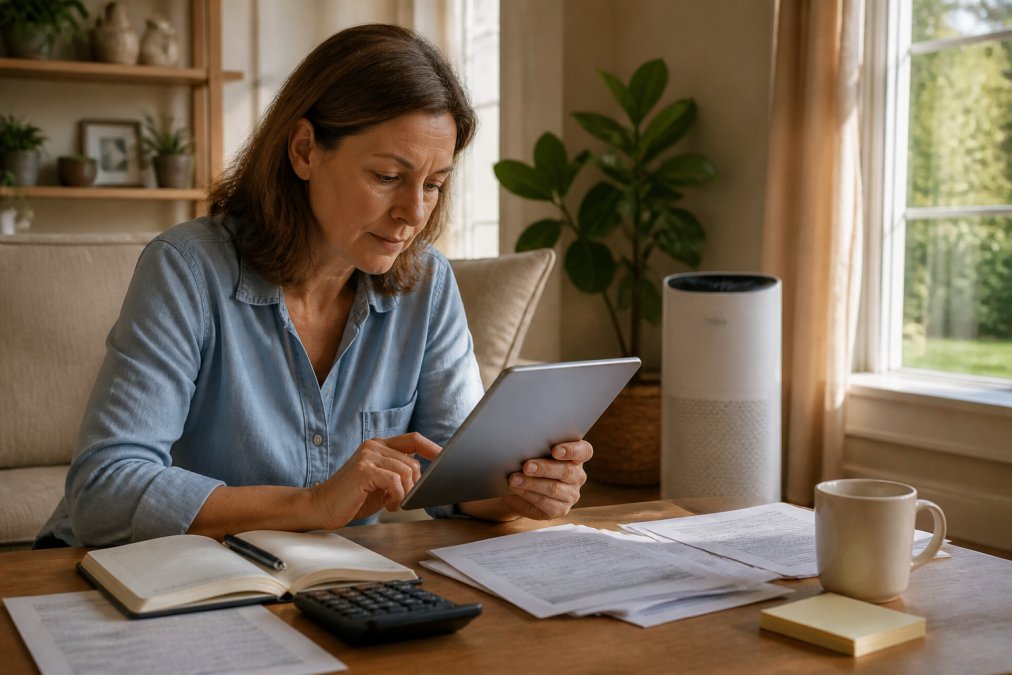
Break LCC into four buckets:
- Capital: purchase price and any initial setup
- Operational: electricity, based on wattage and daily runtime
- Maintenance: filters, cleaning supplies, replacement labor
- End-of-life: disposal or resale value
System durability matters here. A cheaper unit that needs replacing in three years can cost more than a sturdier one that runs for eight. As noted in ENERGY STAR guidance on room air cleaners, energy use varies widely between models, which is why the operational bucket deserves real attention.
Using an Air Purifier Energy Consumption Calculator to Estimate Electricity Costs
An air purifier energy consumption calculator converts wattage and daily runtime into a monthly dollar figure. The formula is simple: watts ÷ 1,000 × hours run per day × your electricity rate × 30. The hard part is choosing honest inputs, because wattage swings enormously across unit classes and fan speeds.
Start by pulling the actual rated wattage from the unit’s label or the ENERGY STAR product finder for room air cleaners rather than trusting a marketing number. Then apply a realistic rate. The U.S. Energy Information Administration publishes average residential electricity prices by state, and most households land somewhere between roughly 11 and 30 cents per kilowatt-hour depending on region and rate plan. Use your own bill, not a national average, or the model will be wrong in the direction that flatters the purchase.
A worked example makes the stakes clear. A small unit drawing 30 watts run 24 hours a day consumes about 0.72 kWh per day, or roughly 21.6 kWh per month. At 16 cents per kWh that is about $3.46 per month. A large unit drawing 120 watts on high for the same 24 hours consumes about 2.88 kWh per day, or roughly 86.4 kWh per month, about $13.82 at the same rate. Over five years, that gap is roughly $620, which is often more than the price difference between the two units.
| Unit Class | Typical Draw (watts) | Monthly kWh (24/7) | Monthly Cost at 16¢/kWh |
|---|---|---|---|
| Small bedroom unit | 20-40 | 14-29 | $2.30-$4.61 |
| Mid-size room unit | 40-80 | 29-58 | $4.61-$9.22 |
| Large-room / high-CADR unit | 80-150 | 58-108 | $9.22-$17.28 |
These are illustrative ranges, not quotes, always substitute your unit’s label and your utility’s rate.
Energy consumption ties directly to filtration efficiency: higher air changes per hour means more fan power. The metric that matters is clean air delivery rate (CADR) per watt, not raw CADR. Two units can move the same volume of clean air while one draws twice the power. When you compare candidates, divide CADR by rated wattage and favor the higher ratio, that single number captures the efficiency trade-off the CBA depends on.
Run the calculator at three fan speeds, not one. Most people run purifiers on high during smoke events and low overnight, so a blended average is more honest than either extreme. If the unit only clears a 1.0 benefit-cost ratio when you assume it runs on low forever, the analysis is hiding the real cost.
One more input people forget: heat. A purifier running 24/7 adds a small but real load to a conditioned space in summer and a marginal benefit in winter. For most residential units this is a rounding error, but in a sealed office with a dozen units it belongs in the operational bucket.
HEPA Filter Replacement Costs and Maintenance Overhead
HEPA filter replacement costs depend on filter type, unit design, and how dirty your air actually is. Homes with pets or wildfire smoke load filters faster than a clean, low-traffic bedroom. Most manufacturers publish a replacement cycle, but real-world intervals often run shorter in heavy-use environments.
Track these maintenance items:
- Pre-filter cleaning (monthly, vacuum or rinse)
- HEPA filter swap (per manufacturer guidance, or when airflow drops noticeably)
- Carbon layer replacement (if separate)
- Sensor calibration check
The sustainability angle most cost-benefit write-ups skip: filters are disposable, and their environmental footprint is real. A typical pleated HEPA filter is not curbside recyclable in most U.S. municipal programs, so it goes to landfill. Over five years a single unit can send several pounds of filter media and plastic framing to disposal. If your organization tracks scope 3 emissions or has a waste-reduction goal, add a line for filter disposal volume and any recycling program your vendor offers. Weighing that footprint against the health benefit is the honest version of the analysis, and it is the part competitors leave out.
Aero Essence LLC designs the SR100 around visual confirmation of purification performance, so you can see when the unit is working rather than guessing from a calendar.
Indoor Air Quality Health Benefits: Respiratory Health, Morbidity Reduction, and Healthcare Savings
Indoor air quality health benefits are the hardest part of any analysis to quantify, and the most important. Reduced exposure to particulate matter supports respiratory health, and for people with asthma or COPD, fewer flare-ups can mean fewer urgent care visits and less lost work time.
Frame benefits in three tiers:
- Direct: medication, copays, missed workdays
- Indirect: sleep quality, concentration, productivity
- Long-term: morbidity reduction and lower mortality risk from chronic exposure
Cost Benefit Analysis Air Purification for Small Businesses and Offices
A practical implementation sequence:
- Measure your space and calculate required air change per hour
- Choose units sized to that volume, not the cheapest option
- Run the three-step analysis from the top of this guide
- Revisit the numbers after one filter cycle with real data
Buying one undersized unit for a large open-plan office is a common mistake. It runs at maximum fan speed constantly, burns through filters faster, and still fails to hit target air change rates. Size for the room, then confirm with a second unit if needed.
Regulatory compliance and health emergency preparedness increasingly factor into office decisions, and a documented analysis gives you defensible reasoning when budgets are reviewed.
Frequently Asked Questions
What are the 5 steps of cost-benefit analysis for home appliances?
The five steps are: 1) Identify all costs, including purchase price, installation, energy, and maintenance. 2) Quantify benefits, such as health improvements and reduced medical visits. 3) Convert future costs and benefits to present value using a discount rate. 4) Compare total benefits to total costs to get the benefit-cost ratio. 5) Perform sensitivity analysis to test how changes in assumptions affect the outcome. For air purifiers, this framework helps you see beyond the sticker price.
Is it expensive to run an air purifier all day?
Running an air purifier 24/7 has electricity costs that depend on wattage and local rates. Many models have low, medium, and high settings; using a lower speed when air quality is good reduces energy consumption. An air purifier energy consumption calculator can give you a precise estimate for your specific model and utility rates.
How do you calculate the life-cycle cost of an air purifier?
Add the purchase price to the present value of all future costs: electricity, filter replacements, and any repairs. For a 5-year horizon, assume filter replacements and annual energy costs. Discount these future costs back to today. The result is the life-cycle cost. Comparing this figure across models reveals which is truly more economical, not just cheaper upfront.
What are the primary health benefits of using an air purifier?
Air purifiers with HEPA filters reduce airborne particulate matter, which can lower respiratory symptoms for people with asthma or allergies. Lower indoor PM2.5 can be linked to fewer emergency room visits and less medication use. For wildfire smoke, purifiers reduce smoke exposure that aggravates heart and lung conditions. The economic value of these health benefits often exceeds the purifier’s cost, especially for households with sensitive individuals.
Cleaner air is a recurring cost, not a one-time purchase, and the businesses that get it right treat the decision like any other capital investment. Aero Essence LLC built the SR100 to handle nine kinds of pollutants, including pet dander, pollen, mold spores, and smoke, with visual confirmation that purification is actively working. If you want a purifier whose performance you can actually see, shop the SR100 and run the numbers with confidence.