
Best Air Purifier for Pet Owners in Large Spaces (2026)
Table of Contents
- What Large-Space Pet Owners Actually Need From an Air Purifier
- How We Evaluated These Large Room Air Purifiers for Pets
- Comparison Table: Top Picks for Pet Owners in Large Spaces
- Aero Essence SR100 Review: Visual Confirmation and Nine-Pollutant Coverage
- Alen BreatheSmart 75i, Coway Airmega 400S, and Medify MA-112: Strengths and Tradeoffs
- Air Purifier for Pet Hair and Dander: What Actually Captures It
- Best Air Purifier for Pet Odor: Separating Gas Removal From Particle Filtration
- Air Purifier Filter Replacement for Pets: Real Cost of Ownership
- Frequently Asked Questions
Last Updated: October 8, 2026
What Large-Space Pet Owners Actually Need From an Air Purifier
The best air purifier for pet owners with large spaces comes down to three specs: clean air delivery rate, filter depth, and how the unit handles hair before it reaches the main filter.
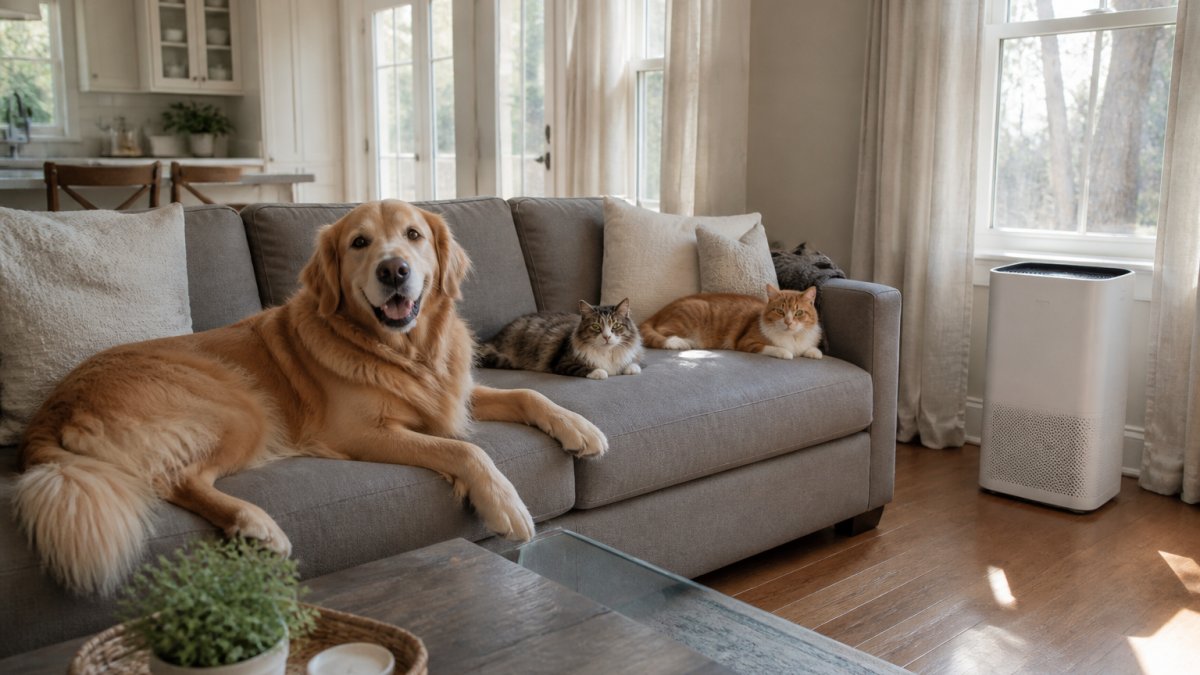
Pet dander, the shed skin cell layer carrying most pet allergens, stays airborne for hours and settles into soft furnishings across an open floor plan.
A room-by-room unit rarely keeps up: air moves between connected spaces, so one purifier must work against the whole volume, not just one room.
Below, we break down what matters, how we evaluated each pick, and where cheap units fall short.
CADR, Air Changes Per Hour, and Why Room Size Claims Vary
The math is simple: a purifier rated for a space at two ACH will not clear smoke or dander as fast as one rated for four ACH at the same size.
Room size claims vary because brands quote different ACH targets. Some measure at one air change per hour, barely enough to notice; others at four or five, which is what allergy-sensitive homes need.
A purifier marketed for “large rooms” at one air change per hour will not keep up with three shedding pets. Check the ACH figure, not just the square footage on the box.
How We Evaluated These Large Room Air Purifiers for Pets
We judged each large room air purifier for pets on five factors: filtration depth, pet hair capture, odor handling, coverage claims, and filter replacement cost.
Filtration depth matters most. A true HEPA filter captures fine particles, but pet odor is a gas, not a particle.
We also weighed maintainability: pet owners clean pre-filters constantly, so a design that fights you adds real friction over a year.
- Filtration: HEPA grade and carbon weight
- Hair capture: pre-filter design and cleanability
- Odor: carbon volume, not just a carbon layer
Comparison Table: Top Picks for Pet Owners in Large Spaces
A ranked list is only useful if you can compare the numbers behind it. The table below separates what each unit is rated to do from the marketing language. Where a manufacturer does not publish a figure, the cell says so, an empty spec is itself a data point.
| Model | Filtration | Carbon Media | Stated Coverage | Best For | Standout Feature |
|---|---|---|---|---|---|
| Aero Essence SR100 | Multi-stage, nine pollutant types | Not published | Not published | Allergy-sensitive homes needing proof it works | Visual confirmation of purification |
| Alen BreatheSmart 75i | H13 HEPA plus Fresh Filter | 3.6 lb pelleted activated carbon | Not published in our research | Odor-heavy homes | Deep pelleted carbon bed |
| Coway Airmega 400S | True HEPA with carbon | Carbon layer | Reported above 600 sq ft | Multi-pet households | Largest stated coverage in this group |
| Medify MA-112 | High-capacity HEPA | Carbon layer | Not published in our research | Whole-floor cleaning | High-capacity airflow design |
How to Read This Table Without Getting Fooled
Three columns do the real work here, and two are usually missing from a spec sheet.
Stated coverage is the weakest number on any box. A manufacturer can pick whatever air changes per hour flatters the unit.
Carbon media is where odor performance lives. HEPA captures particles, not odor molecules, only activated carbon does that, and the amount matters more than the label.
The Standardized Comparison Competitors Skip
Most roundups rank units by manufacturer claims. A more useful comparison holds operating speed constant and asks three questions at the same fan setting:
- What is the CADR? Clean air delivery rate is the volume of filtered air the unit moves per minute, in cubic feet per minute. Higher CADR at the same noise level means more cleaning for the same disturbance.
- What ACH does that CADR produce in your actual room? Divide the CADR by the room’s cubic volume, then multiply by 60. A 600-square-foot room with 8-foot ceilings holds 4,800 cubic feet: a 300 CFM unit delivers roughly 3.75 ACH there; a 200 CFM unit about 2.5.
- Does the unit hold that output as the filter loads? Pet hair and dander cut airflow faster than ordinary dust. A unit that starts strong and fades in six weeks is not a large-space solution.
Run that math before you buy, and the ranked list above becomes a starting point rather than an answer.
Prices for the Alen, Coway, and Medify units are not published in our research, so we do not quote them. For current SR100 pricing, check our site.
Aero Essence SR100 Review: Visual Confirmation and Nine-Pollutant Coverage
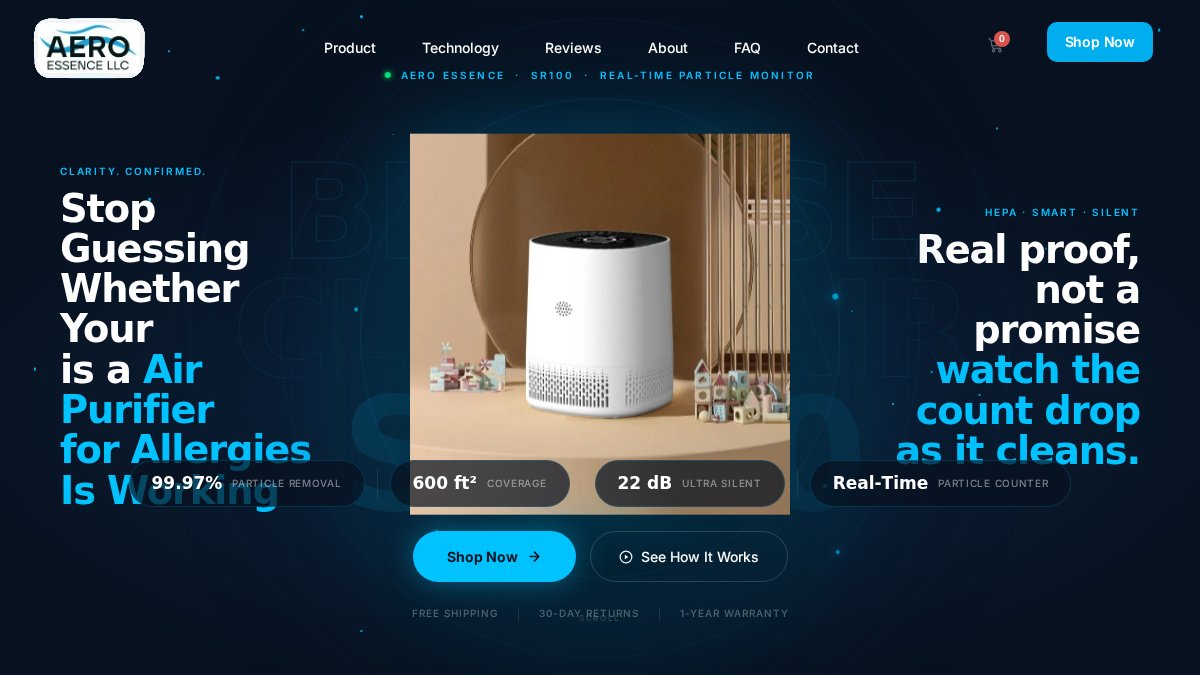
The SR100 targets nine pollutant types and provides visual confirmation that it is working. Many purifiers do not offer this kind of feedback.
That visual confirmation addresses a common question: how do I know this is doing anything? Instead of trusting a light on a panel, you see the purification happening, which can encourage consistent use.
What the SR100 Does Differently
The SR100 handles nine pollutant types, targets invisible particles like those that drive allergy symptoms, and provides visible proof of performance.
Its benefits include removing dust mites, pet dander, pollen, mold spores, and smoke.
The SR100 offers a combination of broad pollutant coverage and visual confirmation.
For a home with cats, dogs, or both, that coverage is the point.
Alen BreatheSmart 75i, Coway Airmega 400S, and Medify MA-112: Strengths and Tradeoffs
Three other units earn a mention for large-space pet use, each with a clear tradeoff.
The Alen BreatheSmart 75i pairs an H13 HEPA filter with a Fresh Filter option holding 3.6 pounds of pelleted activated carbon, why it handles smelly pets well.

The Coway Airmega 400S is built for multi-pet homes, with reported coverage above 600 square feet and the highest CADR in its roundup.
The Medify MA-112 is a high-capacity unit aimed at whole-home results, with dust and pet pollutants called out.
If a brand will not publish its CADR or ACH, assume the room-size claim is optimistic. Ask for the number before you buy.
Air Purifier for Pet Hair and Dander: What Actually Captures It
An air purifier for pet hair and dander captures hair with a pre-filter and dander with a HEPA stage: the pre-filter catches visible hair, the HEPA filter traps the microscopic dander that triggers allergies.
Skipping the pre-filter can lead to hair clogging the main filter fast, driving up replacement cost and dropping airflow.
- Vacuum or rinse the pre-filter every two weeks
- Check for hair wrap around the intake grille
- Replace the HEPA filter on schedule, not when it looks dirty
Letting a pre-filter load up with hair cuts airflow and forces the HEPA stage to work harder. In a multi-pet home, that can shorten filter life noticeably.
Best Air Purifier for Pet Odor: Separating Gas Removal From Particle Filtration
The best air purifier for pet odor removes gases, a different job from removing particles. HEPA filters catch dander and dust but let odor molecules pass straight through.
Odor control comes from activated carbon: the more carbon, the longer it works before saturating. A thin carbon layer fades in weeks; a deep bed of pelleted carbon lasts far longer.
This is where the Alen unit’s 3.6 pounds of carbon stands out, and why we separate odor performance from particle performance when we evaluate: a unit can be excellent at dander and useless against smell.
Air Purifier Filter Replacement for Pets: Real Cost of Ownership
Air purifier filter replacement for pets can cost more than for a pet-free home, because hair and dander load filters faster. The purchase price is only part of the story.
A total-cost-of-ownership view has four line items. Most roundups show you one.
1. Purchase Price
The sticker price is the easiest number to find and the least useful on its own. A cheaper unit with a short filter interval can cost more over two years than a pricier unit with a longer one.
2. Replacement Filter Costs
Filter pricing varies widely by brand and stage. A pre-filter is inexpensive and often washable; the HEPA stage is the expensive one; carbon stages range from a thin layer bundled with the HEPA filter to a separate, refillable bed.
Because we do not have verified pricing for the Alen, Coway, or Medify units in our research, we do not quote their filter costs. For SR100 filter pricing and schedule, check our product page.
3. Replacement Intervals in a Multi-Pet Home
This is where pet ownership changes the math. Manufacturer intervals assume an average home. A home with two or three shedding pets is not average.
| Filter Type | Typical Interval | What Drives Replacement |
|---|---|---|
| Pre-filter | Every 2-4 weeks (clean) | Visible hair buildup |
| HEPA | Per manufacturer schedule, often shorter with pets | Airflow drop, discoloration |
| Activated carbon | Per manufacturer schedule | Odor returning |
In multi-pet homes, the HEPA and carbon stages typically need replacing at the early end of the manufacturer’s range, not the late end. Budget for the shorter interval and you will not be caught off guard.
4. Electricity Use
A large-space purifier runs continuously, so wattage matters. Most full-size units draw 20 to 100 watts on low and considerably more on high. At a typical residential rate, running a 50-watt unit 24 hours a day for a year costs roughly the price of a mid-range replacement filter; running it on high all year can double or triple that. Check wattage at each speed before assuming operating cost is trivial.
Putting It Together
A rough year-one estimate looks like this:
- Purchase price
- Plus one or two HEPA replacements
- Plus one or two carbon replacements
Buy replacement filters in a multi-pack. It lowers the per-filter cost and means you are never running a saturated filter while waiting on a shipment.
The cheapest purifier to buy is rarely the cheapest to own. In a multi-pet home, the filter interval and the carbon load matter more to your two-year cost than the price on the box.
Frequently Asked Questions
What size air purifier do I need for a large space with pets?
Match the purifier’s CADR to your room’s square footage and ceiling height. For spaces over 600 square feet, look for a unit with a high CADR and enough airflow to cycle the air at least four times per hour. The Coway Airmega 400S is reported to handle spaces over 600 square feet, and the Medify MA-112 is described as suitable for large spaces. Measure your room, then compare CADR ratings before buying.
Do air purifiers remove pet hair and dander?
HEPA filters capture pet dander and airborne hair particles, but larger clumps of hair settle on floors and furniture before reaching the filter. A pre-filter catches the bigger debris and protects the HEPA layer. The Alen BreatheSmart 75i uses an H13 HEPA filter, and the Aero Essence SR100 targets pet dander among nine pollutant types. Vacuuming regularly and running the purifier continuously gives the best results for pet hair and dander.
Which air purifier is best for pet odors?
Odor removal depends on activated carbon, not HEPA filtration. The Alen BreatheSmart 75i with the Fresh Filter option contains 3.6 pounds of pelleted activated carbon, which is substantial for a residential unit. More carbon means longer-lasting odor control. Check the carbon weight before buying, because a thin carbon layer saturates quickly in a multi-pet home and stops neutralizing smells within weeks.
How often should I replace an air purifier filter in a home with pets?
In a multi-pet household, expect to replace the HEPA filter more often than the manufacturer’s standard interval. Pet hair clogs pre-filters faster, and dander loads the HEPA media. Check the pre-filter monthly and rinse or vacuum it as needed. The Aero Essence SR100 and other units with multi-stage filtration typically need HEPA replacement every six to twelve months in pet homes, depending on how many animals you have and how often the unit runs.
How many air purifiers do I need for a large home with pets?
One high-CADR unit can cover an open-plan space over 600 square feet if the airflow reaches the whole area. Closed-off rooms, bedrooms, and basements need their own unit because air does not circulate freely through walls and doors. For a large home with pets, start with one purifier in the main living area and add units in rooms where pets sleep or spend most of their time.
Pet dander, hair, and odor build faster in a large open space than any single small unit can handle, and the wrong pick leaves you guessing whether it works at all. Aero Essence LLC built the SR100 for exactly this problem, with nine-pollutant coverage, visual confirmation that purification is happening, and targeting of the invisible particles that drive most symptoms. Get started with Aero Essence LLC and give your pets a home that stays clean, not just looks it. Shop Now.