
How Air Purifiers Improve Sleep for Asthma: 2026 Guide
Table of Contents
- How Air Purifiers Improve Sleep for Asthma: The Basics
- Asthma Triggers in the Bedroom That Disrupt Sleep
- Choosing an Air Purifier for Asthma: Key Features That Matter
- Air Purifier Placement for Bedroom: Where to Put It for Best Results
- How Air Purifier Sleep Quality Improves: What the Evidence Shows
- Maintenance, Costs, and Realistic Expectations
- Conclusion: Setting Up for Better Nights
- Frequently Asked Questions
Last Updated: October 12, 2026
How Air Purifiers Improve Sleep for Asthma: The Basics
Air purifiers improve sleep for asthma by pulling airborne triggers out of the air before they reach your airways. When you breathe cleaner air overnight, you cough less, wake less, and stay asleep longer. That is the short version. The longer version is where most people get it wrong.
At Aero Essence LLC, we talk to people every week who bought a purifier, ran it for a month, and felt nothing changed. Usually the machine was fine. The setup was not.
So here is what actually matters:
- Trigger removal. Fine particles like dust, pollen, and smoke settle in a bedroom and get stirred up when you move.
- Overnight exposure. You spend roughly a third of your life in bed, breathing that same air.
- Consistency. A purifier only helps while it runs. Off at midnight means no protection at 3 a.m.
The EPA guide to indoor air quality notes that indoor air can carry more pollutants than outdoor air, which is why bedroom filtration gets so much attention.
Below, we break down the triggers, the features that matter, and how to set up a purifier that actually helps you sleep.
Cleaner bedroom air does not cure asthma. It removes a nightly irritant load, which makes it easier for your body to rest.
Asthma Triggers in the Bedroom That Disrupt Sleep
Bedrooms collect triggers better than almost any room in the house. Soft surfaces trap them, and low airflow keeps them there.
The usual suspects:
- Dust mites. They live in bedding, pillows, and mattresses, and their waste is a common asthma trigger.
- Pet dander. Fine skin flakes stick to fabric and stay airborne for hours.
- Pollen. It rides in on clothes, hair, and open windows during high season.
- Mold spores. Damp corners, basements, and bathrooms feed them.
- Smoke and odors. Wildfire smoke and cooking fumes drift through the whole house.
- Volatile organic compounds. Paints, new furniture, and cleaning products release these gases over time.
Nighttime makes all of this worse. Lying flat can increase congestion, and a stuffy nose pushes people toward mouth breathing. That dries out airways and triggers coughing.
A common mistake is chasing one trigger at a time. Most bedrooms have several at once, and that is why single-fix approaches often disappoint.
Choosing an Air Purifier for Asthma: Key Features That Matter
The best air purifier for asthma pairs true HEPA filtration with a carbon filter and enough capacity for the room. Skip anything that markets itself on looks alone.
What to check before buying:
| Feature | Why It Matters | What to Look For |
|---|---|---|
| HEPA filter | Captures fine particles like dander and pollen | True HEPA rating, not “HEPA-like” |
| Carbon filter | Handles smoke, odors, and gases | Activated carbon, decent weight |
| Clean air delivery rate | Shows real cleaning speed | Matches or exceeds room size |
| Air changes per hour | Measures how often air cycles | Higher is better for asthma |
| Noise level | Affects whether you keep it on | Quiet mode for overnight use |
PM2.5 is the measurement you will see most often. It covers particles small enough to reach deep into the lungs, and it is the number that matters most for asthma.
Room size is where buyers slip up. A unit rated for a small bedroom will struggle in an open-plan space. If the room is large, one machine may not be enough.
Buying a purifier rated for a smaller room than you have is the most common setup mistake. The unit runs constantly, never catches up, and the owner concludes purifiers do not work.
Air Purifier Placement for Bedroom: Where to Put It for Best Results
Place the purifier a few feet from the bed, not against a wall, and keep it off the floor. Air needs to move freely in and out of the unit.
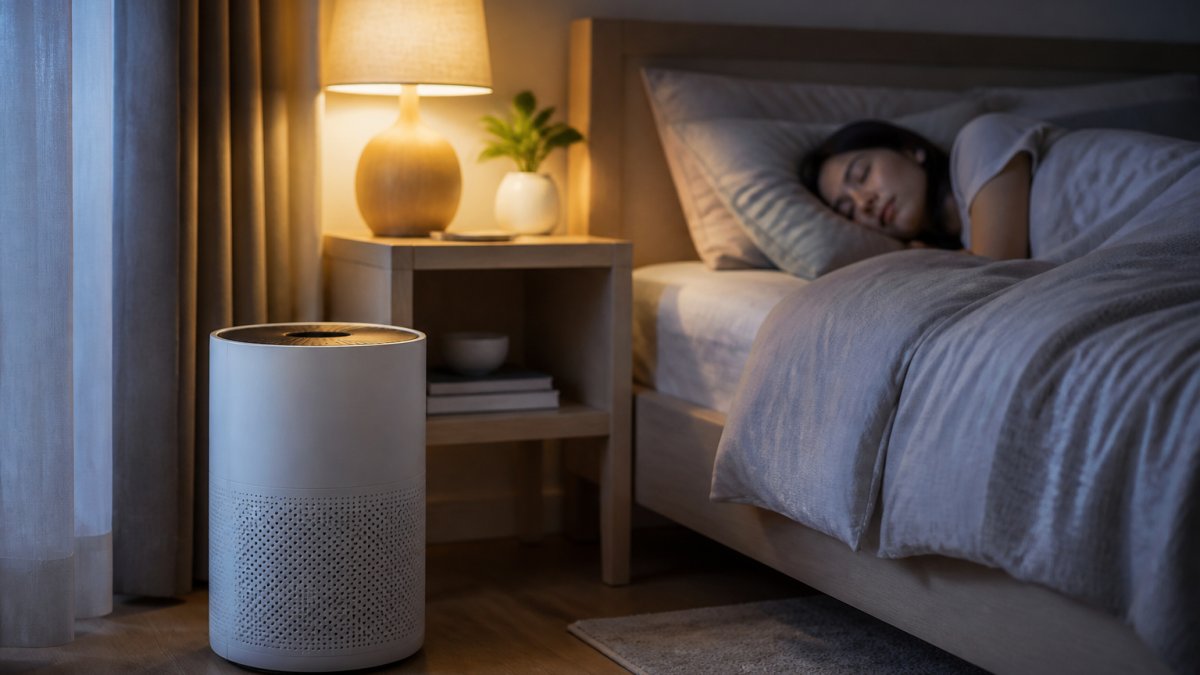
Good air purifier placement for bedroom use follows three rules:
- Leave at least a foot of clearance on all sides.
- Point the airflow toward the sleeping area, not away from it.
- Keep doors closed so the unit cleans one room instead of the whole house.
Where you put it also affects noise. A unit near your head sounds louder than the same unit across the room. Test the placement before you commit to it.
One more thing: do not tuck it behind a curtain or under a nightstand. Blocked intake cuts performance fast.
How Air Purifier Sleep Quality Improves: What the Evidence Shows
The honest answer is that the evidence is mixed, and anyone who tells you otherwise is selling something. But “mixed” is not the same as “unclear.” The trick is to separate what researchers actually measure into two buckets: sleep outcomes and asthma outcomes. Most confusion comes from blending them.
Bucket one: sleep outcomes. These are things like total sleep time, time in bed, number of awakenings, sleep efficiency, and self-reported sleep quality. Studies on air purification in bedrooms have generally shown small-to-moderate improvements in these measures, especially in people with allergies or asthma.
Bucket two: asthma outcomes. These are things like nighttime symptom scores, rescue inhaler use, cough frequency, wheeze, and peak flow. Results here are more inconsistent. Some trials show improvement, some show little change, and some show improvement only in certain subgroups.
Here is why the two buckets do not move together:
- Sleep can improve without asthma improving. A quieter, less irritating bedroom environment may reduce awakenings even if airway inflammation is unchanged.
- Asthma can improve without sleep improving. Better symptom control does not automatically fix sleep if the cause of poor sleep is something else, like reflux, anxiety, or sleep apnea.
- Both can improve for reasons unrelated to the filter. A new bedtime routine, cooler room, or seasonal change can shift results.
Study limitations matter too. Many trials are small, run for only a few weeks, and rely on self-reported symptoms rather than clinical measurements. Some use sham filters as controls, which is good, but sham units still move air and make noise, so the placebo effect is hard to fully remove.
The National Heart, Lung, and Blood Institute overview of asthma explains that asthma symptoms often worsen at night, which is why bedroom air gets so much attention in the first place.
The practical takeaway: if your sleep problems come from airborne triggers, filtration is likely to help. If they come from something else, it probably will not. And even when it helps, do not read improved sleep as proof that your asthma is under control.
Track your nights for two weeks before and after setup. Note coughing, congestion, how many times you wake, and total sleep time. That personal record beats any general claim about air purifier sleep quality, and it gives your clinician something concrete to work with.
Maintenance, Costs, and Realistic Expectations
Filter replacement is the cost most buyers forget. A purifier is cheap to run and expensive to maintain if you ignore the filters. But maintenance is only half the job.
The maintenance schedule that keeps filtration effective:
- Pre-filters. These catch hair, dust, and large debris. Clean or vacuum them monthly. A clogged pre-filter forces the HEPA stage to work harder and shortens its life.
- HEPA filters. Most need replacing every 6 to 12 months. In smoky, dusty, or pet-heavy homes, plan on the shorter end. A dark gray or visibly loaded filter is overdue.
- Carbon filters. They wear out faster than HEPA because they absorb gases rather than trap particles. Many units need carbon changes every 2 to 4 months, especially in homes with cooking odors, smoke, or VOCs.
- Sensors and intakes. Wipe them down monthly. Dust on a particle sensor causes the unit to misread air quality and run at the wrong speed.
Operating costs to plan for. Electricity is usually the smallest line item. Most bedroom-sized units draw roughly the same as a small fan or a light bulb, even running all night. The bigger recurring cost is filters.
Asthma-specific setup steps. This is where most guides stop short, so here is the sequence:
- Match capacity to the room. Use the unit’s clean air delivery rate rating against your actual square footage, not the room you wish you had. If the bedroom is large or open to a hallway, one unit may not be enough.
- Position it for airflow, not looks. A few feet from the bed, off the floor, at least a foot of clearance on all sides. Do not tuck it behind a curtain or under a nightstand.
- Point airflow toward the sleeping area, not away from it, so cleaned air reaches your breathing zone.
- Close the door. Cleaning one room is far more effective than trying to clean the whole house through an open doorway.
- Set fan speed for overnight. Many people run the highest speed before bed, then drop to a quiet setting overnight. That is backwards for asthma. A moderate, consistent speed that you can tolerate all night beats a burst of high speed followed by silence.
- Run it before bed, not just during sleep. Starting the unit an hour before you get in bed means the room is already cleaner when you lie down.
Match filtration to your actual triggers. A HEPA stage handles particles like pollen, pet dander, dust mite waste, and smoke. A carbon stage handles gases and odors. If your main trigger is pollen, prioritize HEPA and keep windows closed during high season.
Safety and realistic expectations. An air purifier is an adjunct, not a replacement for prescribed asthma treatment. Keep taking controller medications as directed and keep a rescue inhaler accessible. Avoid ozone-generating devices entirely, since ozone is a known airway irritant.
Measure whether it is helping. Before you start, spend two weeks logging nighttime symptoms, awakenings, sleep duration, and any indoor conditions you can track, like whether windows were open or pets were in the room. After two weeks of consistent use, compare. Look for trends, not single nights.
The CDC information on asthma triggers is clear that managing asthma means controlling triggers on several fronts, not just one.
Aero Essence LLC built the SR100 around nine kinds of pollutants, from dust mites and pet dander to pollen, mold spores, and smoke.
Conclusion: Setting Up for Better Nights
Getting cleaner bedroom air is not complicated, but it does take the right machine, the right spot, and a filter schedule you actually follow.
If you have asthma, pets, or live where wildfire smoke drifts in, the SR100 from Aero Essence LLC handles nine pollutant types, shows you it is working, and targets the invisible particles that disrupt sleep. Shop now and start sleeping through the night again.
Frequently Asked Questions
Can an air purifier improve sleep quality for people with asthma?
Yes, an air purifier can improve sleep quality for people with asthma by reducing airborne triggers like dust, pollen, pet dander, and smoke that irritate airways at night. Using a HEPA filter in the bedroom lowers fine particles such as PM2.5, which can lead to fewer nighttime symptoms like coughing and congestion. Many users report falling asleep faster and staying asleep longer, though results vary based on trigger sensitivity and consistent use.
Where should you place an air purifier in a bedroom?
Place the air purifier 3 to 6 feet from the bed, ideally not directly against a wall or behind furniture, so air can circulate freely. Avoid corners that block intake vents. For best results, keep it on a low setting overnight to maintain continuous filtration without disrupting sleep. If you have a larger room, position the unit centrally or consider a second unit to ensure proper air changes per hour.
Should an air purifier run all night?
Yes, running an air purifier all night is recommended for asthma sufferers because triggers like dust and dander are constantly present. Continuous use keeps particle levels low while you sleep, which supports easier breathing. Choose a model with a quiet sleep mode to avoid noise disruption. The cost of running it overnight is minimal compared to the benefit of uninterrupted sleep.
Can an air purifier replace asthma medication or other treatment?
No, an air purifier cannot replace asthma medication or a doctor-prescribed treatment plan. It is a complementary tool that reduces airborne triggers in your bedroom, which can lessen symptoms and improve sleep quality. Always follow your healthcare provider’s advice regarding inhalers, controllers, and other medications. Use the purifier as part of a broader strategy that includes trigger management and regular medical care.