
DIY Air Purifier Filter Cleaning: Real Savings
Table of Contents
- DIY Air Purifier Filter Cleaning: Where the Savings Come From
- How to Clean an Air Purifier Filter Without Damaging It
- Can You Wash HEPA Filters? What Happens When You Try
- How Often to Replace Air Purifier Filters (and How to Tell)
- Air Purifier Filter Replacement Cost vs. Cleaning Savings
- When Cleaning Is Not Enough: Signs You Need a Real Air Purifier
- Conclusion
- Frequently Asked Questions
Last Updated: October 4, 2026
DIY Air Purifier Filter Cleaning: Where the Savings Come From
Building a DIY air purifier with a box fan and a furnace filter costs far less upfront than a commercial unit.
Most people assume any filter can be rinsed and reused. That assumption is wrong, and it is expensive.
Here is the core tension: cleaning saves money on disposable filters, but over-cleaning damages filter media and cuts particle removal.
The U.S. Environmental Protection Agency’s indoor air quality guidance notes that effective filtration depends on matching filter type to the job.
| Filter Type | Can You Wash It? | Best Cleaning Method | Typical Lifespan |
|---|---|---|---|
| Washable prefilter | Yes | Rinse with water | Reusable for years |
| Foam layer | Yes | Hand wash, air dry | 6-12 months |
| Disposable MERV filter | No | Vacuum only | 1-3 months |
| HEPA filter | No | Vacuum or replace | 6-12 months |
How to Clean an Air Purifier Filter Without Damaging It
Cleaning an air purifier filter safely means matching the method to the material. Washable layers handle water. Disposable and HEPA media do not. Get this wrong and you destroy the filter’s ability to trap particles.
Washable Prefilters and Foam Layers
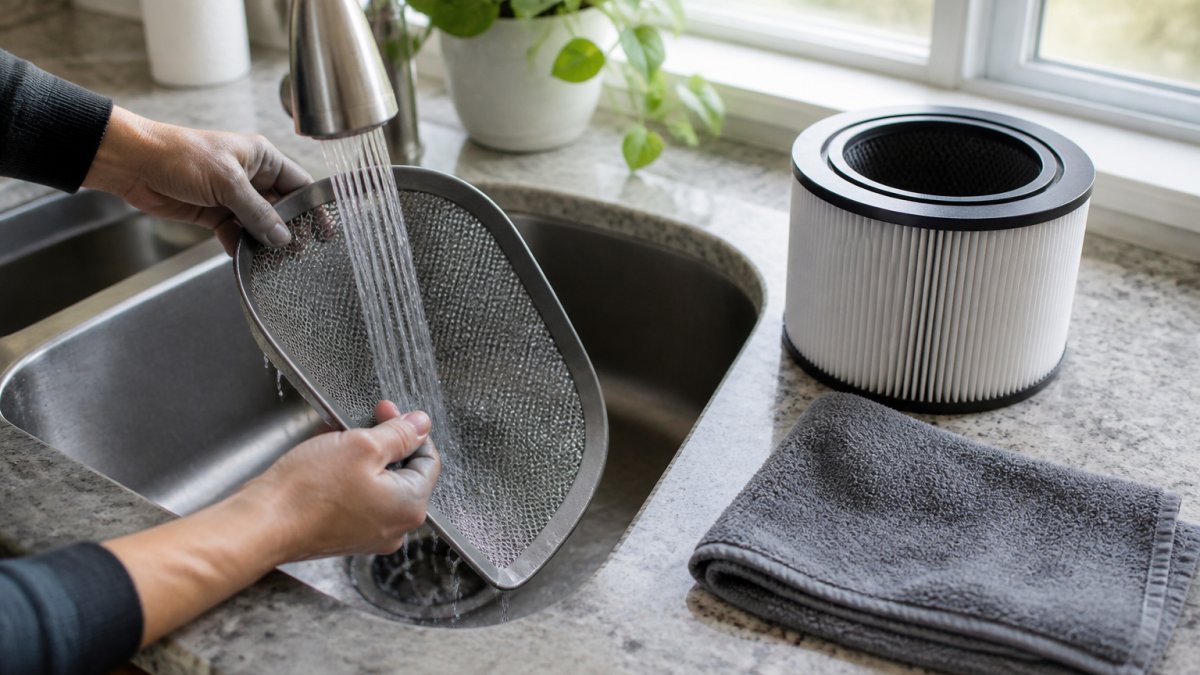
These are the filters you can actually clean and reuse. A washable prefilter catches large debris like pet hair and dust before it reaches the main filter. Rinse it under lukewarm water until the runoff runs clear. Foam layers need a gentle hand wash with mild soap, then a full air dry.
Never put a damp filter back in the unit. Moisture grows mold, and mold spores defeat the whole point of filtering.
Disposable Filters: Vacuum Only, Never Rinse
Disposable MERV filters and HEPA filters cannot be washed. Running water through them collapses the fiber structure that traps small particles. Once that structure fails, the filter lets dust straight through.
You can vacuum the surface to extend life a little. Use a brush attachment on low suction. Do not press hard, and do not scrub.
Rinsing a disposable or HEPA filter does not just fail to clean it. It permanently destroys the filter’s particle removal, so you keep running the fan while breathing dirty air. Replace it instead.
Can You Wash HEPA Filters? What Happens When You Try
No, you cannot wash a HEPA filter. HEPA media is made of dense, fine fibers that trap tiny particles through a mix of physical and electrostatic forces. Water and scrubbing break those fibers apart.
When that happens, three things go wrong at once:
- Airflow increases because the media is now full of holes
- Particle removal drops sharply
- The unit sounds like it is working better when it is actually filtering less
A true HEPA filter is designed as a sealed, disposable part. The U.S. Department of Energy’s guidance on HEPA filtration explains that HEPA media captures particles through interception and diffusion, which is why the fiber structure matters so much.
If you want a reusable option, look for a washable prefilter that sits in front of the HEPA stage. That way the prefilter takes the abuse, and the HEPA filter lasts longer.
How Often to Replace Air Purifier Filters (and How to Tell)
Fixed intervals are a starting point, not a rule. A filter’s real life depends on how many hours the fan runs, how much dust and dander is in the air, and whether a prefilter is catching the big stuff first. Two identical filters in two identical homes can last very different lengths of time.
Start With the Manufacturer’s Guidance
Every filter and every fan has a stated service life or a recommended replacement interval. That guidance is the baseline. Deviating from it, running longer to save money, or replacing early out of caution, is a choice you make with your eyes open. If the filter came with a MERV rating and a recommended interval, write both on the frame.
Inspection Cues, Not Calendar Dates
Check the filter every two to four weeks. Look for:
- Color change. A clean MERV filter is usually white or light gray. Dark gray or black loading across the face means it is holding a lot of particles.
- Matted or crushed media. If the pleats have collapsed or the media feels stiff and brittle, airflow is restricted and capture is compromised.
- Visible bypass. Gaps at the frame edges where air sneaks around the media mean the filter is no longer doing its job, regardless of how it looks.
- Reduced airflow. Hold your hand a few inches from the fan outlet. If the stream feels noticeably weaker than when the filter was new, the filter is loading up.
Interval Ranges by Filter Type
These are typical ranges, not guarantees. Adjust based on what you see during inspection.
- Washable prefilter: rinse every 2-4 weeks; reusable for years with gentle handling
- Foam layer: clean monthly; replace every 6-12 months, sooner if it crumbles or loses shape
- Disposable MERV filter: replace every 1-3 months in a typical home; closer to 1 month with pets, smoking, or wildfire smoke; closer to 3 months in a clean, low-occupancy space
- HEPA filter: replace every 6-12 months per manufacturer guidance; never wash
What Shortens Filter Life
- Running the fan 24/7 instead of 12 hours a day roughly doubles the dust load per calendar month
- Pets, cooking, candles, and wood smoke add particulate load fast
- Wildfire smoke events can load a filter in days, not weeks
- A missing or dirty prefilter pushes large debris straight into the main media
- High humidity encourages biological growth that no amount of cleaning fixes
What Lengthens It
- A clean washable prefilter in front of the main filter
- Running the fan only when the room is occupied
- Sealing gaps around the filter so air goes through the media, not around it
- Storing spare filters sealed and dry so they do not degrade before use
Write the install date on the filter frame with a marker, and note the fan’s daily run hours next to it. When you inspect, you can compare actual loading against expected life and adjust your replacement schedule instead of guessing.
Do not stretch a filter past its inspection cues just to hit a longer interval. A loaded filter raises fan motor temperature, reduces clean-air delivery, and can push particles back into the room. The few dollars saved are not worth the air quality lost.
::: Maintaining a clean filter is only the first step toward improving indoor air quality throughout the rest of your home.
Air Purifier Filter Replacement Cost vs. Cleaning Savings
Most guides tell you cleaning saves money. Almost none show the math. This section does, using transparent assumptions you can swap for your own numbers.
The Three Cost Buckets
Every DIY box-fan purifier has three ongoing costs:
- Filter media, the disposable MERV or HEPA filter, plus any washable prefilter
- Electricity, the fan’s wattage times your run hours times your utility rate
- Your time, cleaning and swapping filters, which has an opportunity cost even if it is not a cash outlay
Cleaning only touches bucket one. If it does not extend filter life, it saves nothing.
Worked Example: One Room, One Year
Assumptions (swap these for your own):
- Box fan rated at 100 watts, run 12 hours per day
- Electricity at the U.S. average residential rate of roughly 17 cents per kWh (check your utility bill for your actual rate)
- Disposable MERV 13 filter purchased at a common retail price of about $15-$25 each
- Replacement interval of 2 months without a prefilter, 3 months with a clean prefilter
- Washable prefilter at about $10, reused for years
Electricity: 100 W × 12 h = 1.2 kWh/day. At $0.17/kWh that is about $0.20/day, or roughly $75/year.
Filters without a prefilter: 6 replacements × $20 = $120/year.
Filters with a prefilter cleaned every 2-4 weeks: 4 replacements × $20 = $80/year, plus the one-time $10 prefilter.
Net first-year saving from adding and cleaning a prefilter: about $30. Every year after, about $40, because the prefilter is already paid for.
What Cleaning Cannot Save
- Electricity. The fan draws the same power whether the filter is clean or clogged. A clogged filter can actually raise fan motor temperature and shorten fan life, but it does not lower your bill.
- A disposable filter past its life. Once MERV or HEPA media is loaded, cleaning does not restore its particle capture. You spend the same money later, plus you breathe dirtier air in the meantime.
- A HEPA filter. Washing destroys it. There is no cleaning-based saving here at all.
Cleaning vs. Replacement vs. Buying a Commercial Unit
A commercial HEPA purifier sized for one room typically runs several hundred dollars upfront, with replacement filters often priced higher than a box-fan MERV filter. Over a year, the DIY setup’s total cost of ownership is usually dominated by electricity, not filters. That is the number most people forget to compare.
Cleaning a washable prefilter is the only reliable saving in a DIY setup, and it is modest, often $30-$50 per year. The bigger lever is run time and fan wattage, because electricity usually costs more than the filters themselves.
Build Your Own Estimate
Plug your numbers into this structure:
- Annual electricity = (fan watts ÷ 1000) × run hours per day × 365 × your $/kWh
- Annual filter cost = (12 ÷ replacement interval in months) × filter price
- Annual saving from cleaning = (filter cost without prefilter) − (filter cost with prefilter) − prefilter price in year one
If the saving is smaller than the value of your cleaning time, cleaning is a hobby, not a saving. That is fine, just do not tell yourself it is a financial win.
When Cleaning Is Not Enough: Signs You Need a Real Air Purifier
Some problems outgrow a box fan setup. If you have pets, mold, wildfire smoke, or a family member with asthma, a DIY build often cannot keep up with the particle load.
Watch for these signals:
- Symptoms return even with a clean filter
- Smoke or odors linger in the room
- One unit cannot cover your open floor plan
- You want proof the air is actually getting cleaner
This is where a purpose-built unit earns its place. At Aero Essence LLC, our SR100 targets nine kinds of pollutants, including dust mites, pet dander, pollen, mold spores, and smoke.
If you are weighing the total cost of ownership, factor in filter replacements over a year, not just the sticker price.
Conclusion
Filter cleaning can genuinely cut what you spend on replacements, but only when you clean the right filters the right way. Rinse the washable layers, vacuum the disposables, and never soak a HEPA filter.
When a DIY setup stops keeping up with dander, mold, or smoke, it is time for a real solution. Aero Essence LLC built the SR100 to handle nine pollutant types and show you it is working.
Frequently Asked Questions
Can you clean air purifier filters instead of replacing them?
It depends on the filter type. Washable prefilters and foam layers can be rinsed and reused for years. Disposable HEPA and MERV-rated filters can be vacuumed gently to extend life by a few weeks, but they cannot be washed. Cleaning a disposable filter instead of replacing it reduces airflow and particle removal, so the purifier works harder without cleaning the air as well.
Does cleaning an air purifier filter reduce its effectiveness?
Yes, if you clean the wrong type. Rinsing a HEPA filter damages the fiber structure and creates gaps that let particles pass through. Vacuuming a disposable filter can also crush the pleats. Washable prefilters are designed for cleaning and keep working at full efficiency. The key is matching the cleaning method to the filter type.
How much can you save by cleaning a reusable air purifier filter?
Savings depend on your purifier and replacement interval. If you replace a disposable filter every three months, cleaning a washable prefilter can extend the main filter’s life and cut replacement frequency. Over a year, that can mean fewer filter purchases. Actual savings vary by model, filter cost, and how dirty your indoor air gets.
How often should I clean or replace an air purifier filter?
Vacuum or rinse washable prefilters every two to four weeks. Replace disposable HEPA filters every six to twelve months, or sooner if you see gray discoloration, notice reduced airflow, or the filter smells musty. Homes with pets, wildfire smoke, or high pollen may need more frequent changes. Check your purifier’s manual for the manufacturer’s recommended interval.