
HEPA Filter Replacement Cost Comparison: 2026 Guide
Table of Contents
- HEPA Filter Replacement Cost Comparison: What You’ll Actually Pay
- Air Purifier Filter Replacement Frequency: How Often Is Too Often?
- Generic vs Brand Name HEPA Filters: Which Saves More Without Sacrificing Performance?
- Understanding HEPA Certification Standards and Filter Grades
- DIY Pre-Filter Maintenance: The Cheapest Way to Extend Filter Life
- Energy Consumption vs. Filter Cost: The Hidden Trade-Off
- Filter Recycling and Environmental Impact
- Long-Term Maintenance Cost Analysis: Total Cost of Ownership
- Frequently Asked Questions
Last Updated: September 27, 2026
HEPA Filter Replacement Cost Comparison: What You’ll Actually Pay
The real cost of owning an air purifier rarely shows up on the price tag. It shows up eighteen months later, when the replacement indicator turns red and you discover that a year of filters can rival what you paid for the machine itself. This guide from Aero Essence LLC breaks down the HEPA filter replacement cost comparison most buyers wish they had before checkout, covering annual budgets, replacement frequency, generic versus brand-name filters, and the maintenance habits that stretch every filter further.
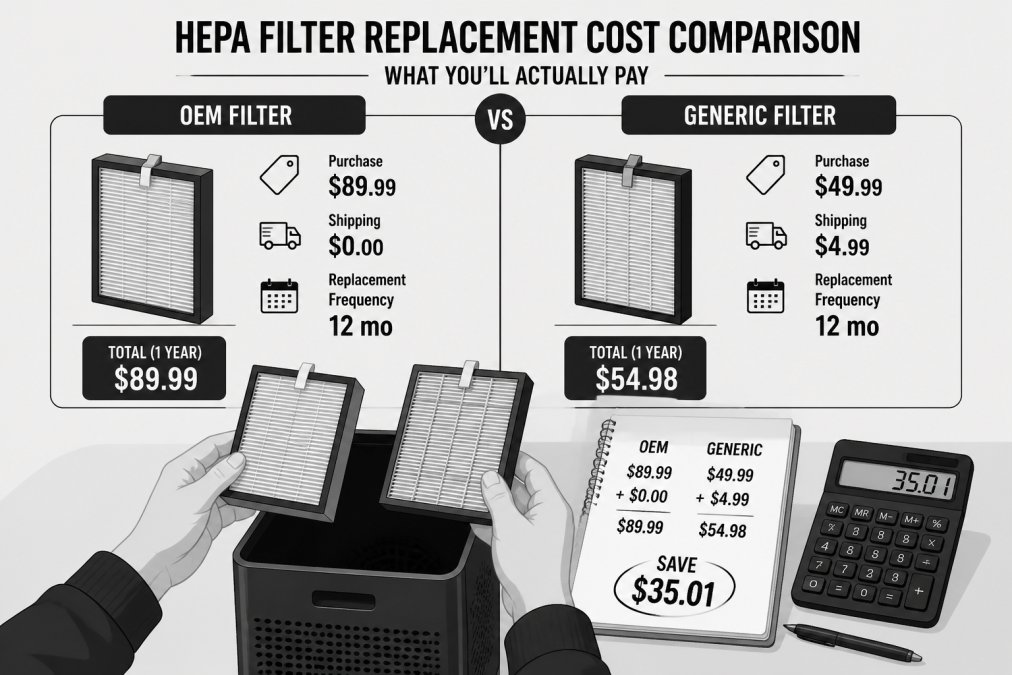
Average Annual Filter Replacement Costs
Annual filter costs depend on three things: how many filters your unit uses, how often you replace them, and whether you buy genuine or third-party parts. A single-filter purifier in a clean home might need one replacement per year. A multi-stage unit in a pet household could need three or four.
Cost Breakdown by Purifier Model
Costs scale with filter complexity, not just unit size. A basic single-filter model carries the lowest annual cost because there’s only one part to replace. Multi-stage units cost more per year but typically capture more particle types.
| Purifier Type | Filters Per Unit | Typical Replacement Cycle | Annual Cost Pattern |
|---|---|---|---|
| Single HEPA | 1 | 12-18 months | Lowest |
| HEPA + carbon | 2 | 6-12 months | Moderate |
| Multi-stage (3+) | 3-4 | 3-12 months | Highest |
| Washable pre-filter + HEPA | 1-2 | Pre-filter reusable | Lowest long-term |
Air Purifier Filter Replacement Frequency: How Often Is Too Often?
Most manufacturers recommend replacing HEPA filters every 6 to 12 months, but that’s a baseline, not a rule. Replacing too early wastes money; replacing too late lets airflow restriction and filter saturation reduce air purification efficiency. The right interval depends on your home, not the calendar.
Factors That Influence Filter Longevity
Several conditions shorten filter life:
- Pets: Dander and hair load the pre-filter fast
- Smoke or wildfire seasons: Particulate matter clogs filter media quickly
- Open windows and pollen: Higher particle capture rate means faster saturation
- Humidity and mold: Moisture can degrade filter material
- Run time: A unit running 24/7 saturates sooner than one running eight hours a day
A common mistake is ignoring the pre-filter. Cleaning it monthly can add months to the HEPA filter‘s life.
Signs Your Filter Needs Replacement
Your unit usually tells you before your nose does. Watch for these signals:
- The replacement indicator light turns on
- Airflow from the vent feels weaker
- The unit runs louder than usual
- Visible gray discoloration on the filter media
- Lingering odors that used to clear quickly
- Allergy symptoms returning in a previously clean room
Vacuum the pre-filter every two to four weeks and rinse washable versions monthly. This single habit is the cheapest way to protect the more expensive HEPA stage behind it.
Generic vs Brand Name HEPA Filters: Which Saves More Without Sacrificing Performance?
Generic filters cost less up front, but the savings only hold if the filter actually performs. Generic vs brand name HEPA filters is a genuine trade-off, not a clear win for either side. Third-party filters vary enormously in quality, and a cheap filter that leaks air around its edges filters almost nothing.
Third-Party vs. OEM Filter Performance Validation
The filter housing seal matters as much as the filter media. A genuine replacement part is built to the exact dimensions of your unit, so air is forced through the filter rather than around it. Many third-party filters fit loosely, which drops particle capture rate even when the media itself is decent.
A poorly sealed filter can let unfiltered air bypass the media entirely. You’ll still hear the fan running, but your indoor air quality won’t improve, and you’ll have paid for filtration you never received.
Understanding HEPA Certification Standards and Filter Grades
A certified HEPA filter must capture 99.97% of particles at 0.3 microns, the size that best tests filter efficiency. That standard is what separates true HEPA from “HEPA-type” or “HEPA-like” marketing labels, which carry no certification and no guaranteed particle capture rate.
DIY Pre-Filter Maintenance: The Cheapest Way to Extend Filter Life
Pre-filter maintenance is the highest-return task in air purifier ownership. It costs nothing but a few minutes a month, and it directly extends the life of the expensive HEPA stage behind it. Most owners skip it because the pre-filter is hidden and unglamorous.
A simple maintenance schedule works for most homes:
- Vacuum the pre-filter every 2-4 weeks
- Rinse washable pre-filters monthly and dry fully before reinstalling
- Check the filter housing for dust buildup quarterly
- Log replacement dates so you track the real replacement cycle
- Replace the HEPA filter when the indicator triggers or airflow drops
Energy Consumption vs. Filter Cost: The Hidden Trade-Off
Filter cost is only half the operating expense. Energy consumption is the other half, and it’s easy to overlook. A unit that runs continuously on high speed burns more electricity, but it also saturates filters faster, so you pay twice.
Filter Recycling and Environmental Impact
Disposable filters end up in landfills, and a household replacing several filters a year adds up over a decade. Most HEPA filters aren’t recyclable because they combine plastic frames, fiber media, and sometimes carbon, which are hard to separate.
Long-Term Maintenance Cost Analysis: Total Cost of Ownership
Total cost of ownership is the only honest way to compare air purifiers, and it’s the angle most cost-comparison articles skip. They quote a filter price and stop. A true TCO figure has four components, and three of them are easy to overlook.
The Four Components of TCO
- Purchase price. The sticker price, paid once.
- Filter replacement cost. Every filter, every interval, multiplied across the years you plan to own the unit. This is usually the largest recurring line.
- Electricity. A purifier running continuously draws power every hour. A clogged filter makes the fan work harder to move the same air, which raises power draw, so filter neglect shows up on your utility bill as well as your parts bill.
- Your time. Cleaning pre-filters, sourcing filters, and troubleshooting a unit that isn’t performing all cost you something, even if it isn’t a line on a receipt.
A Five-Year Comparison Framework
To compare two units fairly, run the same five-year math on both:
- Unit A: $150 purchase price, $160/year in filters, moderate power draw.
- Unit B: $250 purchase price, $100/year in filters, similar power draw.
Where the Electricity Line Comes From
Energy consumption is the hidden half of operating cost. A unit that runs continuously on high speed burns more electricity, and it also saturates filters faster, so you pay twice. Running a purifier on a lower speed for longer can maintain air exchange rate while reducing both power draw and filter wear. Matching fan speed to room size and actual air quality needs, rather than leaving it on maximum, keeps operational costs down on both fronts.
The Maintenance Lever
Pre-filter maintenance is the highest-return task in air purifier ownership. It costs nothing but a few minutes a month, and it directly extends the life of the expensive HEPA stage behind it. Most owners skip it because the pre-filter is hidden and unglamorous. A simple schedule works for most homes:
- Vacuum the pre-filter every 2-4 weeks
- Rinse washable pre-filters monthly and dry fully before reinstalling
- Check the filter housing for dust buildup quarterly
- Log replacement dates so you track the real replacement cycle
- Replace the HEPA filter when the indicator triggers or airflow drops
Matching the Filter to the Pollutants
The U.S. Environmental Protection Agency’s indoor air quality guidance notes that effective filtration depends on matching the filter to the pollutants you actually face, which is why a cost-benefit analysis should weigh filtration performance, not just price. A filter that’s cheap but undersized for your room, or that doesn’t address the particles you actually have, delivers poor value no matter what it costs.
Putting It Together
Buyers who plan for the full cost of ownership, rather than the sticker price, make better decisions and avoid the trap of cheap hardware with costly consumables. The formula is simple: purchase price plus (annual filter cost × years) plus electricity plus your time. Run it before you buy, and re-run it whenever filter prices change.
Frequently Asked Questions
How much do replacement HEPA filters cost?
Pricing for replacement HEPA filters depends on the purifier model, filter grade, and whether it’s a genuine or third-party option. Factors like filter size, certified HEPA status, and unit compatibility affect the price. Always check your purifier’s manual or the manufacturer’s website for current pricing and the exact filter model required.
Are generic HEPA filters as effective as brand-name replacements?
Generic HEPA filters can perform comparably to brand-name options if they meet the same certified HEPA standard, typically capturing 99.97% of 0.3 micron particles. However, third-party filters vary widely in quality. Look for independent testing data or certifications. A poorly made generic filter may restrict airflow or fail to seal properly, reducing air purification efficiency and potentially damaging your unit.
How often do you actually need to replace a HEPA filter?
Most manufacturers recommend replacing HEPA filters every 6 to 12 months, but actual replacement frequency depends on usage hours, local air quality, and pre-filter maintenance. Homes with pets, wildfire smoke exposure, or high particulate matter may need replacements every 3 to 6 months. Check your purifier’s replacement indicator and inspect the filter for discoloration or airflow restriction.
What factors influence the total cost of ownership for an air purifier?
The total cost of ownership includes the initial unit price, annual filter replacement costs, energy consumption, and any pre-filter maintenance. A cheaper purifier with expensive proprietary filters can cost more over five years than a higher-priced unit with affordable filters. Calculate annual maintenance budget by multiplying filter cost by replacement frequency, then add electricity costs based on wattage and usage hours.
The hard part of HEPA filter ownership isn’t choosing a unit. It’s managing the ongoing cost of filters without sacrificing air quality. Aero Essence LLC built the SR100 to make that easier, with a system that targets dust mites, pet dander, pollen, mold spores, and smoke, and provides visual confirmation that it’s actively working. If you’re tired of guessing whether your purifier is earning its keep, get started with Aero Essence LLC and see the difference for yourself.