
Best Air Purifier Brands for Allergies
Table of Contents
- What Makes an Air Purifier Effective for Allergies
- HEPA Air Purifier Benefits and Why They Matter
- Understanding Air Purifier CADR Ratings Explained
- How to Reduce Indoor Allergens with the Right Purifier
- Top Air Purifier Brands for Allergy Relief
- Filter Maintenance and Long-Term Ownership Costs
- Frequently Asked Questions
Last Updated: September 26, 2026
What Makes an Air Purifier Effective for Allergies
The right air purifier transforms your indoor environment by tackling the specific pollutants that trigger allergic reactions. The best air purifier brands for allergies combine proven filtration technology with measurable performance metrics.
Effective purifiers combine three factors: filtration type, Clean Air Delivery Rate (CADR), and targeted pollutants. A purifier handling dust mites, pet dander, pollen, and mold spores delivers results; one that merely circulates air won’t.
The best air purifier brands for allergies combine HEPA filtration with visual confirmation of performance, so you know your investment is working.
HEPA Air Purifier Benefits and Why They Matter
HEPA filtration is the foundation of effective allergy relief. A True HEPA filter captures 99.97% of microscopic particles as small as 0.3 microns, including common allergens, a measurable standard that makes HEPA the gold standard (the EPA).
Combined with a pre-filter for larger debris and activated carbon for odors, HEPA creates a multi-stage defense system addressing multiple allergen types.
HEPA effectiveness depends on airflow. CADR ratings measure how much clean air a purifier delivers per minute, critical for actual performance.
Check the CADR rating for the specific pollutants affecting you. A purifier might have an excellent dust CADR but weak performance on smoke or pollen. Match the rating to your primary allergen source.
Understanding Air Purifier CADR Ratings Explained
The Clean Air Delivery Rate measures filtered air production for smoke, dust, and pollen. A CADR of 300 for pollen cleans a typical room roughly 10 times per hour.
CADR ratings are verified by AHAM (Association of Home Appliance Manufacturers), an independent testing body, providing third-party verified performance data.
Match CADR to room size: a CADR of 200 works for a 200-square-foot bedroom but not a 400-square-foot space. Most people underestimate room size and buy undersized purifiers.
For allergy sufferers, a CADR rating of at least 200 for pollen and dust is the practical minimum. Anything lower won’t deliver noticeable relief in real-world conditions.
How to Reduce Indoor Allergens with the Right Purifier
Placement and maintenance determine whether a purifier reduces allergen exposure. Strategic positioning based on airflow physics transforms it from a background appliance into an active capture system.
Room-Specific Placement Optimization
Airflow patterns in a room follow predictable paths. Warm air rises; cool air sinks. Furniture creates dead zones where stagnant air accumulates. Your purifier’s effectiveness depends on positioning it where it can intercept allergen-laden air before it settles into these dead zones.
Bedroom placement: Position the purifier 3-6 feet from your bed at head height to intercept allergens before they reach your breathing zone during sleep. Avoid windows and exterior walls where outside air infiltration can overwhelm the unit.
Living room and open-concept spaces: Place the unit centrally, away from walls and furniture. Position in the highest-traffic zone where allergen generation is greatest. Avoid corners where air stagnates. For open staircases, position on the lower level where allergens settle.
Pet owner considerations: Place the purifier where your pet spends the most time. A secondary unit in your bedroom ensures you’re not sleeping in an allergen-rich environment. Many pet owners find a bedroom purifier plus one in a common area provides better relief than a single powerful unit.
Avoiding common placement mistakes: Don’t place near HVAC vents, doors, or windows where competing airflow interferes with performance. Don’t hide in cabinets or behind furniture, this restricts intake airflow and reduces efficiency.
Air Exchange Rate and Room Coverage
The air exchange rate, how many times per hour the purifier cycles the room’s air, is your primary performance metric. For allergy relief, aim for at least 3-4 air exchanges per hour.
Calculate room volume (length × width × height), then divide CADR by volume to determine exchanges per hour. A CADR of 300 in a 1,000-cubic-foot bedroom delivers only 0.3 exchanges, insufficient. You’d need a CADR of 900-1,200 or multiple units. Optimizing air circulation remains only half the battle, as minimizing the off-gassing of volatile compounds through non-toxic home decor further reduces the total allergen load within your living space.
In open-concept spaces, a single purifier often proves ineffective. A 1,500-square-foot space with a CADR of 300 achieves only 0.02 exchanges per hour. Many allergy sufferers use two or three strategically placed units instead.
Filter Maintenance and Allergen Reduction
A clogged pre-filter reduces airflow and shortens HEPA filter lifespan. Check monthly and replace when visibly dirty to extend HEPA life and maintain air exchange rate.
Activated carbon filters require more frequent replacement if odors are a concern, typically every 3-6 months in homes with pets or smokers. HEPA filters themselves last 6-12 months depending on usage and baseline air quality. In high-allergen environments (multiple pets, high pollen counts, smokers in the home), expect to replace HEPA filters every 6 months rather than 12.
Operational Patterns for Maximum Relief
Run your purifier continuously to maintain lower ambient allergen levels. Set it to run during sleep hours at minimum, when you’re most sensitive to airborne particles.
Program the unit to run at full speed 30 minutes before bedtime, then medium speed during sleep. In the morning, run at full speed for 30 minutes to clear overnight allergen accumulation.
During high pollen season or poor outdoor air quality, increase runtime or fan speed.
Effective allergen reduction requires three elements working together: strategic placement based on room geometry and airflow patterns, sufficient air exchange rate for your room size, and consistent operation with regular filter maintenance. A perfectly specified purifier in a poor location will underperform; a modest purifier optimally placed will outperform it.
Top Air Purifier Brands for Allergy Relief
Aero Essence SR100
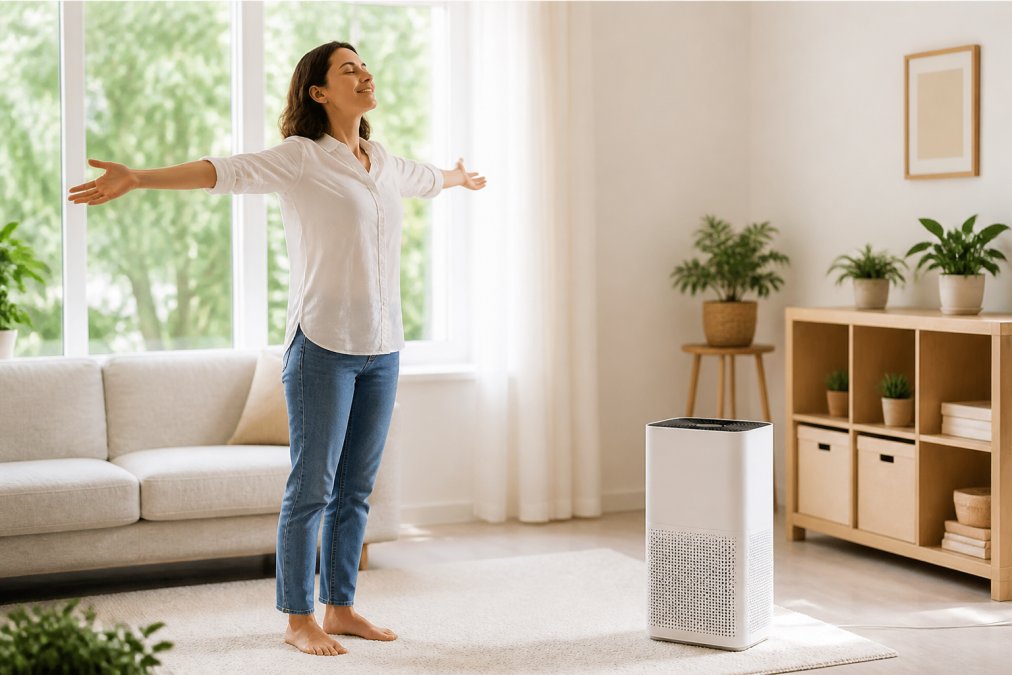
The Aero Essence SR100 handles nine pollutant types including dust mites, pet dander, pollen, mold spores, and smoke, with visual confirmation of performance.
Pros:
- Handles nine types of pollutants in a single system
- Visual confirmation of active purification
- Designed for serious allergen reduction
- Targets dust mites, pet dander, pollen, mold spores, and smoke
Cons:
- Premium positioning reflects advanced filtration capability
Coway Airmega Mighty2
Pros:
- Four-stage filtration including HEPA
- Compact, space-efficient design
- Quiet operation suitable for sleeping areas
- Air quality indicator with real-time monitoring
- Energy-efficient with auto-mode
Cons:
- Lacks advanced smart home integration features
- May require multiple units for very large spaces
NuWave OxyPure
Pros:
- Extremely high air cleaning capacity
- Advanced sensor technology for automatic adjustment
- Durable stainless steel construction
- Effective for large rooms and heavy allergen loads
Cons:
- Higher initial investment cost
- Larger physical footprint
Oransi mod
Pros:
- AHAM Verified CADR for pollen, dust, and smoke
- ETL and UL certified for safety
- Very quiet operation
- Long filter lifespan up to 12 months
- High-quality, durable components
Cons:
- Premium price point reflects certified performance
- May be overkill for smaller spaces
Honeywell HPA300
Pros:
- True HEPA filter captures 99.97% of microscopic allergens
- Simple, reliable manual controls
- Proven effectiveness over years of use
- Suitable for large rooms
- Very easy to operate
Cons:
- Lacks modern smart features like app connectivity or air quality sensors
- No auto-mode functionality
Filter Maintenance and Long-Term Ownership Costs
Initial purchase price tells only part of the cost story. Filter replacement, electricity, and maintenance determine true five-year ownership cost.
Annual Filter Replacement Costs by Brand Category
HEPA filters last 6-12 months; pre-filters need replacement every 1-3 months. Budget for at least one full replacement yearly, sometimes two in heavy-use situations.
Five-Year Total Cost of Ownership Calculator
Initial purchase price, annual filter replacement cost, and annual electricity cost contribute to the five-year total cost. Most purifiers consume 40-150 watts. At $0.14/kWh, a 100-watt unit costs approximately $123/year (24/7) or $62/year (12 hours/day). Energy Star models typically use 30-40% less.
Filter Sourcing and Availability
Some brands use proprietary filters available only from the manufacturer. Generic HEPA filters for standard models may be available.
Maintenance Impact on Long-Term Costs
Neglecting filter replacement increases long-term costs. A clogged filter forces the motor to work harder and shortens lifespan. A neglected pre-filter clogs the HEPA filter prematurely, doubling annual filter costs.
Replacing filters on schedule is not optional maintenance, it’s the most cost-effective way to extend your purifier’s lifespan and maintain the air exchange rate your allergies require. Skipping filter replacements to save money typically costs you more in the long run.
| Scenario | Initial Cost | Annual Filter Cost | Annual Electricity | 5-Year Total |
|---|---|---|---|---|
| Budget model (24/7 operation) | $250 | $80 | $62 | $960 |
| Mid-range model (24/7 operation, Energy Star) | $450 | $145 | $52 | $1,435 |
| Premium model (24/7 operation, high-efficiency) | $900 | $175 | $45 | $2,000 |
| Budget model (12 hours/day operation) | $250 | $80 | $31 | $705 |
| Mid-range model (12 hours/day, Energy Star) | $450 | $145 | $26 | $1,185 |
Frequently Asked Questions
Do air purifiers actually work for allergies?
Yes, air purifiers with HEPA filters effectively remove airborne allergens like pollen, dust mites, pet dander, and mold spores from your indoor air. HEPA filters capture 99.97% of particles 0.3 microns or larger. To see results, choose a purifier with a CADR rating suited to your room size and run it consistently, especially during high pollen seasons or if you have pets.
What features should I look for in an air purifier for allergies?
Look for a true HEPA filter, a CADR rating appropriate for your room square footage, and filtration for specific allergens you face, pet dander, pollen, dust, or mold. Auto-mode functionality adjusts fan speed based on air quality, while a pre-filter extends overall filter life. Visual air quality indicators help you confirm the purifier is working. Quiet operation matters if you run it while sleeping.
How often should I change the filter in my air purifier?
Most air purifier filters last 6 to 12 months, depending on your home’s air quality and how often you run the unit. Homes with pets or high pollen counts may need more frequent replacements. Check your purifier’s filter indicator light or manual for specific guidance. Replacement frequency directly affects long-term ownership costs, so factor filter pricing into your initial purchase decision.
Can an air purifier help with pet dander and dust mites?
Yes, HEPA air purifiers are highly effective at removing pet dander and dust mites from the air. Pet dander particles are typically 5-10 microns in size, well within the capture range of HEPA filters. For best results, pair your purifier with regular vacuuming and washing of pet bedding. Running the purifier continuously or on auto-mode provides better allergen control than intermittent use.