
Where to Place an Air Purifier for Maximum Efficiency
Table of Contents
- Air Purifier Placement: The Rules That Actually Matter
- Room-by-Room Guide: Bedroom, Kitchen, Living Room
- Air Purifier Placement Mistakes That Kill Performance
- How Many Air Purifiers Do I Need for My Home?
- Multi-Story and Open-Concept Layouts: What Changes
- Acoustic and Visual Integration: Placement Without Compromise
- Frequently Asked Questions
Last Updated: September 20, 2026
Air Purifier Placement: The Rules That Actually Matter
Air purifier placement is the single biggest factor in how well a unit cleans your air, and most people get it wrong within five minutes of unboxing. Put a purifier in the wrong spot and it pulls dirty air from a dead zone while you breathe the rest.
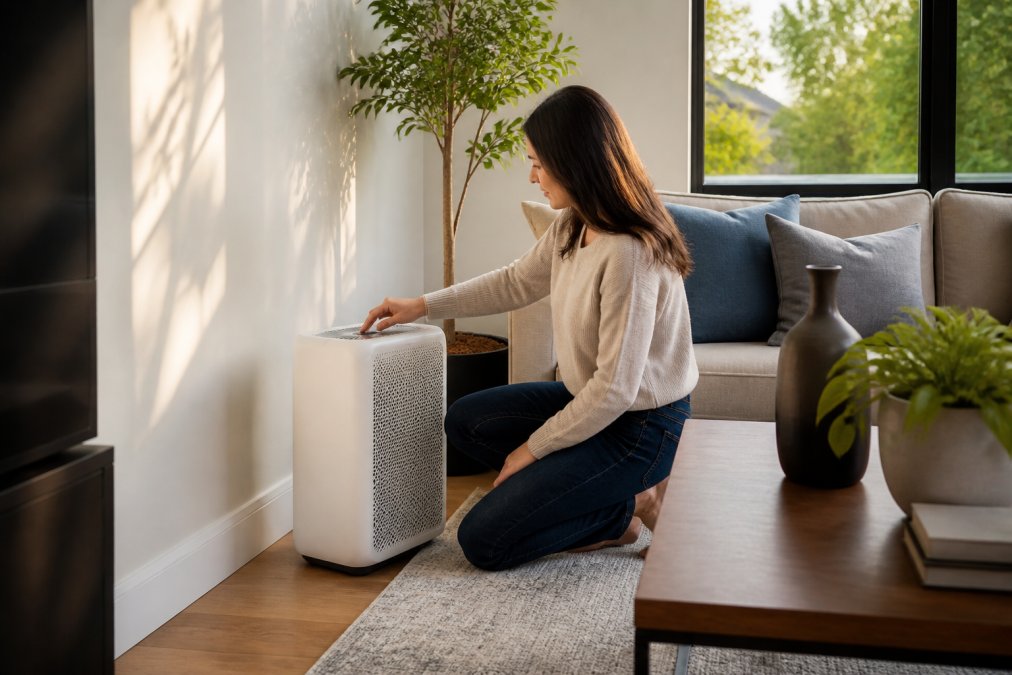
Clearance, Height, and Airflow Basics
Air purifiers need room to breathe. A unit pressed against a wall or tucked behind a sofa can’t pull in enough air to clean the room.
Keep these basics in mind:
- Wall clearance: Leave 12 to 18 inches on all sides, especially the intake side.
- Height: Floor level or a low table works best. Most pollutants settle low.
- Airflow: Don’t block the front or back vents with curtains, furniture, or boxes.
- Open space: Point the exhaust toward the center of the room, not into a corner.
The 80/20 of Positioning: What to Prioritize First
If you only fix one thing, fix the clearance. A purifier crammed into a corner loses more performance than one in a slightly imperfect spot with good airflow.
Here’s the priority order:
- Clear the intake and exhaust. No obstructions, ever.
- Get it off the wall. 12 to 18 inches minimum.
- Put it near the pollution source. Pet beds, litter boxes, kitchens.
- Aim for the center. Let the clean air circulate.
- Keep it low. Most particles hang out near the floor.
A common mistake is placing a purifier on a high shelf for looks. That pulls clean air from the ceiling while the dust, dander, and pollen stay down where you breathe. Keep it low.
Room-by-Room Guide: Bedroom, Kitchen, Living Room
Each room has its own pollution sources, so placement changes with the space.
Placing a purifier directly beside a litter box or pet bed seems smart, but it pulls concentrated ammonia and dander straight into the filter. Keep 4 to 6 feet of distance so the unit can process the whole room, not just one hot spot.
Air Purifier Placement Mistakes That Kill Performance
Most air purifier placement mistakes come down to blocking airflow. The unit runs, the light stays on, and you assume it’s working. Meanwhile, the intake is half-covered and the clean air never reaches you.
Watch for these:
- Pushing it into a corner. Corners trap air and starve the intake.
- Hiding it behind furniture. Sofas, curtains, and plants block circulation.
- Setting it on a high shelf. Clean air stays up high, away from you.
- Placing it near a vent or window. Outdoor air and HVAC drafts overwhelm the unit.
- Ignoring the exhaust direction. Point it into the room, not at a wall.
How Many Air Purifiers Do I Need for My Home?
The number of air purifiers you need depends on room size and the unit’s clean air delivery rate. One purifier handles one enclosed room; open layouts usually need more.
Here’s a simple way to decide:
- One small room: One purifier with enough CADR for the square footage.
- Open-concept space: Two or more units, spaced apart.
- Multiple bedrooms: One per room, or one for the hallway if doors stay open.
- Whole home: One per main living zone, not one for the entire house.
More units in the right spots beat one oversized unit in the wrong spot. Airflow and coverage matter more than raw power.
Multi-Story and Open-Concept Layouts: What Changes
Multi-story homes and open-concept spaces break the normal placement rules because air doesn’t respect room boundaries. A purifier rated for 500 square feet won’t clean a 500-square-foot open floor plan the way it cleans a closed bedroom, same air volume, completely different mixing pattern.
Multi-story placement: floor-by-floor beats one big unit
Air stratifies. Warm air and the particles it carries rise, which is why upper floors often measure higher airborne particle counts than the ground floor after cooking, cleaning, or a shower. A single purifier at the bottom of a stairwell mostly cleans the air it can reach before that air migrates upstairs.
The practical rule most indoor air quality practitioners follow:
- One purifier per occupied level. A two-story home with bedrooms upstairs and living space downstairs needs at least two units, not one oversized unit on the ground floor.
- Place the upstairs unit in the bedroom or hallway where you sleep, not at the top of the stairs. Stairwells act as chimneys, air moves through them quickly, so a purifier parked there processes a moving stream rather than the still air in a room.
- If you can only afford one unit, put it in the room where you spend the most consecutive hours. For most households, that’s the bedroom.
Open-concept placement: think in zones, not rooms
An open-concept kitchen, dining, and living area is effectively one large room with three pollution profiles: cooking sends fine particulate matter and VOCs into the shared volume, upholstered furniture and carpet shed fibers and hold dust, and foot traffic resuspends whatever settled.
A workable zone strategy:
- Kitchen zone: One unit on the opposite side of the kitchen from the range, ideally 6 to 10 feet away. It should not sit in the direct plume of the range hood exhaust.
- Living zone: One unit near the seating area, positioned so its exhaust blows toward the center of the shared space rather than into a wall or back toward the kitchen.
- Transition zone (optional): In very large open plans, roughly 800 square feet or more of continuous space, a third unit near the midpoint keeps air from stagnating in the middle.
How ceiling fans and HVAC vents change the math
This is the part most placement guides skip, and it’s where real-world performance is won or lost.
Run a quick airflow test: light a stick of incense, hold it near the purifier’s intake, and watch the smoke. If it drifts sideways instead of straight in, something, a fan, a vent, a draft, is disrupting the intake. Move the unit a few feet and test again.
Don’t place a purifier in a closed room with the door shut and expect it to help the rest of the house. Portable units clean the air they can reach. If you want whole-home coverage, you need either multiple units or a central filtration upgrade, not one unit in a closed bedroom.
Acoustic and Visual Integration: Placement Without Compromise
A purifier that’s too loud or too ugly ends up unplugged, a performance problem, not a design one, because a purifier at 30% capacity in a good spot beats one at 100% in a closet. Here’s how positioning changes what you hear, and how to hide a unit without choking its airflow.
Sound: why the same purifier sounds different in two rooms
Air purifier noise is rated in decibels (dB), and most units fall into a predictable range:
- Low speed: roughly 20-30 dB, about as quiet as a whisper or a quiet library.
- Medium speed: roughly 40-50 dB, comparable to a refrigerator hum or light rainfall.
- High speed: roughly 55-65 dB, about the level of a normal conversation or a dishwasher running.
Practical acoustic placement:
- Bedroom: Place the unit 6 to 10 feet from the bed and aim the exhaust away from the head of the bed. At that distance, most units on low or medium fade into background noise.
- Add soft surfaces near the unit. A rug under the purifier, curtains, and an upholstered chair or sofa within a few feet reduce reflected noise, no acoustic panels needed.
- Avoid corners for sound, not just airflow. Corners amplify sound the same way they trap air, so a unit there is both less effective and louder.
- Don’t put it on a hard, hollow surface. A purifier on a bare wood side table can rattle or resonate; a small rubber mat or felt pad cuts vibration noise significantly.
Visual integration: hiding the unit without killing airflow
Air purifiers are bulky by design, they need surface area for intake and exhaust. The goal isn’t to hide the unit completely, but to place it where it reads as furniture rather than an appliance.
What works:
- Beside a sofa or armchair, not behind it. The unit stays visible but blends into the seating arrangement and keeps its 12-18 inch clearance.
- Under a console table or bench with open sides. With clearance on all sides and no blocked intake or exhaust, this reads as intentional rather than hidden.
- Next to a houseplant or floor lamp. The unit’s footprint disappears into an existing visual cluster.
- On a low media console, offset from the TV. Keeps it off the floor without a high shelf that kills effectiveness.
What doesn’t work:
- Inside a cabinet, even with the door cracked. Airflow drops sharply and the unit overheats or underperforms.
- Behind a curtain or drape. Fabric blocks intake and traps dust against the unit.
- On a high shelf for looks. Clean air stays near the ceiling; you breathe the dirty air below.
- Tucked into a corner. You lose both airflow and noise performance.
If noise is your main concern, run the purifier on high while you’re out of the room and drop it to low or medium when you’re home. You get the cleaning cycle without the noise during the hours you actually notice it. A smart plug or the unit’s own timer makes this automatic.
The best placement is the one you’ll actually leave running. A unit in a slightly imperfect spot that you can tolerate beats a perfectly positioned unit you turn off every night.
Frequently Asked Questions
Should an air purifier be on the floor or a table?
Elevated placement on a table or shelf can improve air intake if the unit is small and the room has low furniture. But most full-size purifiers are designed for floor placement to draw in heavier particles like dust and pet dander that settle low. The key is to avoid blocking the intake and to keep the unit at least 6 to 12 inches from walls. If you place it on a table, ensure it is stable and that the cord does not create a tripping hazard.
Can I put an air purifier in the corner of a room?
Corners are one of the worst spots for air purifier placement because they restrict airflow on two sides, creating dead zones. The unit will recirculate the same air instead of pulling in contaminants from the rest of the room. If a corner is your only option, pull the purifier at least 12 inches away from each wall and angle it toward the center of the room. For maximum efficiency, choose a spot with open space on all sides.
Does air purifier placement really make a difference?
Yes. A unit placed against a wall or behind furniture can lose 30 to 50 percent of its effective cleaning power due to air intake blockage. Proper placement ensures the purifier can pull in ambient air from across the room, improving circulation and filtration efficiency. For example, placing a purifier near a pollution source like a litter box or kitchen can capture contaminants before they spread. Always follow the manufacturer’s clearance guidelines for your specific model.
How much space should be around an air purifier for proper airflow?
Most manufacturers recommend at least 6 to 12 inches of clearance on all sides, but some high-CADR units need up to 18 inches. Check your manual for exact specs. Keep the top of the unit unobstructed if it has a top-mounted fan. Avoid placing it under shelves, curtains, or low furniture that can block exhaust. Proper clearance reduces air turbulence and allows the unit to move air freely, which directly affects how many air purifiers you need for your home.
Clean air starts with smart placement, and smart placement starts with clearance, height, and airflow. If you’re tired of guessing whether your purifier is doing anything, the SR100 from Aero Essence LLC handles nine kinds of pollutants and shows you visual confirmation that it’s working. It targets dust mites, pet dander, pollen, mold spores, and smoke, so you can see the difference instead of hoping for it. Get started with Aero Essence LLC and breathe easier in every room.