
How to Reduce Pollen in Home Naturally: 7 Proven Methods
Table of Contents
- Why Pollen Invades Your Home and How to Stop It at the Door
- How to Keep Pollen Out of Bedroom Spaces for Better Sleep
- How to Clean Pollen Off Surfaces Without Spreading It Around
- Best Air Purifier for Pollen: What to Look For in 2026
- Natural Humidity Control and Ventilation Tactics That Work
- HVAC Maintenance and Pollen Tracking: Two Steps Most Homeowners Skip
- Conclusion: Building a Pollen-Resistant Home Environment
- Frequently Asked Questions
Last Updated: September 16, 2026
Why Pollen Invades Your Home and How to Stop It at the Door
Pollen is one of the most persistent indoor allergens, and learning how to reduce pollen in home naturally starts with understanding that most of it walks in on you. The particles ride in on shoes, clothing, hair, and pets, then settle into fabrics and circulate through your HVAC system for weeks.
The Invisible Pollen Problem: What You’re Actually Breathing
Pollen particles are microscopic, often between 10 and 100 microns, which means they stay airborne for hours and slip past standard furnace filters. The [EPA guide to indoor air quality(/managing-indoor-air-quality-with-pets/) | epa.gov] notes that indoor allergen levels can exceed outdoor levels when ventilation is poor. Your home environment becomes a reservoir, not a refuge.
How to Keep Pollen Out of Bedroom Spaces for Better Sleep
The bedroom is where pollen control pays off fastest. You spend six to eight hours there with your face inches from fabric that collects airborne allergens all day.
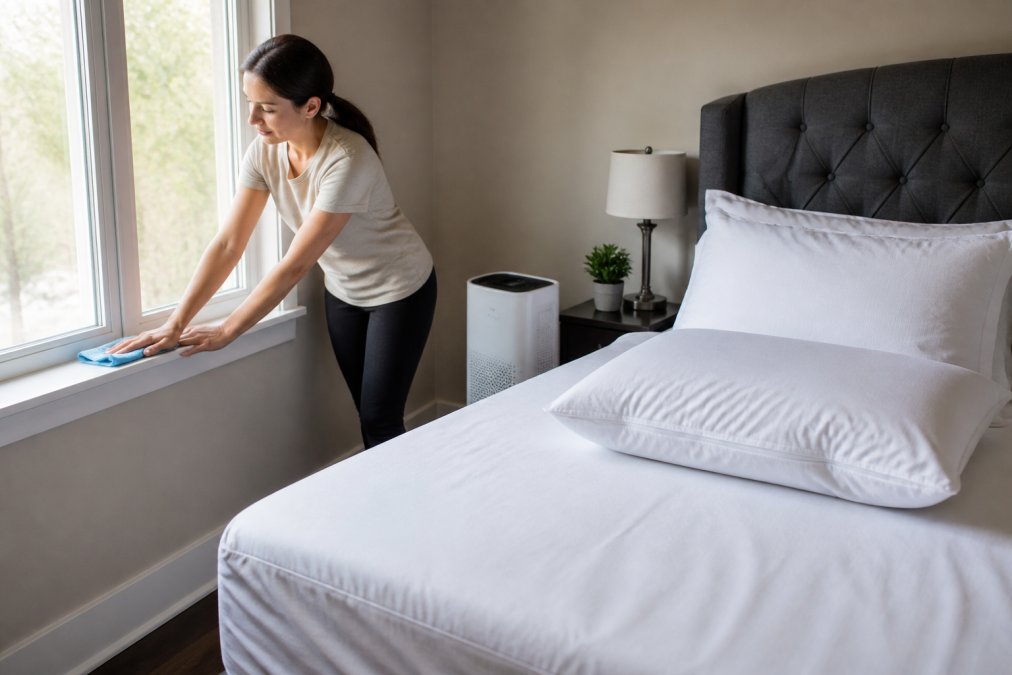
- Keep windows closed during peak pollen hours, typically early morning and late afternoon
- Run air conditioning on recirculate mode with a clean filter
- Vacuum with a HEPA-equipped machine twice weekly
- Damp dust all surfaces before you sleep
- Wash bedding weekly in hot water
Bedding and Mattress Encasement Strategies
Mattress covers and pillow encasements create a physical barrier that stops pollen and dust mites from colonizing your bedding. Choose zippered, allergen-proof covers and wash them monthly. This single step reduces allergen buildup in the place you breathe most.
How to Clean Pollen Off Surfaces Without Spreading It Around
Cleaning pollen off surfaces requires one rule: never dry-clean anything. Dry dusting and sweeping just launch microscopic particles back into the air, where they settle again within hours.
Damp Dusting vs. Dry Dusting: Why It Matters
A damp cloth traps pollen instead of scattering it. Use a microfiber cloth lightly misted with water, wipe in one direction, and rinse the cloth often. For floors, a damp mop outperforms a broom every time. According to the Asthma and Allergy Foundation of America, reducing airborne irritants through wet cleaning methods is one of the most effective indoor allergy strategies.
Work top to bottom in each room, and change your mop water before it turns cloudy. Dirty water just redistributes allergen buildup across clean floors.
Best Air Purifier for Pollen: What to Look For in 2026
The best air purifier for pollen uses a true HEPA filter, because that is the only filtration standard proven to capture the microscopic particles that trigger respiratory symptoms. But the unit itself is only half the equation. The other half is your home’s HVAC infrastructure, which most pollen guides skip entirely.
HEPA Filters, MERV Ratings, and Air Exchange Rates
A HEPA filter is a high-efficiency particulate air filter that captures at least 99.97% of particles 0.3 microns and larger, which includes most pollen grains, pet dander, and mold spores. Pollen grains typically range from 10 to 100 microns, so a true HEPA filter catches them easily, the challenge is getting the pollen to the filter before it settles into carpet and upholstery.
| Feature | What to Look For | Why It Matters |
|---|---|---|
| Filter type | True HEPA (99.97% at 0.3 microns) | Captures pollen, dander, mold spores |
| MERV rating | 13+ for HVAC systems (if airflow allows) | Traps pollen before it recirculates |
| Air exchange | 4-6 air changes per hour | Clears a room’s air fully several times hourly |
| Coverage | Matches room square footage | Undersized units leave dead zones |
| CADR | 200+ for pollen in a 300 sq ft room | Higher CADR means faster pollen removal |
The HVAC Maintenance Step Most Homeowners Skip
A portable purifier cleans one room. Your HVAC system moves air through every room, which makes it the higher-leverage target during pollen season. Three maintenance habits matter most:
- Change the filter on schedule. Every one to three months is standard, but during peak pollen season (typically March through May for tree pollen and August through October for ragweed), check it monthly. A clogged filter stops trapping pollen and forces the blower to work harder.
- Seal the filter slot. A common pattern technicians find is unfiltered air bypassing the filter through gaps around the frame. A cheap foam gasket or a filter with a built-in gasket closes that leak.
- Inspect the ductwork annually. Allergen buildup inside ducts recontaminates every room each time the system runs. A professional duct inspection and cleaning every few years, more often in older homes, keeps that reservoir from growing.
What to Look For in a Portable Purifier
If you are buying a standalone unit for a bedroom or living room, focus on three specs:
- Clean Air Delivery Rate (CADR): This is the volume of clean air the unit produces per minute. For pollen, look for a CADR at least two-thirds of the room’s square footage. A 300-square-foot bedroom needs a CADR of roughly 200 for pollen.
- True HEPA, not “HEPA-type.” Marketing language like “HEPA-like” or “HEPA-style” usually means the filter does not meet the 99.97% threshold. Look for the words “True HEPA” or a HEPA certification.
- No ozone generation. Some purifiers use ionizers or UV-C lamps that produce trace ozone, which irritates airways. If you have asthma or allergies, choose a unit that is ozone-free.
A true HEPA purifier handles one room. A MERV 13 filter in a well-sealed HVAC system handles the whole house. Run both during peak pollen season, and check your system’s airflow limits before upgrading the filter.
Natural Humidity Control and Ventilation Tactics That Work
Humidity control is the lever most homeowners ignore. Pollen itself does not care about moisture, but dust mites and mold thrive in damp air, and those add to your total allergen load. Keep indoor humidity between 30% and 50% with a dehumidifier or by running your AC, which pulls moisture from the air as it cools. A hygrometer, a small, inexpensive humidity gauge, takes the guesswork out of this.
Ventilation Is a Timing Problem, Not a Yes-or-No Decision
You want air exchange to dilute indoor pollutants, but opening windows during high pollen count days defeats the purpose. The fix is to ventilate on a schedule, not on a whim.
- On high-count days: keep windows shut, run the AC on recirculate, and rely on filtration.
- On low-count days: ventilate aggressively, open windows for 10 to 15 minutes in the late evening to flush stale indoor air, then close them before counts climb again.
- After rain: this is your best window for a longer airing-out, since rain temporarily clears airborne pollen.
How to Track Local Pollen Counts
Pollen tracking is free and takes about 30 seconds a day. The National Allergy Bureau publishes station-based pollen and mold counts, and most weather apps and local news outlets report a daily pollen index. Check the count the same way you check the forecast, and let it drive your decisions about windows, outdoor exercise, and laundry.
A few practical rules:
- Do not line-dry laundry outside on high-count days. Fabric is a pollen magnet, and sheets dried on a line can carry pollen straight to your bed.
- Time outdoor activity for the late evening. If you must be outside, the hours after dusk usually carry the lowest counts.
- Shower before bed on high-count days. Pollen collects in hair and on skin, and your pillow is the last place you want it.
Exhaust Fans and Air Exchange
Bathroom and kitchen exhaust fans remove moisture at the source, which keeps humidity in the 30% to 50% range without a whole-house dehumidifier. Run the bathroom fan for 15 to 20 minutes after a shower and the kitchen fan while cooking. If your home feels stuffy but outdoor counts are high, a heat recovery ventilator (HRV) or energy recovery ventilator (ERV) can bring in filtered fresh air without opening a window, though these require professional installation and are a bigger investment than a standalone purifier.
Pair humidity control with pollen tracking. A hygrometer tells you whether your indoor air is dry enough to discourage mites and mold; a daily pollen count tells you whether it is safe to open a window. Together, they turn ventilation from a guess into a decision.
HVAC Maintenance and Pollen Tracking: Two Steps Most Homeowners Skip
Two habits separate a pollen-resistant home from a reactive one: HVAC upkeep and checking your local pollen count before you open anything.
Pet-Specific Pollen Management
Pets are pollen taxis. Their coats collect pollen outdoors and deposit it on every surface they touch. Wipe paws and bellies at the door, brush pets outside rather than indoors, and bathe them more often during peak season. If dander is also a trigger, a purifier that targets pet dander alongside pollen covers both problems at once.
Never skip the entry routine for pets. A single dog can track in enough pollen to undo a full day of cleaning, and the particles embed deep in carpet and upholstery.
Conclusion: Building a Pollen-Resistant Home Environment
Pollen season doesn’t have to mean months of congestion and restless nights. The challenge is that outdoor particles keep finding their way in, and cleaning alone can’t keep pace with what your HVAC and fabrics collect. Aero Essence LLC built the SR100 to close that gap, with true HEPA filtration that removes pollen, dust mites, pet dander, mold spores, and smoke, plus visual confirmation that the unit is actively working.
Frequently Asked Questions
How do I neutralize pollen that’s already inside my house?
Start by running a HEPA air purifier in the rooms you use most, which captures microscopic particles including pollen. Then damp dust all surfaces with a microfiber cloth, vacuum with a HEPA-filter vacuum, and wash bedding in hot water weekly. Keep windows closed during high pollen count days and use air conditioning with a clean filter. These steps together reduce airborne pollen particles and prevent them from recirculating through your home environment.
Does keeping windows closed really stop pollen from entering?
Closing windows significantly reduces pollen entry, but it does not eliminate it entirely. Pollen particles can still enter through gaps, on clothing, on pets, and through HVAC systems that draw in outside air. To reduce pollen in home naturally, combine closed windows with door mats, removing shoes at entry points, and running air conditioning on recirculation mode. If you have a fresh air intake, check that its filter has a MERV rating of at least 8 to trap airborne allergens.
What’s the best air purifier for pollen and pet dander?
Look for a unit with a true HEPA filter, which captures 99.97% of particles at 0.3 microns including pollen, dust mites, and dander. Check the clean air delivery rate and match it to your room size. Some purifiers also offer visual confirmation that they are actively working, which helps you verify performance. For homes with pets, choose a model designed to handle multiple pollutant types and replace filters according to the manufacturer’s schedule.
How often should I clean to reduce indoor pollen levels?
During peak allergy season, vacuum high-traffic areas at least twice weekly with a HEPA-filter vacuum. Damp dust surfaces every two to three days. Wash bedding weekly in hot water. Clean or replace HVAC filters every 60 to 90 days, more often if you have pets or live in a high-pollen area. These routines prevent allergen buildup and keep pollen particles from becoming airborne again through daily activity.